When apparel brands build a new collection, clothing is often grouped by consumer-facing categories such as:
- Casualwear
- Formalwear
- Sportswear
- Streetwear
But from a manufacturing and sourcing perspective, another framework can be more useful.
Factories need to understand:
- How the fabric is constructed
- How much it stretches
- What machinery is required
- How the garment should be patterned
- What finishing processes are needed
- Where production cost comes from
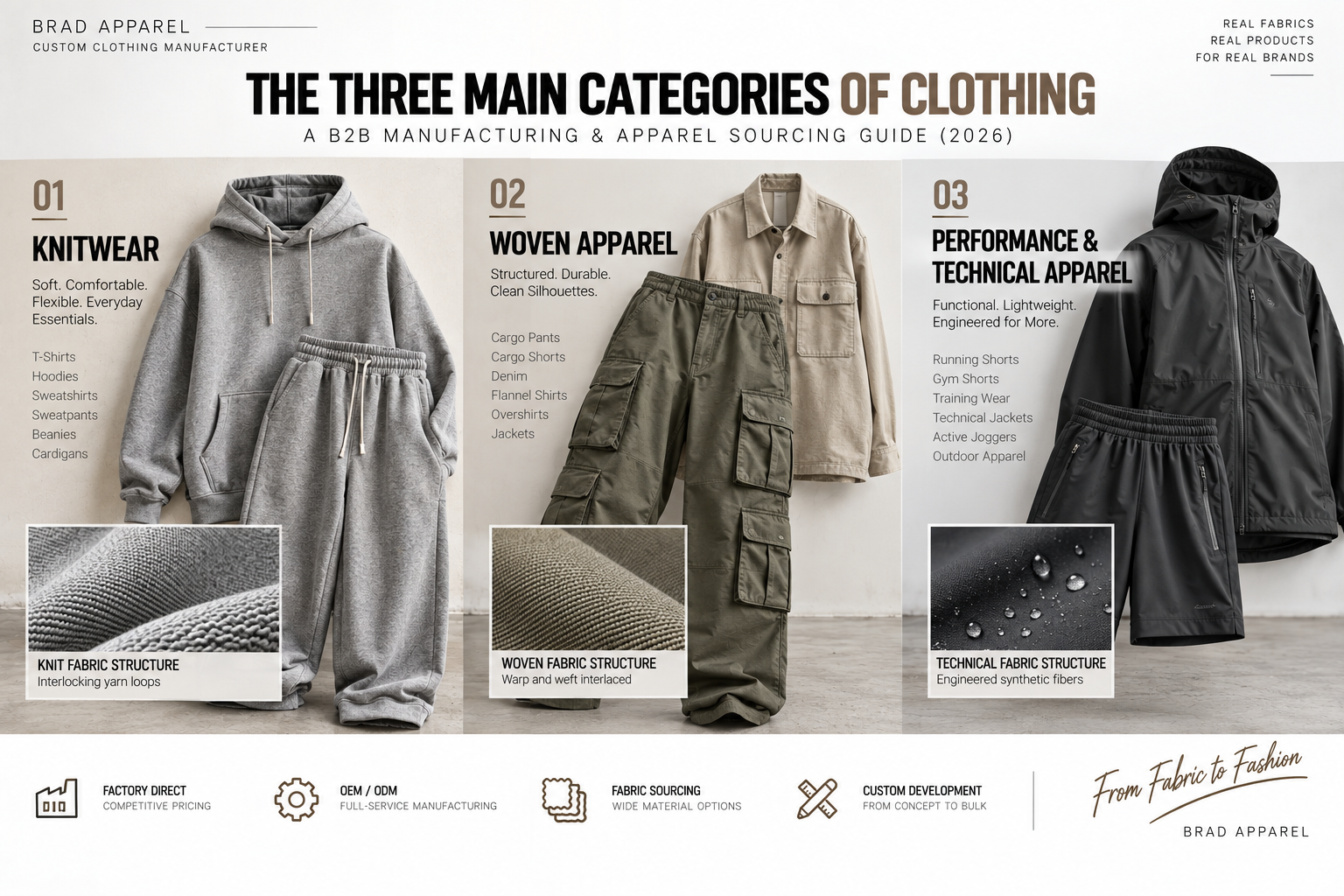
For this guide, we will look at three practical apparel manufacturing groups:
- Knitwear
- Woven Apparel
- Performance & Technical Apparel
Each category behaves differently during cutting, sewing, washing and bulk production.
The Three Main Clothing Categories
1. Knitwear
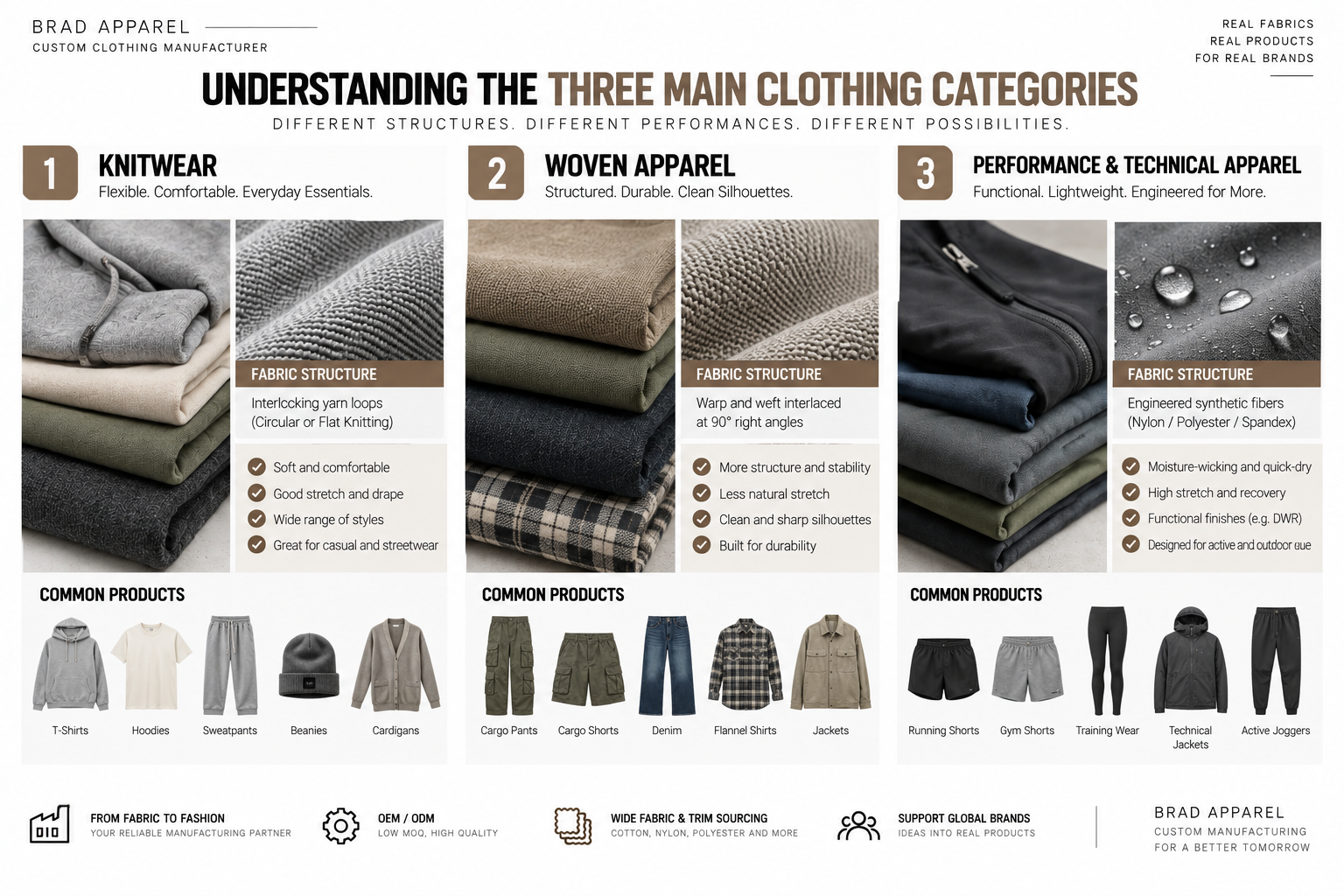
Knit fabrics are built from interlocking yarn loops.
This construction naturally provides:
- Stretch
- Softness
- Drape
- Comfort
Common knit garments include:
- T-shirts
- Hoodies
- Sweatshirts
- Sweatpants
- Beanies
- Cardigans
Knits form the foundation of much of modern streetwear and athleisure.
2. Woven Apparel
Woven fabrics are created by interlacing:
Warp yarns + Weft yarns
normally at approximately 90-degree angles.
Compared with knits, woven fabrics generally provide:
- More structure
- Less natural stretch
- Sharper silhouettes
- Greater dimensional stability
Common woven garments include:
- Cargo shorts
- Cargo pants
- Denim
- Flannel shirts
- Overshirts
- Jackets
- Utility bottoms
3. Performance & Technical Apparel
Performance garments are built around function.
They frequently use engineered synthetic fabrics such as:
- Nylon
- Polyester
- Nylon / Spandex
- Polyester / Spandex
and may include additional treatments such as:
- DWR water-repellent finishing
- Moisture management
- Quick-dry finishing
- Anti-bacterial treatments
- Bonded seams
- Seam sealing
Common applications include:
- Running shorts
- Gym shorts
- Compression garments
- Technical jackets
- Performance joggers
Knit vs Woven vs Technical Apparel
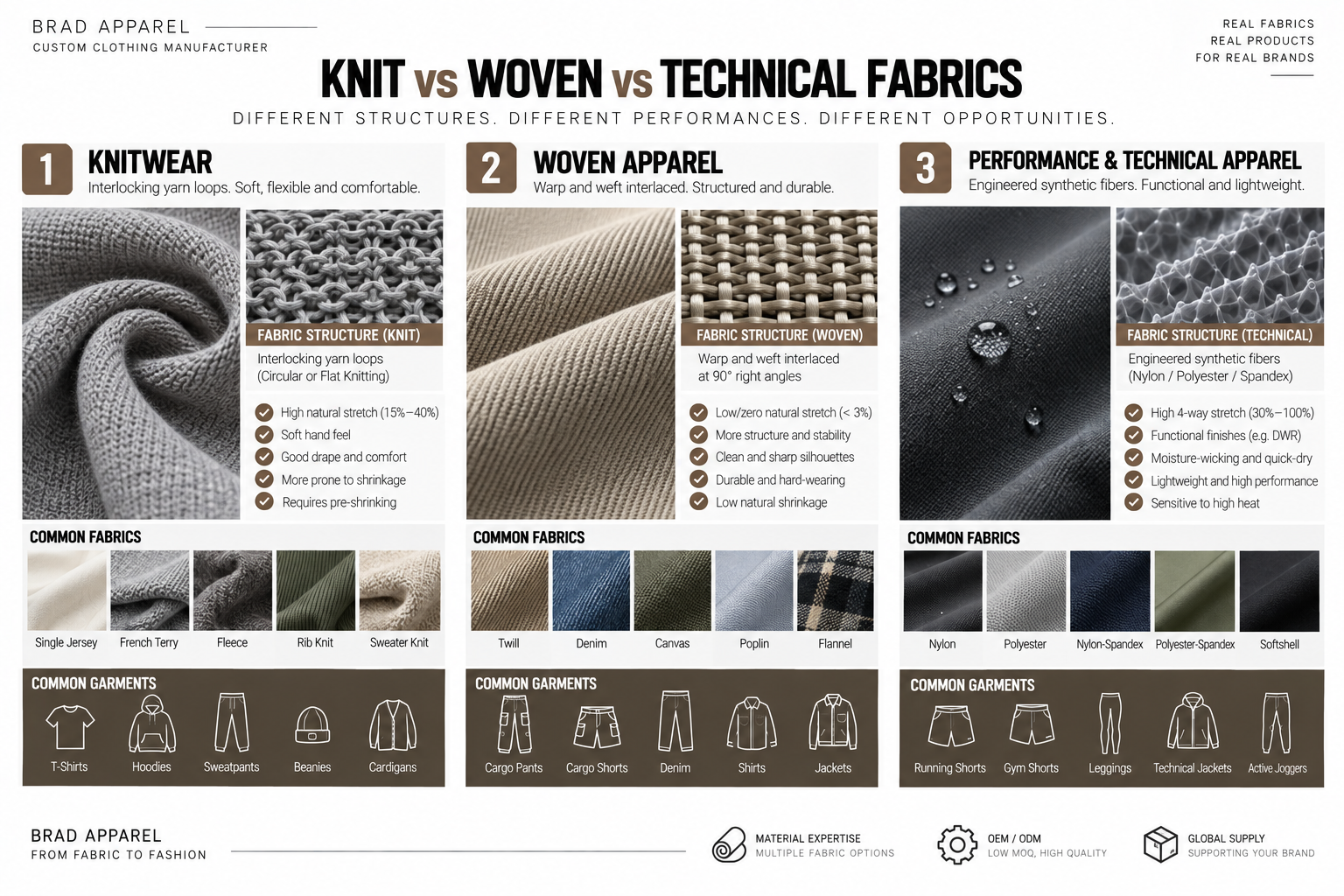
| Technical Area | Knitwear | Woven Apparel | Performance / Technical |
|---|---|---|---|
| Fabric Structure | Interlocking yarn loops | Warp + weft construction | Engineered synthetic structures |
| Natural Stretch | Generally higher | Generally lower | Can be very high with elastane |
| Typical Products | Hoodies, tees, sweatpants | Cargo, denim, shirts | Running shorts, tights, shells |
| Common Sewing Equipment | Overlock, coverstitch, flatlock | Lockstitch, twin needle | Flatlock, bonding, laser cutting |
| Main Challenge | Shrinkage / torque | Seam stress / puckering | Heat sensitivity / seam performance |
Actual stretch and dimensional behavior depend on the exact fabric construction and fiber composition.
Knitwear: The Foundation of Streetwear
Knitwear is one of the most important categories for modern clothing brands.
Its natural stretch and soft hand feel make it especially suitable for:
- Oversized silhouettes
- Casualwear
- Streetwear
- Loungewear
- Athleisure
Heavyweight French Terry
For premium streetwear, a common specification is:
380–480 GSM French Terry
Possible composition:
100% combed cotton
Key characteristics include:
- Loopback interior
- Heavy drape
- Structured silhouette
- Breathability
- Good pigment-wash compatibility
This fabric works particularly well for:
- Oversized hoodies
- Heavy sweatpants
- Sweat sets
Heavy Single Jersey
For premium T-shirts, heavier single jersey fabrics may use approximately:
240–300 GSM
Compared with lightweight jersey, they create:
- More structure
- Less transparency
- Heavier hand feel
- Premium streetwear positioning
Manufacturing Challenge: Shrinkage and Fabric Torque
Knitted fabrics can move more easily than woven fabrics.
Potential problems include:
- Shrinkage
- Spirality
- Side-seam twisting
- Shape distortion
Proper fabric finishing and wash testing are therefore important before bulk cutting.
Woven Apparel: Structure and Durability
Woven construction is useful when the product needs:
- Shape
- Durability
- Utility
- Clean seams
- Structured pockets
Typical applications include:
- Cargo shorts
- Cargo pants
- Denim
- Utility jackets
- Overshirts
Fabrics for Woven Garments
Taslan Nylon
Useful for:
- Technical cargo shorts
- Utility bottoms
- Outdoor-inspired pieces
Heavy Cotton Twill
A useful weight range for structured bottoms can be approximately:
220–280 GSM
It works well for:
- Cargo pants
- Workwear
- Structured shorts
Brushed Cotton Woven
Often used for:
- Flannel shirts
- Overshirts
- Casual outer layers
Manufacturing Challenge: Stress Points
Because many woven fabrics have limited natural stretch, stress can concentrate around:
- Pocket corners
- Belt loops
- Fly seams
- Crotch seams
- Cargo pocket attachments
Reinforcement methods such as bar-tack stitching can help improve durability.
Performance & Technical Apparel
Technical garments are usually designed around a performance requirement rather than only appearance.
Examples include:
- Stretch
- Water repellency
- Quick drying
- Breathability
- Low weight
- Reduced seam friction
Nylon / Spandex Activewear
A common example is:
88% Nylon / 12% Elastane
with fabric weights around:
120–160 GSM
This type of fabric can provide:
- Four-way stretch
- Recovery
- Lightweight comfort
- Mobility
It works particularly well for:
- Running shorts
- Gym shorts
- Training apparel
Manufacturing Challenge: High-Stretch Seams
Technical stretch fabrics place more stress on stitching.
If the seam cannot extend with the fabric, problems may include:
- Thread popping
- Broken seams
- Chafing
- Restricted movement
Possible manufacturing solutions include:
- Flatlock stitching
- Multi-thread stretch seams
- Bonded seams
- Ultrasonic construction
The exact method depends on the fabric and garment design.
Manufacturing Equipment by Clothing Category
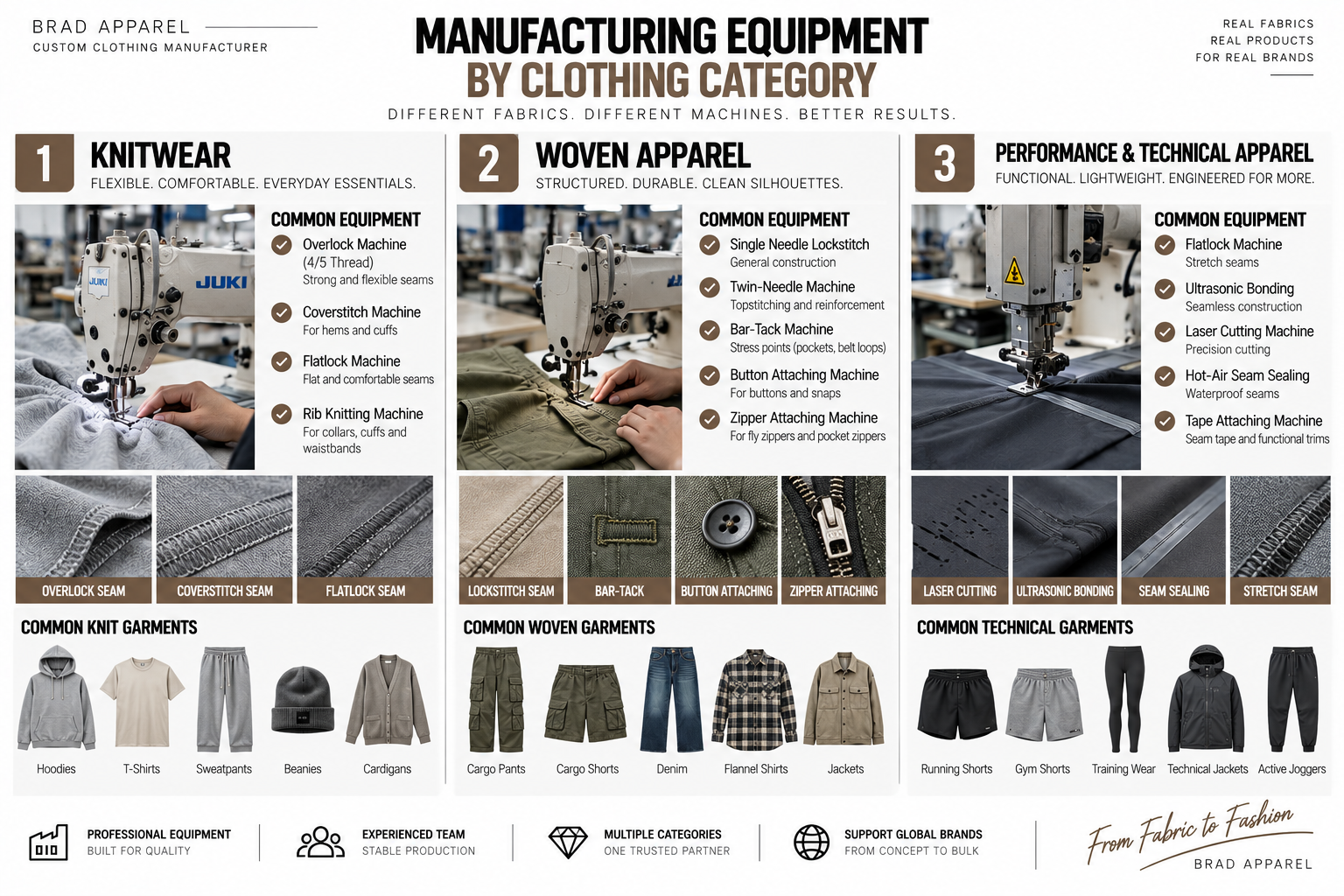
Knitwear
Common equipment:
- Overlock
- Coverstitch
- Flatlock
These machines allow seams to maintain more flexibility.
Woven Apparel
Common equipment:
- Single-needle lockstitch
- Twin needle
- Bar-tack machine
These are suitable for more structured construction.
Technical Apparel
Depending on the product:
- Laser cutting
- Hot-air seam sealing
- Ultrasonic bonding
- Flatlock sewing
may be used.
Technical machinery can add production cost but also enables construction that conventional sewing cannot easily achieve.
BOM Cost Comparison Across the Three Categories
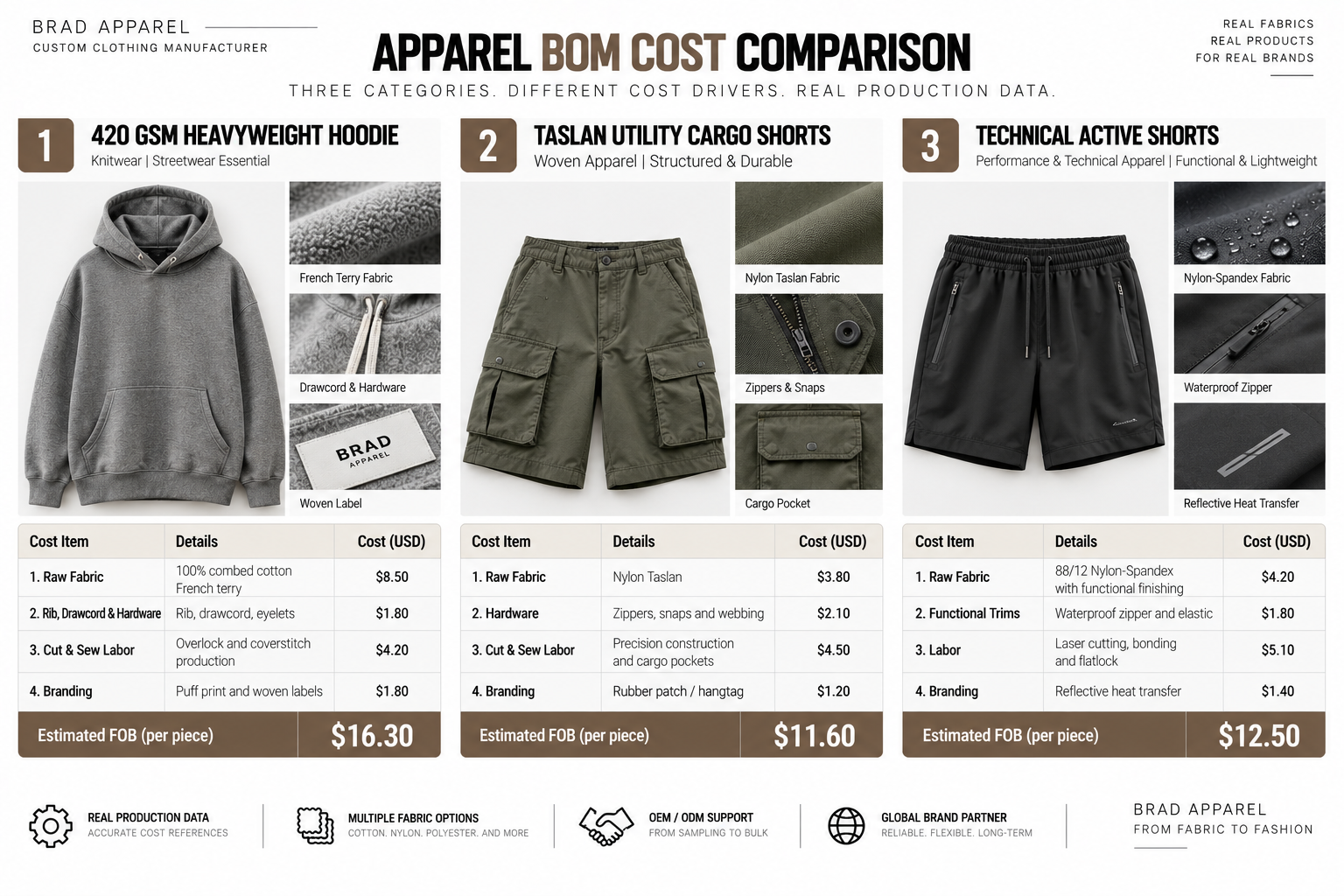
The following examples come from the source production scenarios and illustrate how cost drivers differ by garment category.
Category 1 — 420 GSM Heavyweight Hoodie
Raw Fabric
100% combed cotton French terry:
$8.50
Rib, Drawcord & Hardware
$1.80
Cut & Sew Labor
Overlock and coverstitch production:
$4.20
Branding
Puff print and woven labels:
$1.80
Estimated FOB
$16.30 per piece
Category 2 — Taslan Utility Cargo Shorts
Raw Fabric
Nylon Taslan:
$3.80
Hardware
Zippers, snaps and webbing:
$2.10
Cut & Sew
Precision construction and cargo pockets:
$4.50
Branding
Rubber patch / hangtag:
$1.20
Estimated FOB
$11.60 per piece
Category 3 — Technical Active Shorts
Raw Fabric
88/12 Nylon-Spandex with functional finishing:
$4.20
Functional Trims
Waterproof zipper and elastic:
$1.80
Labor
Laser cutting, bonding and flatlock:
$5.10
Branding
Reflective heat transfer:
$1.40
Estimated FOB
$12.50 per piece
Why Labor Cost Changes Between Categories
A more expensive fabric does not always create the most expensive garment.
For example, technical activewear may use a lighter fabric but require:
- Laser cutting
- Bonding
- Specialized stitching
- Technical zippers
- More controlled production
That increases labor and processing cost.
Woven cargo garments may also require significant labor because of:
- Multiple pockets
- Flaps
- Snaps
- Webbing
- Reinforcement
Cost should therefore be evaluated through the complete BOM and construction process, not fabric price alone.
Quality Control Across All Clothing Categories
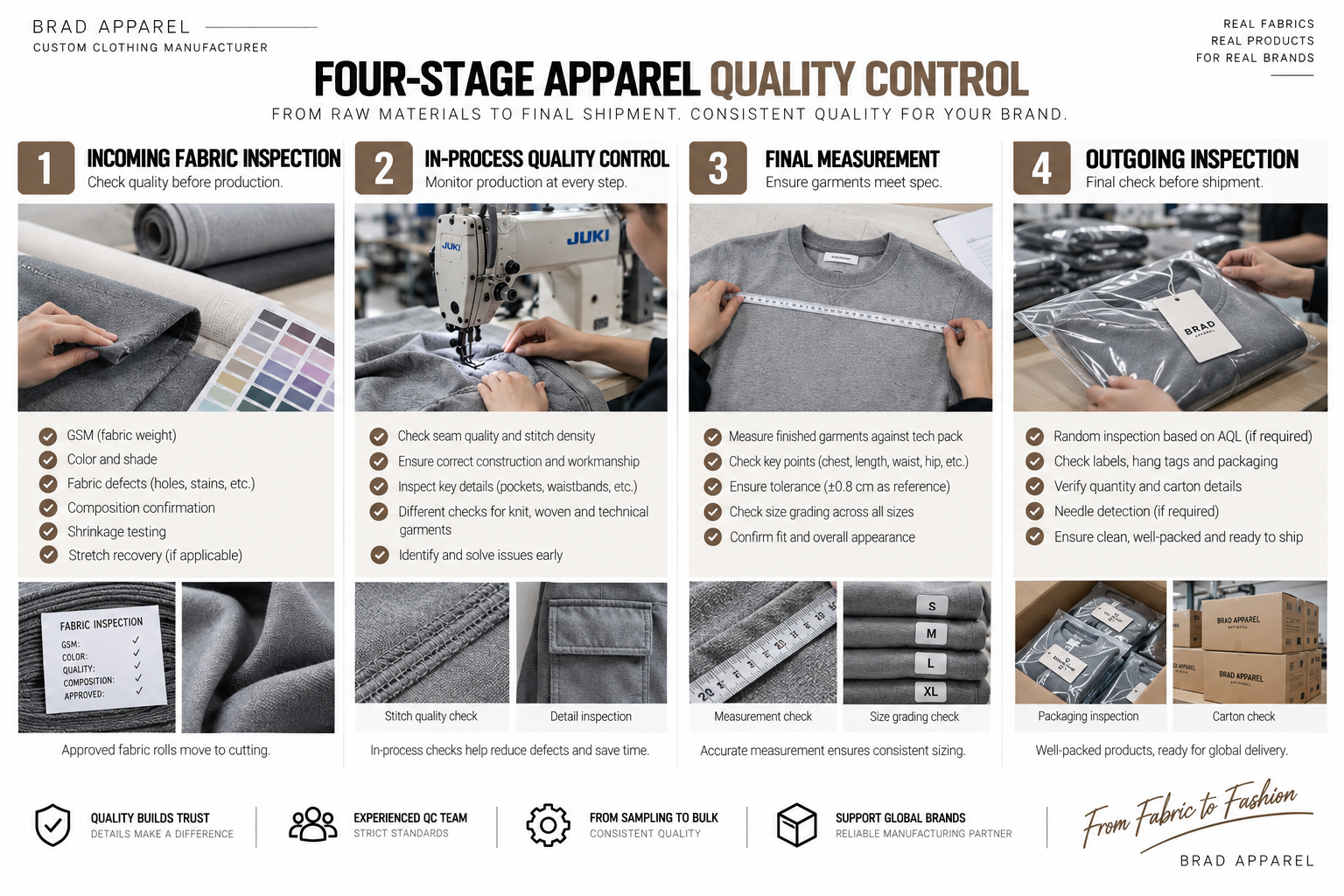
Regardless of the clothing category, QC should begin before production and continue through final packing.
Stage 1 — Incoming Fabric Inspection
Check:
- GSM
- Colour
- Fabric defects
- Composition
- Shrinkage
- Stretch where applicable
Stage 2 — In-Process Quality Control
Different categories require different checks.
Knitwear
Check:
- Seam elasticity
- Stitch density
- Fabric stretching
Woven Apparel
Check:
- Needle tension
- Seam puckering
- Bar-tack reinforcement
Technical Apparel
Check:
- Bonding
- Seam tape adhesion
- Stretch seams
- Functional trims
Stage 3 — Final Measurement
Finished garments should be measured against the approved tech pack.
Important points can include:
- Chest
- Body length
- Waist
- Hip
- Rise
- Inseam
- Sleeve
- Leg opening
The source production framework uses a reference tolerance around:
±0.8 cm
for its QC example.
Stage 4 — Outgoing Inspection
Before shipping, check:
- Random finished garments
- Labels
- Packaging
- Carton quantities
- Needle detection where required
- Moisture control
Formal AQL sampling may also be arranged according to buyer requirements.
How Brad Apparel Supports Different Apparel Categories
At Brad Apparel, we support development across knit, woven and technical garments.
Our custom production includes:
- Hoodies
- T-shirts
- Sweatpants
- Sweat sets
- Cargo pants
- Cargo shorts
- Jackets
- Running shorts
- Technical activewear
Fabric & Accessory Sourcing
Through our Fabric & Accessory Sourcing, brands can compare:
- Cotton knits
- French terry
- Fleece
- Single jersey
- Twill
- Nylon
- Taslan
- Stretch synthetic fabrics
- Rib
- Zippers
- Elastic
- Hardware
Pattern Development
Through Pattern Development, products can be developed around the behavior of the selected fabric.
For example:
Knitwear
Pattern allowance needs to consider:
- Stretch
- Shrinkage
- Drape
Woven Garments
Pattern development needs to consider:
- Ease
- Structure
- Reinforcement
Technical Apparel
Patterns may need to account for:
- Mechanical stretch
- Bonded seams
- Articulation
- Mobility
The same pattern approach should not be applied blindly across all three categories.
FAQ
What Are the Three Main Clothing Categories in This Manufacturing Framework?
This guide groups apparel into:
- Knitwear
- Woven Apparel
- Performance & Technical Apparel
The framework is intended to help brands think about sourcing and manufacturing requirements.
What Is the Difference Between Knit and Woven Fabric?
Knits are made from interlocking loops and normally provide more natural stretch.
Wovens use interlaced warp and weft yarns and generally provide more structure.
Is Technical Apparel Always Woven?
No.
Technical apparel can use:
- Knitted fabrics
- Woven fabrics
- Bonded structures
The category is defined here mainly by performance requirements and specialized manufacturing processes.
Which Category Is Best for Streetwear?
Streetwear can use all three.
For example:
Knitwear: Heavyweight hoodie
Woven: Cargo pants
Technical: Nylon performance shorts
A complete streetwear collection may combine several construction categories.
Which Category Is Most Expensive to Manufacture?
There is no universal answer.
Cost depends on:
- Fabric
- Pattern complexity
- Labor
- Hardware
- Finishing
- Decoration
- Quantity
Technical apparel can have high labor costs even when the fabric itself is lightweight.
What MOQ Does Brad Apparel Support?
Brad Apparel supports custom manufacturing starting at approximately 50 pieces per style/color for many projects.
Actual MOQ depends on:
- Fabric
- Colour
- Construction
- Hardware
- Decoration
Final Thoughts
Understanding clothing categories from a manufacturing perspective makes product development much easier.
The most useful question is not simply:
"What kind of clothing am I making?"
Instead ask:
"How is the fabric constructed, how does it behave, and what production process does the garment require?"
Knitwear, woven apparel and technical garments each place different demands on:
- Fabric sourcing
- Pattern development
- Sewing
- Finishing
- Quality control
When those requirements are understood before sampling begins, brands can build more consistent products and make better sourcing decisions.
Keep Reading