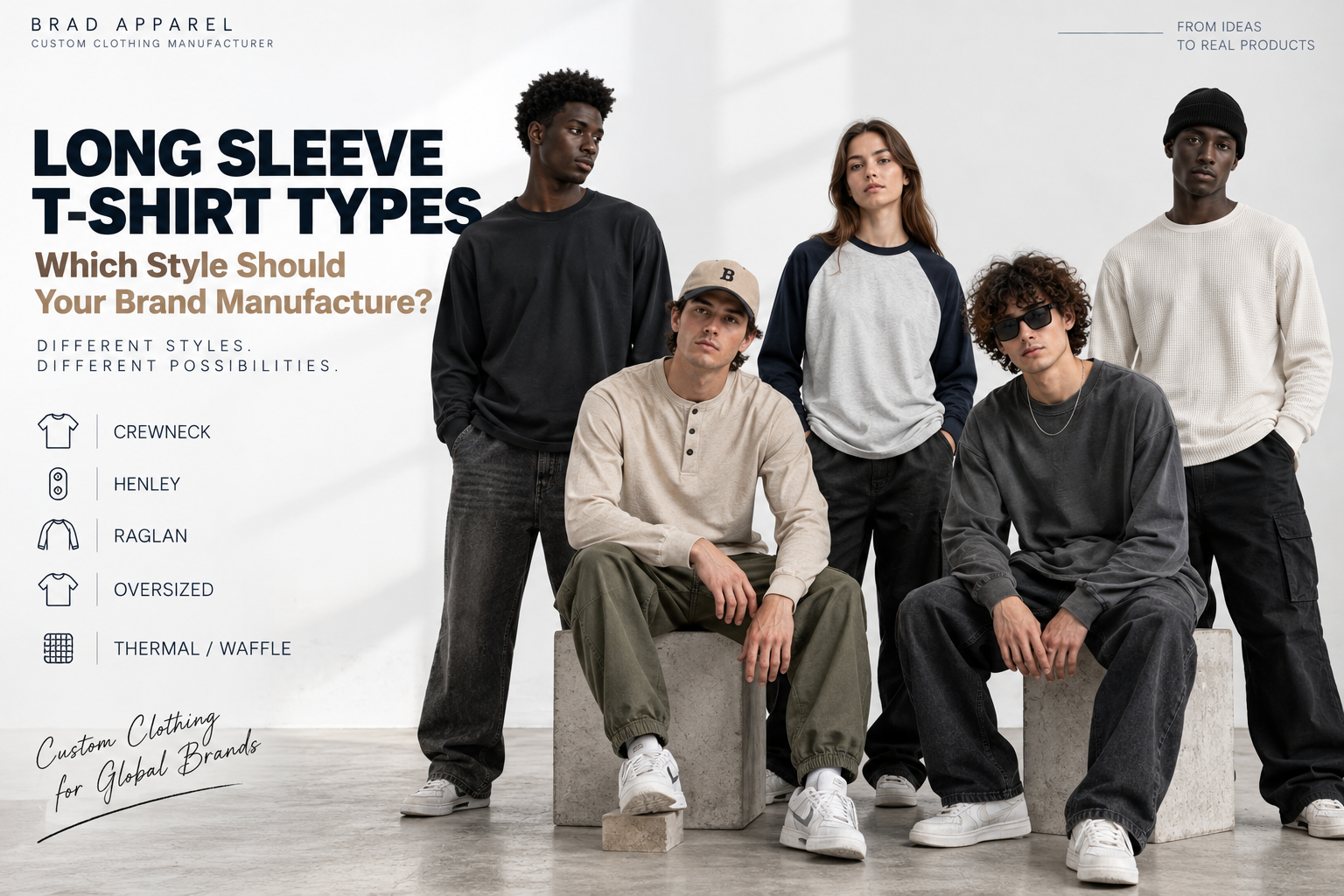
A long sleeve T-shirt may look like a simple product category, but small changes in pattern, sleeve construction, fabric and cuffs can create completely different garments.
For a clothing brand, choosing between a:
- Classic crewneck
- Henley
- Raglan
- Oversized long sleeve
- Thermal or waffle knit
is not only a styling decision.
Each type requires different decisions around:
- Pattern development
- Fabric selection
- Sleeve construction
- Cuff design
- Decoration placement
- Sewing operations
- Target customer
This guide compares the main long sleeve T-shirt types from a manufacturing perspective and explains which direction may suit your collection.
The 5 Main Types of Long Sleeve T-Shirts
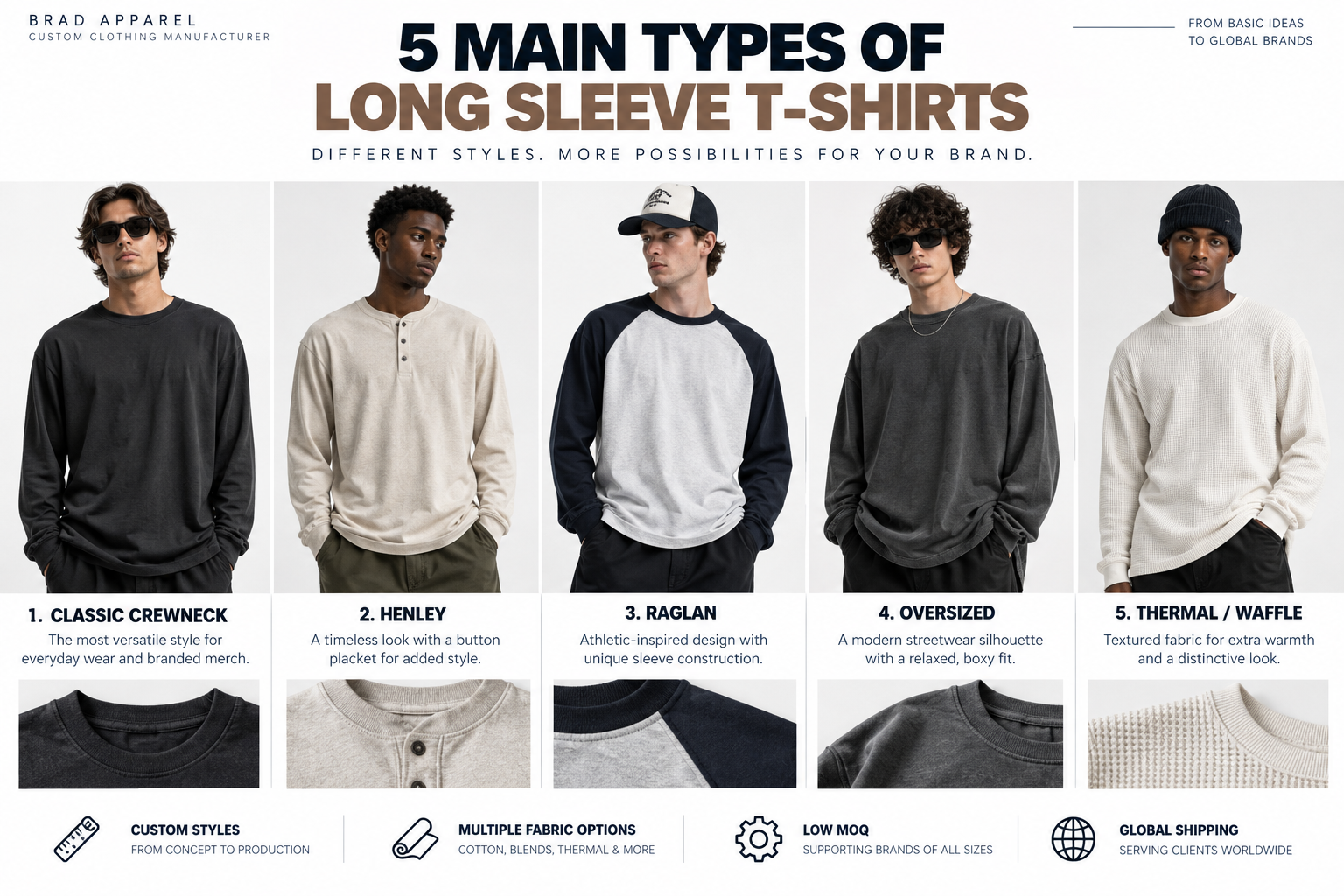
| Long Sleeve Type | Main Construction Feature | Common Use |
|---|---|---|
| Classic Crewneck | Set-in sleeves and standard neck rib | Basics, merch, casualwear |
| Henley | Button placket without a collar | Heritage, workwear, premium casual |
| Raglan | Sleeve seam extends toward neckline | Athletic, retro, baseball-inspired |
| Oversized / Drop-Shoulder | Extended shoulder and wider body | Streetwear, fashion collections |
| Thermal / Waffle | Textured knit structure | Layering, cold-weather collections |
There is no single "best" long sleeve T-shirt.
The right choice depends on the brand's intended:
Fit + Fabric + Customer + Decoration + Price Position
1. Classic Crewneck Long Sleeve
The classic crewneck is the most versatile long sleeve T-shirt construction.
It normally includes:
- Round rib neckline
- Set-in sleeves
- Straight or slightly relaxed body
- Standard jersey fabric
- Optional rib cuffs
This style works well for:
- Everyday basics
- Branded merchandise
- Uniform programs
- Graphic collections
- Layering pieces
Because the construction is relatively straightforward, it is also one of the easiest long sleeve styles to customize.
Set-In Sleeve Construction
A set-in sleeve joins the body through a defined armhole.
This creates a more conventional shoulder shape.
It works especially well for:
- Regular fits
- Slim fits
- Boxy streetwear fits
- Drop-shoulder variations
The final silhouette depends on where the shoulder seam is positioned.
A standard shoulder creates a cleaner fitted appearance.
Moving the shoulder seam outward creates a more relaxed streetwear proportion.
2. Henley Long Sleeve
A Henley adds a button placket to the front neckline while remaining collarless.
Typical construction includes:
- Round neckline
- Short front placket
- 2–5 buttons
- Reinforced placket structure
Henleys often appear in:
- Heritage collections
- Workwear-inspired clothing
- Premium basics
- Outdoor lifestyle collections
The additional placket makes the garment more complex than a standard crewneck.
What Matters in Henley Manufacturing?
The factory needs to control:
- Placket length
- Button spacing
- Placket reinforcement
- Topstitching
- Neckline balance
If the fabric is soft or stretchy, the placket may require stabilization so it does not distort after washing.
Button size and material also affect the final visual style.
Possible options include:
- Plastic
- Metal
- Shell-style
- Wood-look
- Custom branded buttons
3. Raglan Long Sleeve
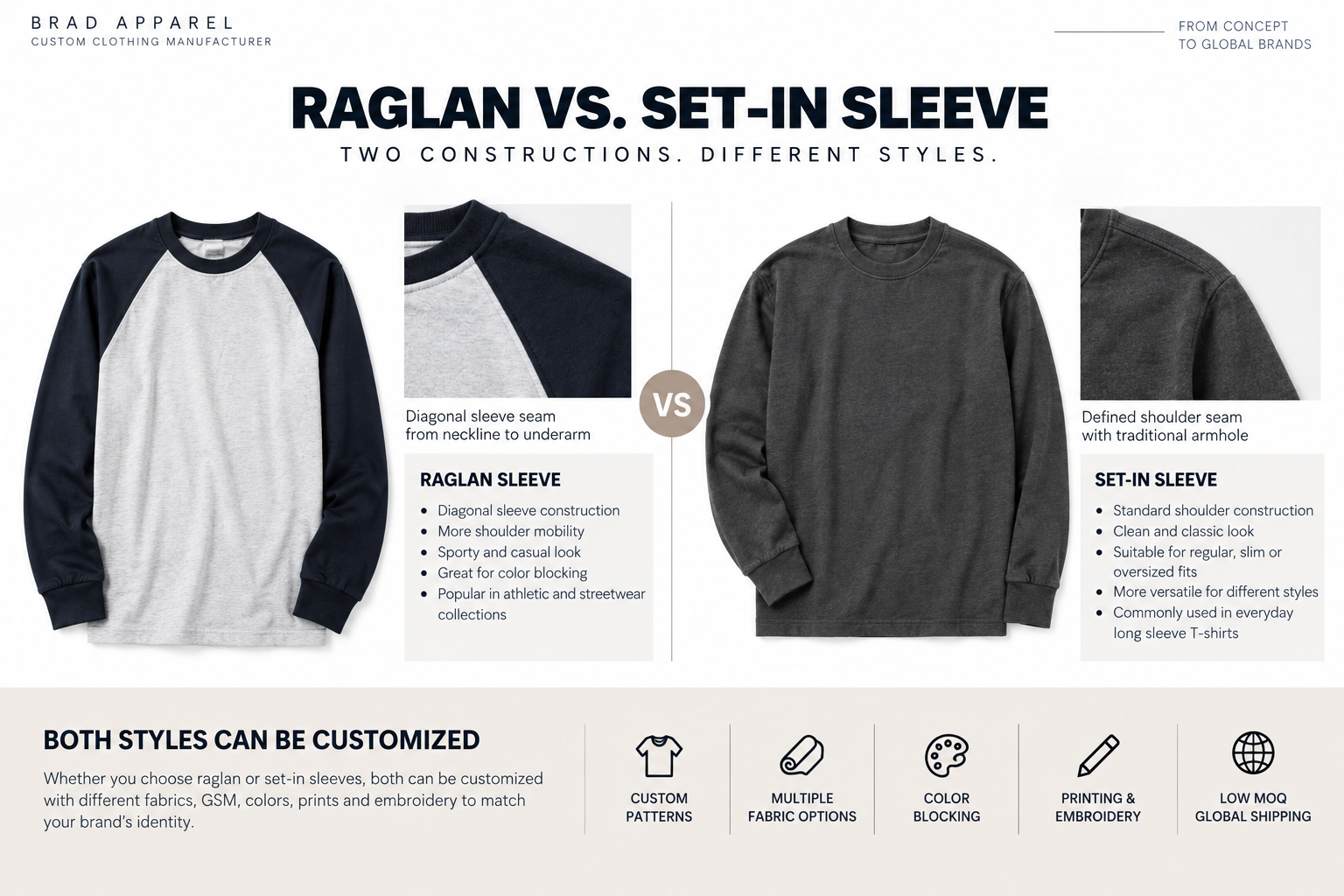
A raglan sleeve does not use a conventional shoulder seam.
Instead, the sleeve extends diagonally toward the neckline.
This creates a very different visual line.
Raglan long sleeves are commonly associated with:
- Baseball tees
- Athleticwear
- Retro sportswear
- Casual streetwear
Why Brands Choose Raglan Sleeves
Raglan construction can create:
- More shoulder mobility
- Softer shoulder definition
- Strong color-block opportunities
- A distinctive vintage sports look
For example:
White body + black raglan sleeves
creates an immediately recognizable baseball-inspired appearance.
The diagonal seams can also become part of the overall graphic composition.
4. Oversized / Drop-Shoulder Long Sleeve
Oversized long sleeves are particularly common in contemporary streetwear.
Typical features include:
- Wider chest
- Extended shoulder
- Lower armhole
- Wider sleeves
- Boxier body
- Heavier jersey
The important point is:
Oversized does not mean simply increasing every measurement.
A well-developed oversized pattern balances:
Chest width
with
Shoulder width
with
Sleeve volume
with
Body length
Boxy vs Long Oversized Fit
Two oversized garments can feel completely different.
Boxy Fit
Usually has:
- Wide chest
- Shorter body
- Drop shoulder
- Wide sleeve
This creates a more structured streetwear silhouette.
Long Oversized Fit
May have:
- Wide chest
- Longer body
- Relaxed sleeve
- Lower hem
This creates a softer and more casual appearance.
Brands should define the desired proportion before sampling.
5. Thermal / Waffle Long Sleeve
Thermal long sleeves use a textured knit rather than standard smooth jersey.
Common constructions include:
- Waffle knit
- Honeycomb knit
- Ribbed thermal structures
These fabrics create small raised areas that trap air and add texture.
Thermal long sleeves are commonly used for:
- Autumn / winter collections
- Layering
- Outdoor-inspired fashion
- Workwear
- Vintage casualwear
Why Waffle Fabric Changes the Garment
Waffle fabric usually behaves differently from single jersey.
It may have:
- More stretch
- More dimensional texture
- Different shrinkage behavior
- Greater thickness
- Different drape
The pattern should therefore be tested using the intended bulk fabric.
A pattern developed in normal jersey should not automatically be reused for waffle fabric without checking fit.
Which Long Sleeve Style Is Best for Your Brand?
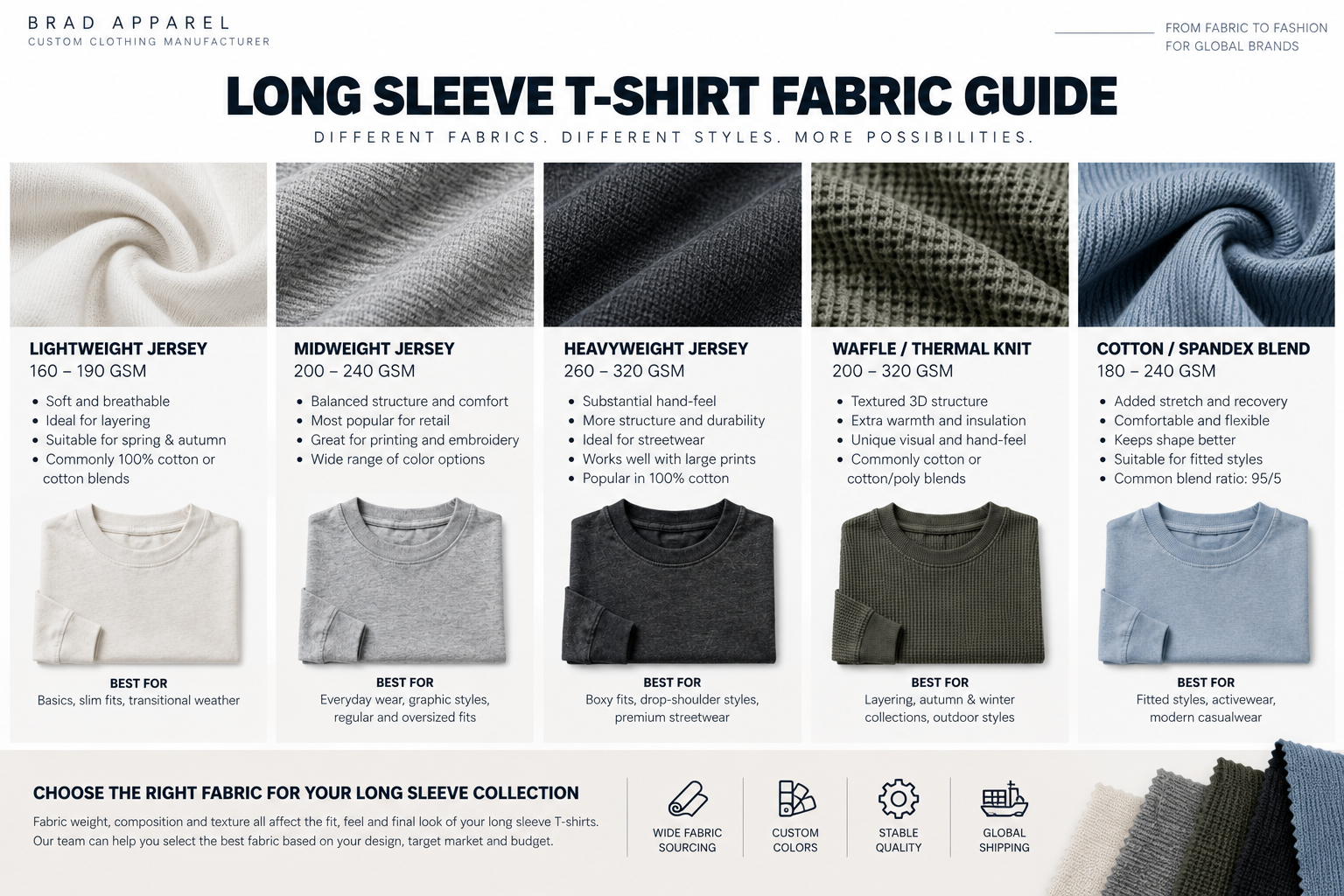
A useful way to choose is to start with your market positioning.
| Brand Direction | Suitable Long Sleeve Type |
|---|---|
| Minimal Basics | Classic Crewneck |
| Premium Casual | Henley |
| Retro / Athletic | Raglan |
| Streetwear | Oversized / Drop-Shoulder |
| Outdoor / Workwear | Thermal / Waffle |
| Graphic Merchandise | Crewneck or Oversized |
| Layering Collection | Crewneck or Thermal |
The same fabric does not need to be used across every category.
The style and material should support each other.
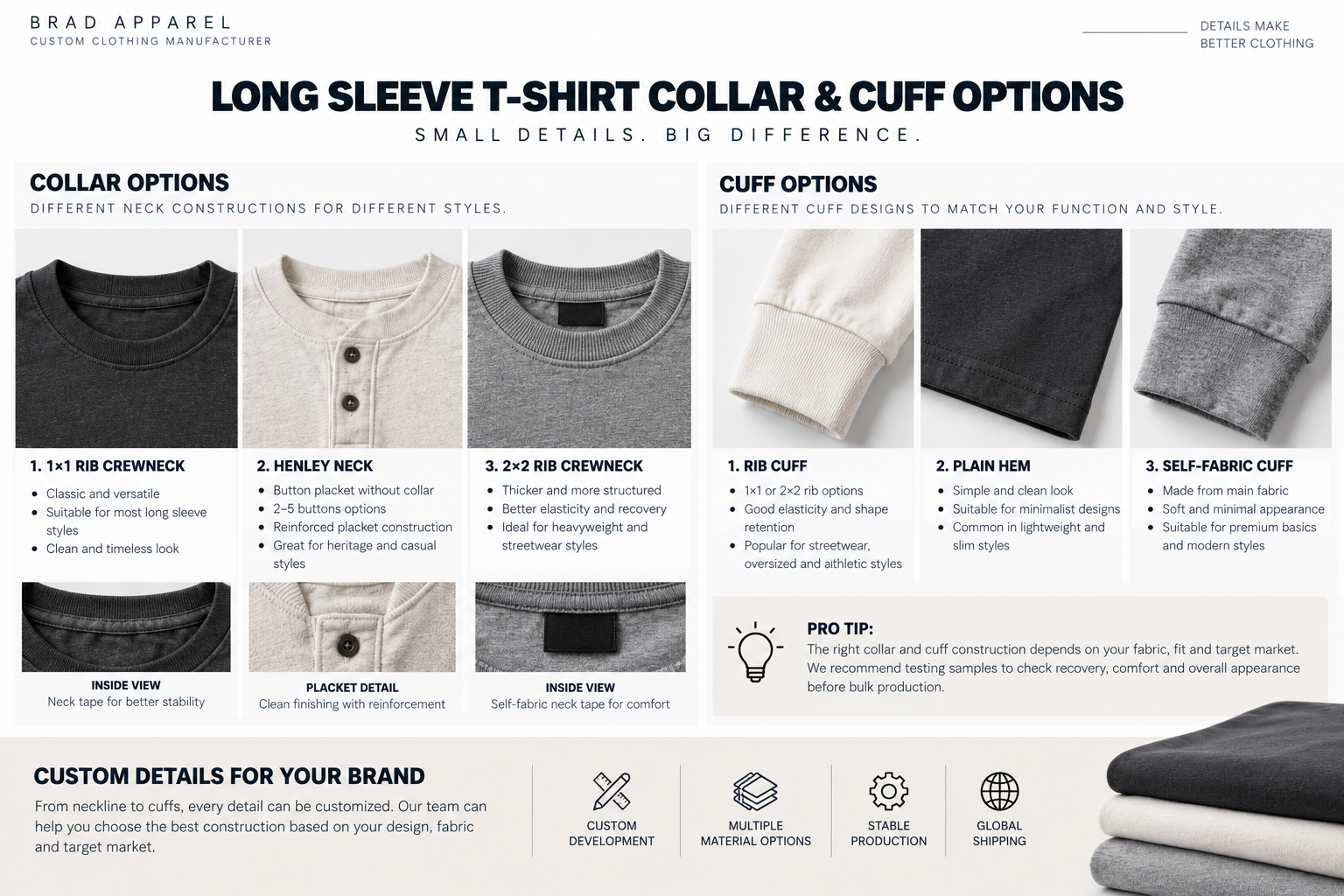
Matching Fabric to the Long Sleeve Style
Instead of asking:
"What is the best fabric for a long sleeve T-shirt?"
it is better to ask:
"What fabric works best for this specific long sleeve design?"
Lightweight Jersey: Approximately 160–190 GSM
Useful for:
- Layering
- Slim silhouettes
- Transitional weather
- Lightweight casualwear
Possible compositions include:
- Cotton
- Cotton/poly
- Cotton/spandex
Midweight Jersey: Approximately 200–240 GSM
Useful for:
- Premium basics
- Graphic tees
- Regular fits
- Moderate oversized styles
This range provides more structure than lightweight jersey without becoming extremely heavy.
Heavyweight Jersey: Approximately 260–320 GSM
Useful for:
- Boxy streetwear
- Drop-shoulder designs
- Structured silhouettes
- Large prints
Heavyweight fabric can create more body and visual volume.
However, fabric composition, knit density and finishing matter just as much as GSM.
Cotton / Spandex
A 95/5 cotton-spandex blend can be useful when the design requires:
- More stretch
- Better recovery
- A fitted silhouette
It may work especially well for:
- Slim long sleeves
- Fitted basics
- Stretch cuffs
Waffle / Thermal Knit
Best suited to:
- Thermal styles
- Layering
- Textured casualwear
The final appearance depends on:
- Waffle size
- Fabric weight
- Fiber composition
- Stretch
Collar and Cuff Construction
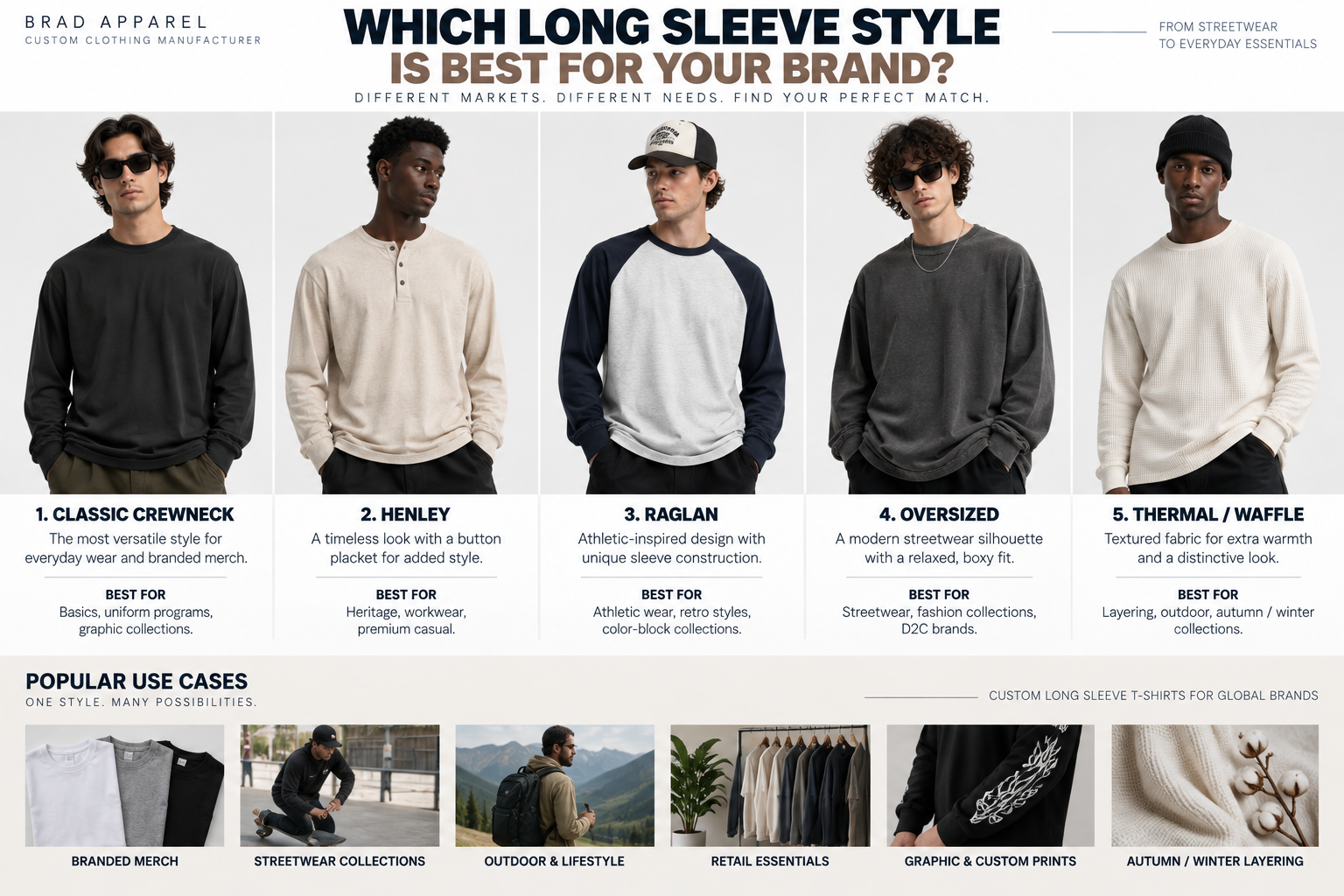
Small details around the neck and wrist strongly affect how a long sleeve T-shirt feels after repeated wear.
Neck Rib
Possible constructions include:
- 1×1 rib
- 2×2 rib
- Self-fabric binding
The correct option depends on:
- Main fabric weight
- Desired appearance
- Stretch
- Neck opening
A heavier streetwear long sleeve may benefit from a more substantial rib than a lightweight layering tee.
Cuff Options
Long sleeves may use:
Plain Hem
Simple and clean.
Useful for:
- Basic tees
- Slim designs
- Minimal styling
Rib Cuff
Creates a more defined wrist.
Useful for:
- Streetwear
- Heavyweight tees
- Athletic designs
Self-Fabric Cuff
Provides a softer and more minimal finish.
The cuff should be tested for recovery before bulk production.
Decoration Compatibility by Long Sleeve Type
Long sleeves offer more decoration space than short sleeve T-shirts.
Possible placements include:
- Chest
- Back
- Sleeve
- Upper arm
- Wrist area
Screen Printing
Suitable for:
- Chest graphics
- Sleeve graphics
- Large back artwork
- Typography
Actual print performance depends on the fabric surface, artwork and ink system rather than one fixed GSM threshold.
Puff / High-Density Printing
Works well for:
- Bold streetwear graphics
- Typography
- Raised logos
The fabric, artwork line width and curing setup should be tested before bulk production.
DTG / Digital Printing
Useful for:
- Detailed artwork
- Multi-color designs
- Photographic graphics
Smooth cotton-rich surfaces generally provide a more suitable base than highly textured fabrics.
Embroidery
Works particularly well for:
- Small chest logos
- Sleeve branding
- Small patches
Heavier fabrics can support denser embroidery more easily, while lighter jersey may require additional stabilization.
Raglan vs Set-In: Which Should You Choose?
The answer depends on the visual goal.
Choose Set-In Sleeves If You Want:
- A traditional T-shirt appearance
- Clean shoulder structure
- Drop-shoulder streetwear options
- Maximum versatility
Choose Raglan Sleeves If You Want:
- Athletic influence
- Retro styling
- Contrast sleeves
- More visible seam lines
Neither construction is inherently better.
They simply create different garments.
Example BOM: 240 GSM Midweight Long Sleeve T-Shirt
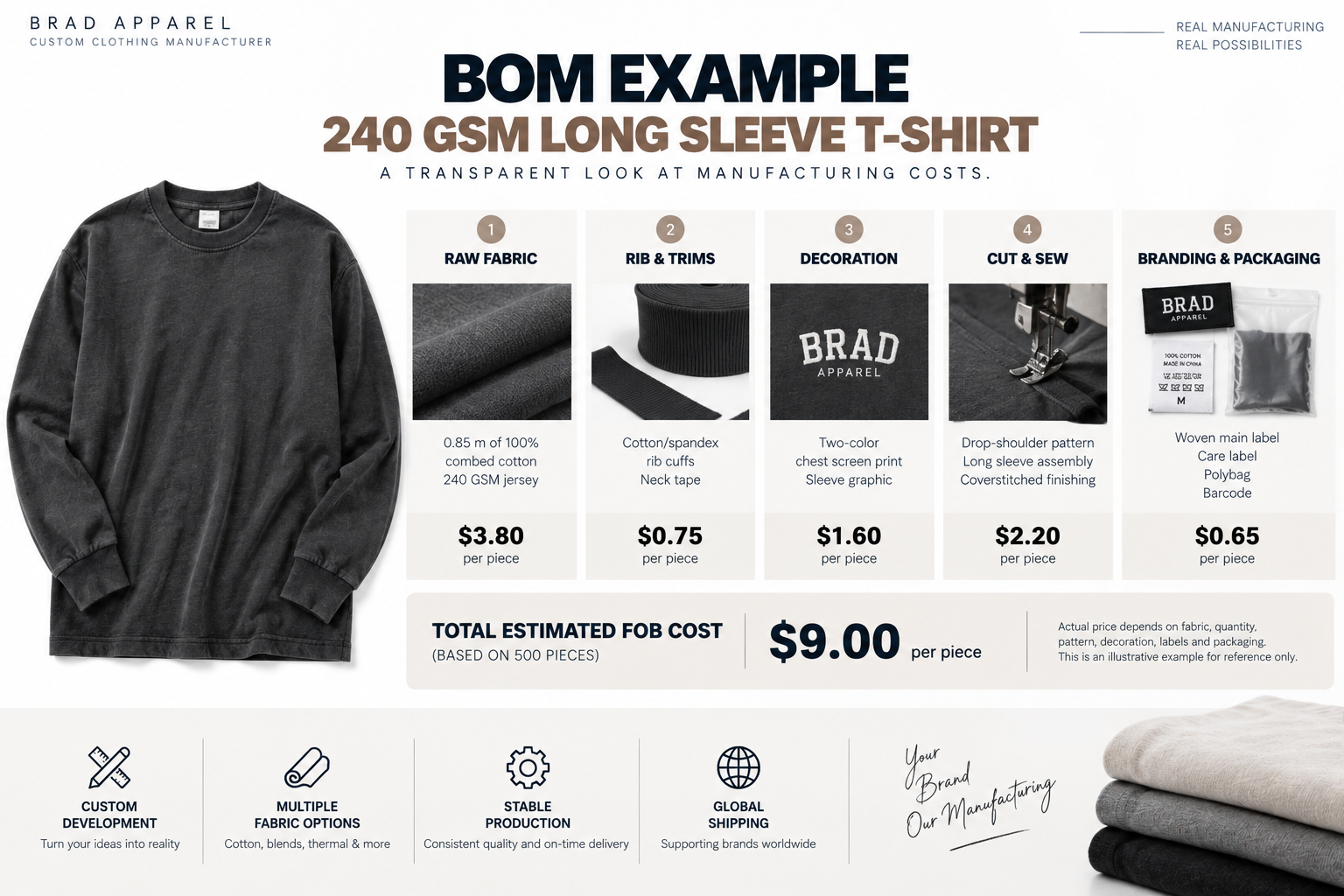
The following example shows one possible cost structure for a 500-piece custom long sleeve T-shirt.
This is an illustrative production example rather than a universal quotation.
Raw Fabric
0.85 m of 100% combed cotton 240 GSM jersey
Reference cost:
$3.80
Rib & Trims
Example:
- Cotton/spandex rib cuffs
- Neck tape
Reference cost:
$0.75
Decoration
Example:
- Two-color chest screen print
- Sleeve graphic
Reference cost:
$1.60
Cut & Sew
Example:
- Drop-shoulder pattern
- Long sleeve assembly
- Coverstitched finishing
Reference cost:
$2.20
Branding & Packaging
Example:
- Woven main label
- Care label
- Polybag
- Barcode
Reference cost:
$0.65
Estimated Example FOB Cost
$9.00 per piece
Calculation:
$3.80 + $0.75 + $1.60 + $2.20 + $0.65 = $9.00
Actual price depends on:
- Fabric
- Quantity
- Pattern
- Decoration
- Labels
- Packaging
What Should You Confirm Before Sampling?
Before a custom long sleeve enters sampling, confirm:
Style
- Crewneck
- Henley
- Raglan
- Oversized
- Thermal
Fabric
- Composition
- GSM
- Color
- Texture
Fit
- Slim
- Regular
- Boxy
- Oversized
Sleeve
- Set-in
- Raglan
- Drop shoulder
Cuff
- Plain
- Ribbed
- Self-fabric
Decoration
- Printing
- Embroidery
- Sleeve graphics
Branding
- Main label
- Care label
- Hang tag
These decisions create a much more useful production brief than simply requesting:
"I need a long sleeve T-shirt."
Quality Checks for Long Sleeve T-Shirts
Quality control does not need to be treated as a separate complicated system for every product.
For long sleeves, several areas deserve particular attention:
- Left and right sleeve length
- Cuff alignment
- Shoulder symmetry
- Collar shape
- Sleeve twist
- Printing position
- Garment measurements
- Shrinkage after washing
For Henley styles, also inspect:
- Placket alignment
- Button spacing
For raglan styles:
- Diagonal seam symmetry
For thermal fabrics:
- Stretch and shrinkage behavior
The exact tolerance should be agreed according to the product and tech pack rather than applying one universal number to every style.
What Makes a Good Custom Long Sleeve T-Shirt?
A good long sleeve is not simply a short sleeve T-shirt with longer sleeves.
The product should balance:
Silhouette
Fabric
Sleeve Construction
Collar
Cuffs
and
Decoration
For example:
A heavyweight oversized streetwear long sleeve may need:
- Wider body
- Drop shoulders
- Strong neck rib
- Rib cuffs
- Large graphics
while a premium layering long sleeve may need:
- Lighter jersey
- Regular shoulder
- Clean cuffs
- Minimal decoration
The right construction depends on what the product is supposed to achieve.
FAQ
What Are the Main Types of Long Sleeve T-Shirts?
Five common categories are:
- Classic crewneck
- Henley
- Raglan
- Oversized / drop-shoulder
- Thermal / waffle
Each style uses different pattern and construction details.
What Is a Raglan Long Sleeve T-Shirt?
A raglan long sleeve uses diagonal sleeve seams that extend toward the neckline instead of a traditional shoulder seam.
It is common in athletic, baseball and retro-inspired styles.
What Is the Difference Between Raglan and Set-In Sleeves?
Set-in sleeves use a defined armhole and conventional shoulder structure.
Raglan sleeves extend toward the neckline and create a diagonal seam.
They produce different silhouettes rather than representing different quality levels.
What GSM Is Good for a Long Sleeve T-Shirt?
It depends on the product.
A useful development range might include:
- 160–190 GSM: lightweight
- 200–240 GSM: midweight
- 260–320 GSM: heavyweight
Fabric construction and composition should also be considered.
What Fabric Is Best for an Oversized Long Sleeve?
Midweight or heavyweight cotton jersey can work well because it provides more structure.
The correct choice depends on the intended drape and silhouette.
What Fabric Is Used for Thermal Long Sleeves?
Thermal styles commonly use:
- Waffle knit
- Honeycomb knit
- Other textured knit constructions
Composition and GSM vary according to the intended warmth and stretch.
Can You Print on Long Sleeve T-Shirts?
Yes.
Common decoration options include:
- Screen printing
- Puff printing
- DTG
- DTF
- Embroidery
Long sleeves also provide additional placement options along the arms.
How Much Does a Custom Long Sleeve T-Shirt Cost to Manufacture?
There is no universal price.
In the example in this guide, a 240 GSM custom long sleeve T-shirt produced at 500 pieces has an illustrative FOB cost of:
$9.00 per piece
Actual cost depends on the complete specification.
Final Thoughts
The best long sleeve T-shirt type depends on the product your brand is trying to create.
A crewneck provides versatility.
A Henley adds construction detail.
A raglan creates a sporty visual line.
An oversized long sleeve creates a stronger streetwear silhouette.
A waffle thermal adds texture and layering performance.
Instead of starting with:
"Which long sleeve is best?"
start with:
"What should this garment look, feel and function like?"
Once that is clear, the pattern, fabric and construction become much easier to define.
Keep Reading