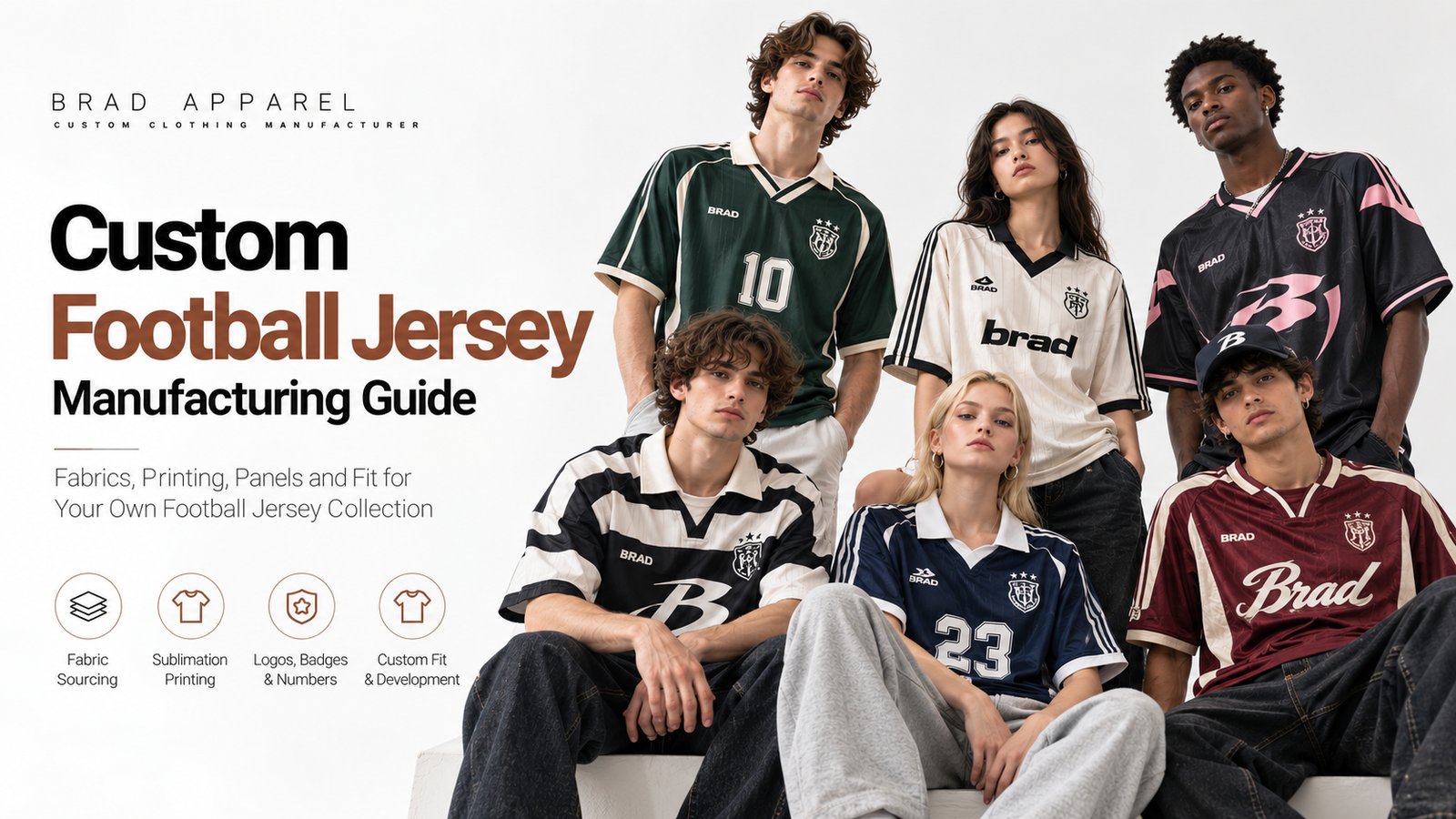
Football jerseys are no longer limited to match day.
They now appear across:
- Streetwear
- Festival fashion
- Music merchandise
- Lifestyle collections
- Vintage-inspired sportswear
- Fashion collaborations
- Team apparel
But developing a good football jersey requires more than adding a number and logo to a polyester T-shirt.
A successful jersey depends on how the:
Fabric
Fit
Panel construction
Collar
Ventilation
Printing
Names and numbers
Badges
and
Seams
work together.
This becomes even more important when the same football-inspired silhouette is being developed as a fashion product rather than a professional sports uniform.
This guide explains the main construction decisions clothing brands should understand before developing a custom football or soccer jersey.
What Is a Football Jersey?
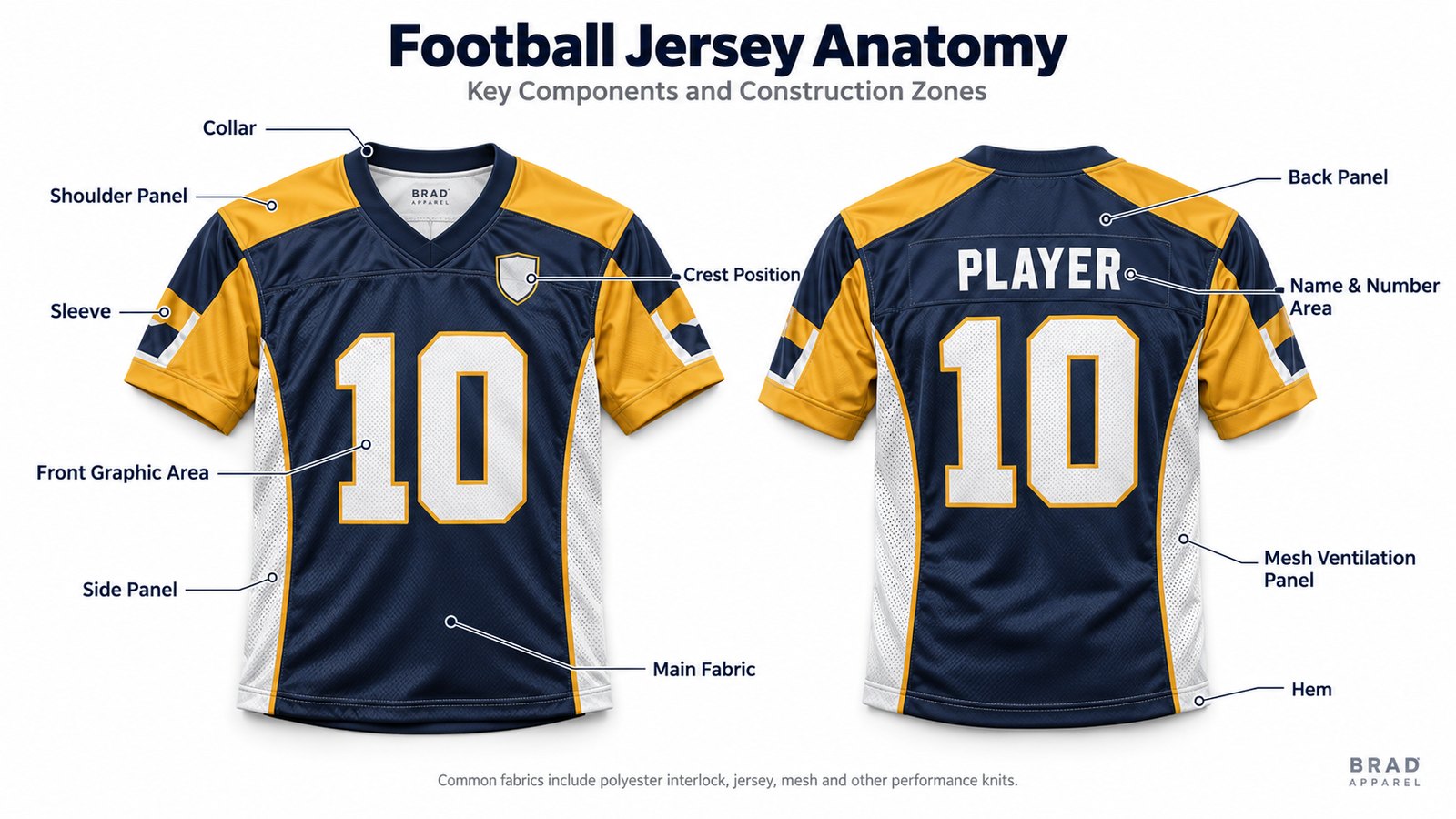
A football jersey—also called a soccer jersey in markets such as the United States—is a knitted sports top inspired by association football uniforms.
Typical features may include:
- Lightweight knitted fabric
- Short or long sleeves
- Crew, V-neck or other collar construction
- Team or brand crest
- Front graphics
- Player name and number
- Color-blocked panels
- Mesh or ventilated zones
- Straight or slightly shaped hem
However, modern football-inspired shirts are no longer one category.
They can be developed as:
- Performance jerseys
- Replica-style jerseys
- Lifestyle football shirts
- Oversized streetwear jerseys
- Cropped fashion jerseys
- Music or event merchandise
The intended use should therefore be defined before fabric and construction are selected.
Why Are Football Jerseys Relevant in 2026?
Football shirts have moved far beyond traditional sports merchandise.
Their visual language works naturally with several current fashion directions:
- Blokecore
- Retro sportswear
- Oversized streetwear
- Y2K styling
- Team-inspired graphics
- Heritage branding
- Sport-luxe fashion
This creates an important opportunity for clothing brands.
A football jersey does not necessarily need to represent a real football club.
Brands can develop original:
- Colors
- Stripes
- Crests
- Numbers
- Sponsors-style graphics
- Panel layouts
to create their own football-inspired identity.
That makes the silhouette useful for both:
performance apparel
and
fashion collections.
Performance Football Jersey vs Fashion Football Jersey
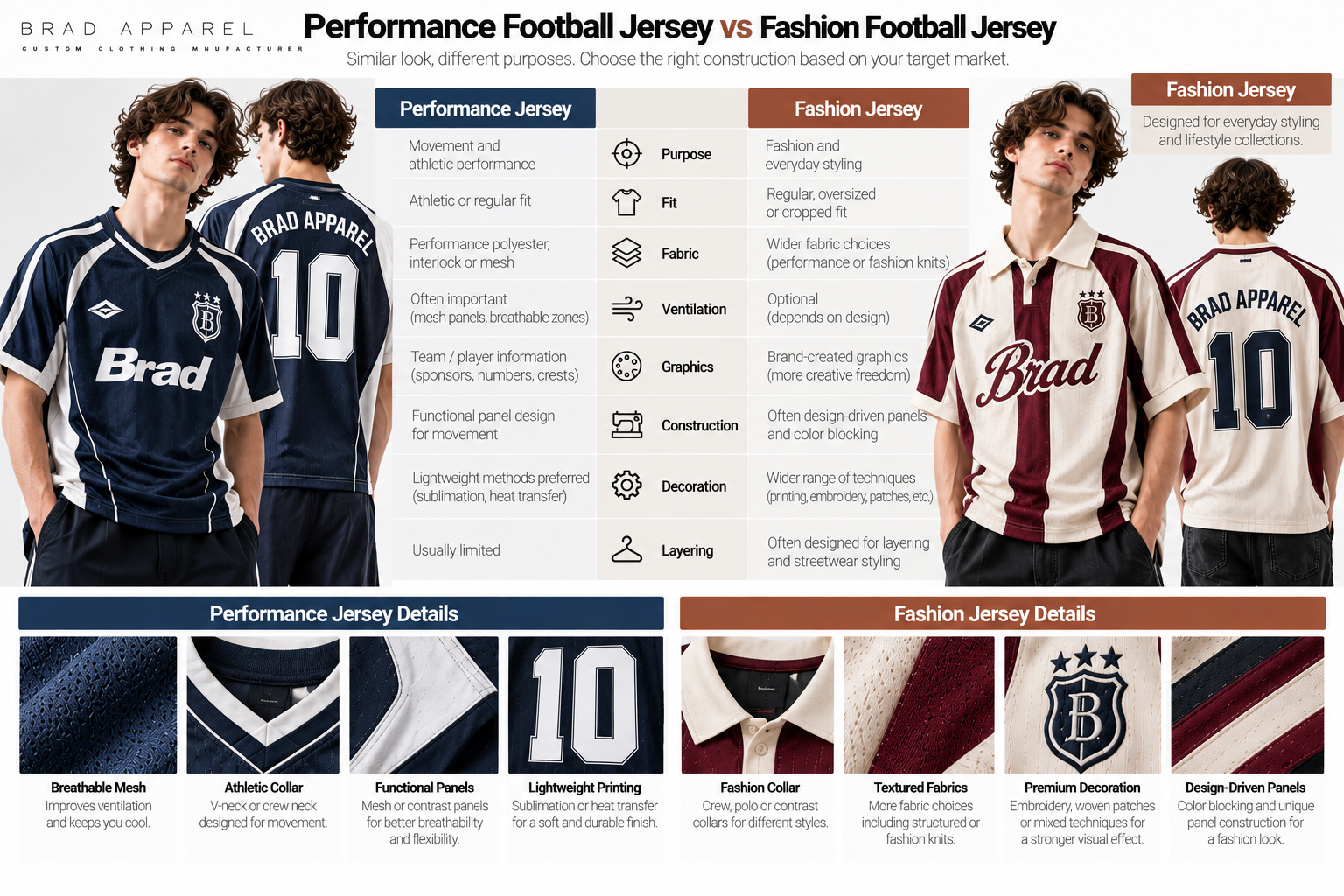
These products can look similar but may have very different development priorities.
| Detail | Performance Jersey | Fashion Jersey |
|---|---|---|
| Primary Goal | Movement and athletic use | Appearance and everyday styling |
| Fit | Athletic or regular | Regular, oversized or cropped |
| Fabric | Performance polyester / mesh | Performance knit or fashion knit |
| Ventilation | Often important | Optional |
| Graphics | Team / player information | Brand-created graphics |
| Panels | Functional or visual | Often strongly design-driven |
| Decoration | Lightweight methods preferred | Wider range of techniques |
| Layering | Usually limited | Often designed for layering |
Neither construction is automatically better.
The correct approach depends on the intended customer.
A fashion brand should not automatically copy a professional match jersey specification if the garment is primarily intended for streetwear.
Football Jersey vs Regular T-Shirt
A football jersey may resemble a T-shirt from a distance.
But the manufacturing logic can be different.
A basic T-shirt usually relies on:
- Simple front and back body
- Standard sleeve
- Basic neck rib
- Limited seam lines
A football jersey may use:
- Multiple body panels
- Contrast shoulder panels
- Raglan-style sleeves
- Side inserts
- Mesh sections
- Printed graphics
- Number placement
- Different collar structures
This means the tech pack usually needs more construction information than a standard tee.
Fabric Is the Foundation of the Jersey
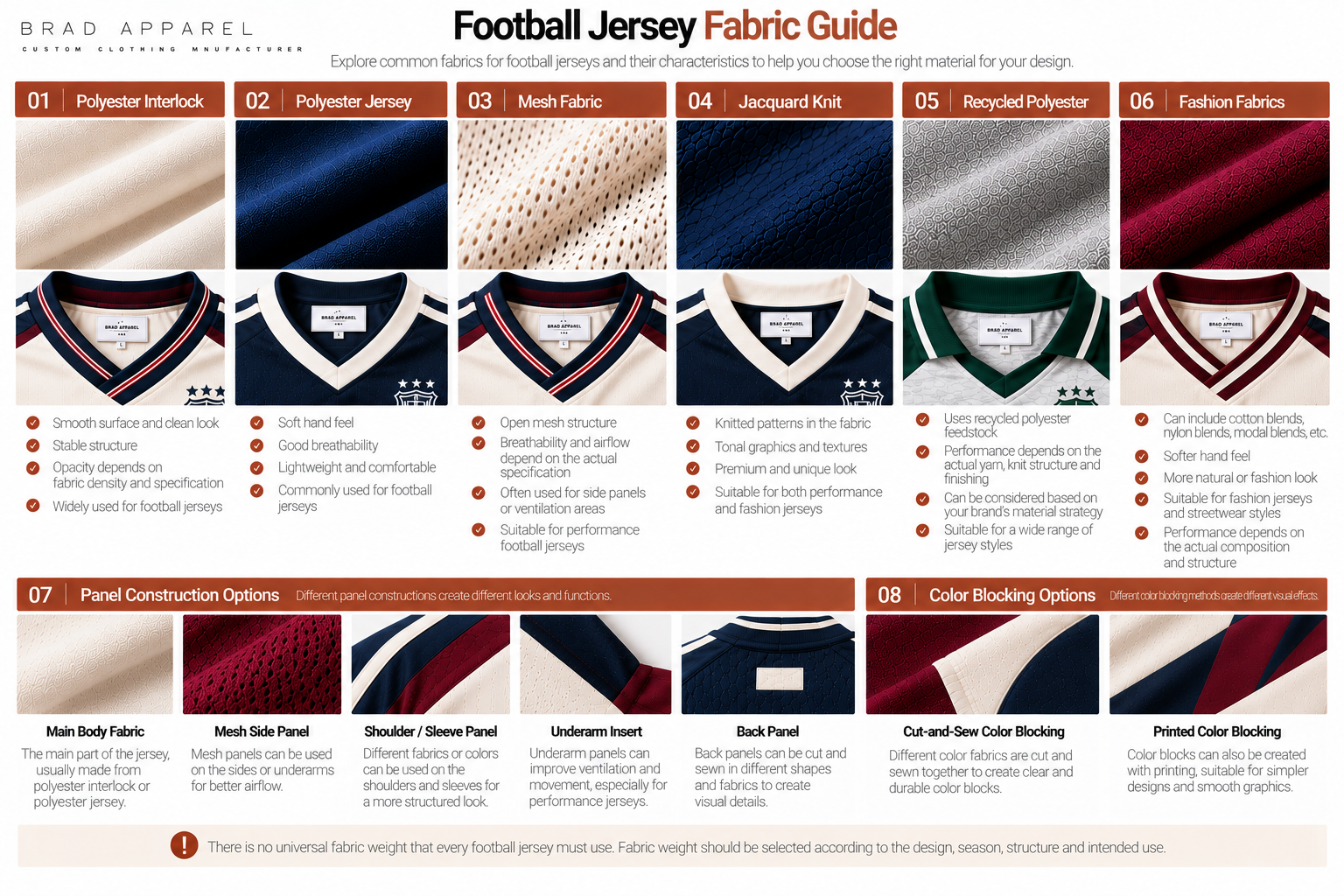
There is no single mandatory football-jersey fabric.
The correct choice depends on whether the product is intended for:
- Sport
- Lifestyle
- Streetwear
- Merchandise
- Premium fashion
Polyester Interlock
Polyester interlock is a common direction for sports-inspired jerseys.
It can provide:
- Smooth surface
- Stable construction
- Clean print base
- Good opacity depending on specification
Different interlocks can vary significantly in:
- Weight
- Density
- Stretch
- Surface
- Hand feel
The actual fabric should therefore be reviewed physically rather than selected by construction name alone.
Polyester Jersey
Single-knit polyester jersey can create a lighter and softer garment.
It may work for:
- Lifestyle football shirts
- Lightweight sportswear
- Relaxed fashion jerseys
Its stability depends on:
- Yarn
- Density
- Gauge
- Finishing
Mesh Fabric
Mesh can be used as:
- Main body fabric
- Side panels
- Underarm inserts
- Back panels
- Decorative panels
The mesh structure creates visible openings in the fabric.
However, not every mesh behaves the same way.
Before production, evaluate:
- Hole size
- Transparency
- Stretch
- Weight
- Recovery
- Surface stability
Jacquard Knit
Jacquard construction can create patterns directly within the knitted fabric.
Possible effects include:
- Tonal graphics
- Geometric texture
- Repeating brand motifs
- Subtle stripes
- Custom surface patterns
This creates a different result from printing because the visual effect is built into the textile.
Custom jacquard development may require different mill minimums and lead times from stock fabric.
Recycled Polyester
Recycled polyester can also be considered when it fits the brand's material strategy.
But fiber origin alone does not define:
- Hand feel
- Durability
- Stretch
- Moisture behavior
The finished textile specification still needs to be evaluated.
Fashion Jerseys Can Use Different Fabrics
Not every football-inspired shirt needs performance polyester.
Fashion versions can experiment with:
- Heavier knitted fabrics
- Textured polyester
- Cotton blends
- Pointelle-style knit
- Open mesh
- Double-knit
The fabric should follow the intended silhouette rather than the traditional category.
Brad Apparel's Fabric Sourcing & Development capabilities include polyester, mesh, jersey, double-knit and athletic/performance fabrics that can be selected according to garment structure, weight and hand feel.
There Is No Universal GSM for a Football Jersey
Fabric weight should be selected according to:
- Intended use
- Fit
- Season
- Transparency
- Printing method
- Desired drape
A lightweight match-inspired jersey and an oversized fashion jersey may require very different textiles.
Rather than beginning with a universal GSM number, brands should first define the finished product.
Mesh Panels Should Be Purposeful
Adding mesh everywhere does not automatically make a better jersey.
Mesh may be used when the design requires:
- Visual contrast
- Ventilation zones
- Lighter construction
- Vintage sportswear styling
But every additional panel also creates:
- More seams
- More pattern pieces
- More alignment requirements
- Additional sewing operations
The panel should have a clear purpose.
Sublimation Is One of the Most Important Football-Jersey Printing Methods
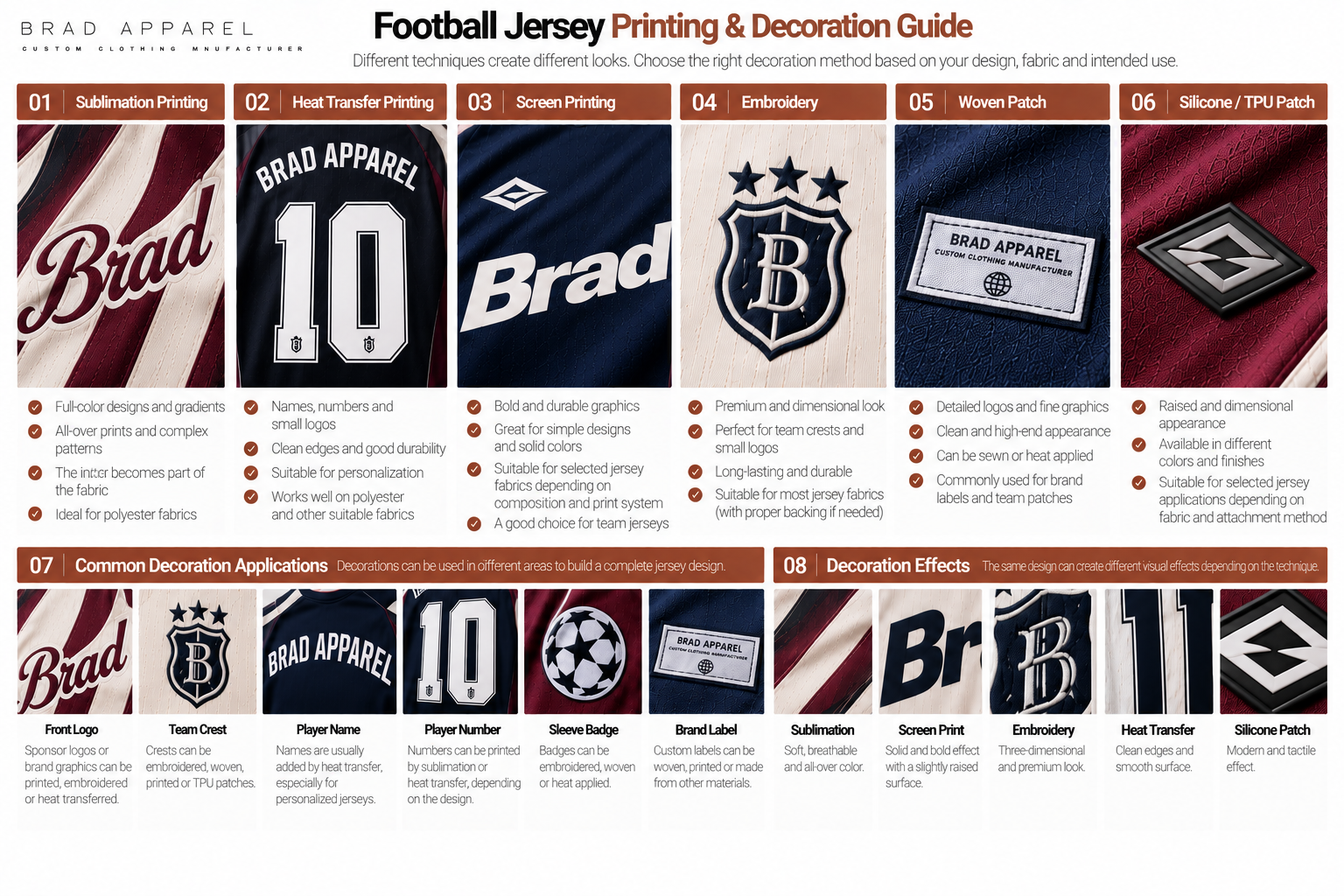
Dye-sublimation is commonly associated with polyester sportswear.
The artwork is transferred so that the color becomes part of the synthetic textile rather than creating a thick graphic layer on top.
This makes it especially useful for:
- All-over graphics
- Gradients
- Complex patterns
- Multiple colors
- Large sponsor-style artwork
- Full jersey designs
Brad Apparel's Printing Techniques capabilities include digital dye-sublimation for synthetic sportswear as well as other printing methods.
When Is Sublimation a Good Choice?
Sublimation can be especially useful when the design includes:
- Full-color artwork
- Repeating patterns
- Large graphics
- Multiple sponsor-style elements
- Complex color transitions
- Graphics that cross multiple areas
But the suitability depends on the actual fabric composition and production process.
The decoration method should always be selected together with the textile.
Heat Transfer Names and Numbers
Names and player numbers are often added separately from the main garment artwork.
Heat-transfer applications can be useful for:
- Player names
- Numbers
- Small sponsor marks
- Individual personalization
Important checks include:
- Position
- Size
- Adhesion
- Edge quality
- Fabric compatibility
Personalized jerseys require especially careful order control because every garment may use different information.
Screen Printing
Screen printing can also be used for certain football-inspired products.
It may work well for:
- Simple logos
- Bold graphics
- Fashion jerseys
- Cotton-rich or suitable blended fabrics
However, a large solid print can affect the hand feel differently from sublimation.
The print method should match both the artwork and fabric.
Embroidery
Embroidery can create a more dimensional crest or logo.
Possible uses include:
- Brand crest
- Small chest logo
- Sleeve badge
- Embroidered patch
But embroidery adds weight and stitch density.
A lightweight jersey should be tested to make sure the decorated area does not:
- Pucker
- Sag
- Distort
Brad Apparel's Embroidery Techniques page covers direct embroidery and patch-based constructions for different base fabrics.
Woven and Embroidered Badges
A football-inspired crest does not need to be printed directly onto the jersey.
Possible badge constructions include:
- Embroidered patch
- Woven patch
- Heat-transfer badge
- Silicone-style badge
- Printed patch
Each creates a different:
- Thickness
- Texture
- Visual appearance
- Cost structure
The badge should be tested on the actual production fabric.
Do Not Copy Real Team Logos Without Permission
Football aesthetics can inspire a collection.
But a brand-created fashion jersey should use original:
- Crests
- Team names
- Sponsor-style artwork
- Numbers
- Graphics
unless the brand has permission to use protected club, league or sponsor marks.
Creating an original fictional-club identity can deliver the same visual language without copying another brand's intellectual property.
Panel Construction Creates the Jersey Identity
Football jerseys often use more pattern pieces than basic T-shirts.
Possible panels include:
- Shoulder panels
- Sleeve panels
- Side panels
- Underarm inserts
- Upper-back panels
- Chest color blocks
These panels can be:
functional
or
purely visual.
Cut-and-Sew Color Blocking
Instead of printing every color, separate fabrics can be sewn together.
For example:
navy body
+
cream shoulder panel
+
burgundy sleeve
This creates physical color blocking.
Advantages can include:
- Strong visual separation
- Different fabric combinations
- Retro sportswear appearance
But the seams need accurate alignment.
Printed Color Blocking
The same visual effect can sometimes be created through printing.
This reduces some physical panel seams but creates different artwork and printing requirements.
For complicated designs, brands should compare:
printed panel effect
vs
real cut-and-sew panels
during development.
Seam Placement Should Follow the Design
Additional seams may affect:
- Stretch
- Comfort
- Visual balance
- Decoration placement
A seam should not accidentally pass through:
- Crest
- Number
- Sponsor graphic
- Important artwork
Panel layout and graphic layout should therefore be developed together.
Sleeve Construction
Possible directions include:
- Set-in sleeve
- Raglan sleeve
- Hybrid panel sleeve
- Drop shoulder for fashion versions
A raglan construction creates a different visual line from a set-in sleeve.
An oversized fashion jersey may intentionally use:
- Wider shoulders
- Lower armholes
- Larger sleeves
The sleeve pattern should follow the intended silhouette.
Collar Options
Football jerseys can use several collar constructions.
Possible directions include:
- Crew neck
- V-neck
- Rib V-neck
- Rib crew neck
- Polo-inspired collar
- Split-neck construction
- Contrast collar
The collar can completely change whether the product feels:
- Modern
- Retro
- Technical
- Casual
- Fashion-led
Rib Structure Matters
Collar rib should be selected according to:
- Neck opening
- Fabric weight
- Stretch
- Recovery
- Collar shape
A rib that is too loose may stretch out.
A rib that is too tight may distort the neckline.
The completed neckline should be approved on a garment sample.
Player Names and Numbers Need a Placement System
The location of a number should not be decided independently for every size.
Brands should define a placement rule based on:
- Center back
- Neckline
- Body length
- Number height
- Graphic composition
The position may need grading adjustments across the size range.
Large Numbers Change the Visual Balance
A very large back number becomes one of the dominant visual elements of the garment.
It should therefore be reviewed together with:
- Shirt length
- Shoulder width
- Name placement
- Hem
- Other graphics
The same number size may not visually suit every silhouette.
Sponsor-Style Graphics
Fashion jerseys often use sponsor-inspired graphics even when no real sponsor exists.
Possible approaches include:
- Brand wordmark
- Fictional sponsor
- Collection name
- Location
- Year
- Original graphic symbol
These elements should be developed as one graphic system rather than placed randomly around the shirt.
Four Modern Football Jersey Directions
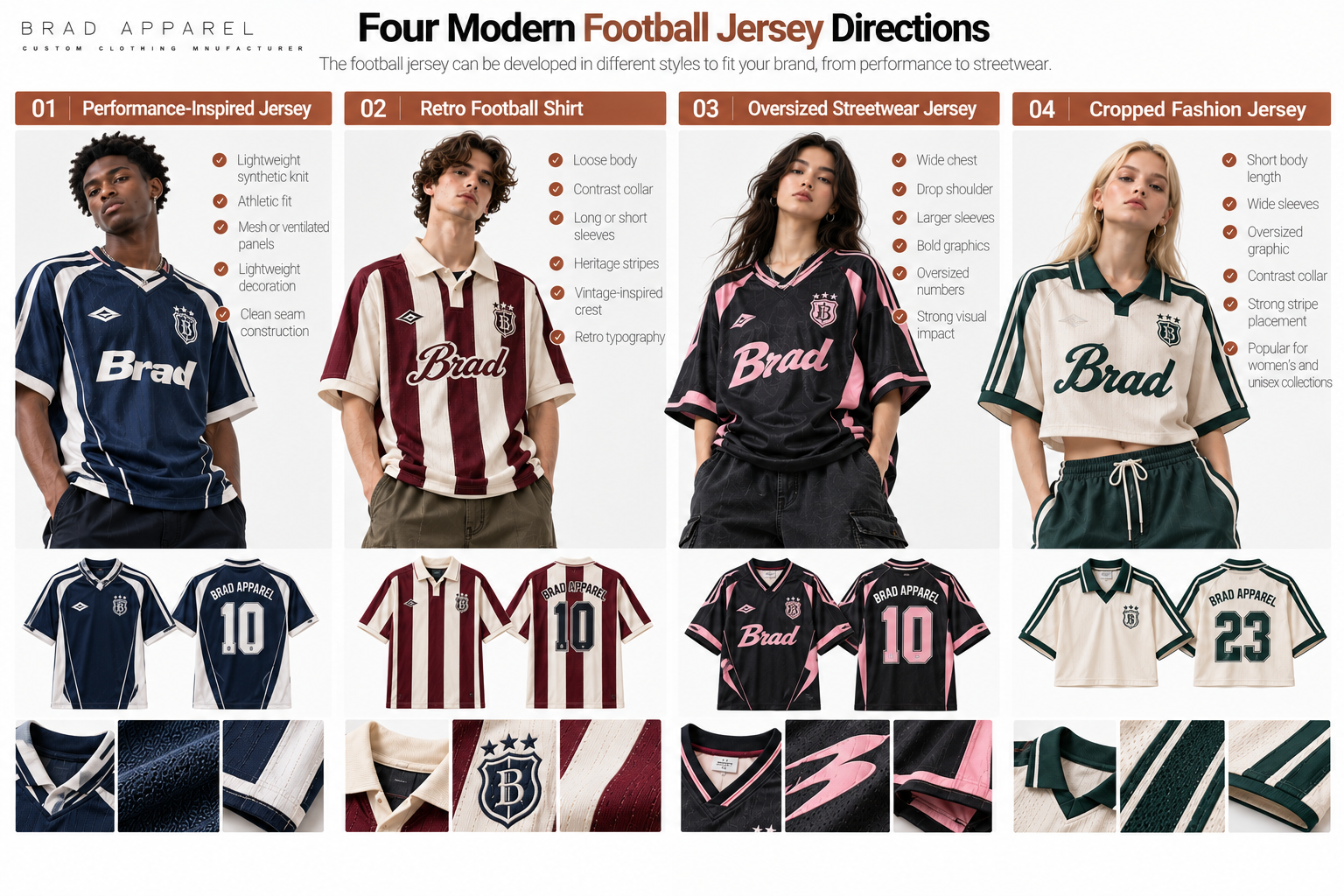
Football-inspired products can be developed in several directions.
1. Performance-Inspired Jersey
Typical features:
- Lightweight synthetic knit
- Athletic fit
- Mesh or ventilated panels
- Lightweight decoration
- Clean seam construction
Suitable for:
- Sports collections
- Team-inspired programs
- Performance aesthetics
The technical requirements should reflect the intended level of athletic use.
2. Retro Football Shirt
Possible features include:
- Loose body
- Contrast collar
- Long or short sleeves
- Heritage stripes
- Vintage-inspired crest
- Retro typography
This direction works well for:
- Heritage sportswear
- Blokecore collections
- Lifestyle brands
3. Oversized Streetwear Jersey
Possible features include:
- Wide chest
- Drop shoulder
- Longer or boxier sleeves
- Large back number
- Bold sponsor-style artwork
- Oversized crest
The pattern should be intentionally oversized.
Simply increasing a performance jersey by several sizes may create:
- Excessive length
- Incorrect sleeve proportions
- Poor neckline scale
4. Cropped Fashion Jersey
Possible features include:
- Short body
- Wide sleeves
- Oversized graphic
- Contrast collar
- Strong stripe placement
This direction can work for:
- Women's fashion
- Unisex collections
- Festival clothing
- Coordinated sets
The crop length should be developed together with the full outfit.
Oversized Football Jerseys Need Purpose-Built Patterns
A good oversized jersey may use:
- Wider body
- Extended shoulder
- Larger sleeve
- Controlled body length
- Larger graphics
The goal is not simply to make every measurement bigger.
For example, a brand may want:
more width
without:
excessive length.
That needs to be reflected in the base pattern.
Cropped Jerseys Need Graphic Rebalancing
Shortening the body reduces the available vertical print area.
This may require adjustments to:
- Front artwork
- Sponsor position
- Numbers
- Stripe placement
- Crest position
A graphic layout developed for a normal-length jersey should not automatically be reused on a cropped version.
Long-Sleeve Football Jerseys
Long sleeves can create a strong retro football look.
Important development areas include:
- Sleeve length
- Sleeve width
- Cuff
- Stripe placement
- Number or badge placement
Possible cuff directions include:
- Rib cuff
- Self-fabric cuff
- Straight sleeve hem
Sublimation Artwork Needs the Pattern Pieces
For all-over sublimation, artwork is often related directly to the garment pattern.
This means the artwork needs to consider:
- Front panel
- Back panel
- Sleeves
- Side panels
- Collar pieces
Graphics that cross seam lines need particular attention.
Otherwise a stripe or graphic may not align as intended after sewing.
Artwork Alignment Across Seams
If a design crosses several panels, check:
- Horizontal lines
- Vertical stripes
- Geometric graphics
- Gradients
- Logos near seams
Perfect alignment may not be appropriate or necessary in every area.
The important points should be defined before bulk production.
Color Approval
Digital artwork on a monitor is not enough for final color approval.
The actual result can vary according to:
- Fabric
- Print process
- Color profile
- Finishing
Brands should approve a physical printed sample or strike-off before bulk production.
White and Light Areas Need Attention
On printed polyester jerseys, the base fabric and print process can affect how light colors appear.
Brands should inspect:
- White areas
- Pale colors
- Gradients
- Fine graphics
on the actual production textile.
Fabric Stretch Can Affect Graphics
If the fabric stretches significantly, graphics may visually change when the garment is worn.
This is especially relevant for:
- Large logos
- Fine lines
- Circular crests
- Typography
The artwork should be evaluated both:
flat
and
on-body.
What Should You Check on a Football Jersey Sample?
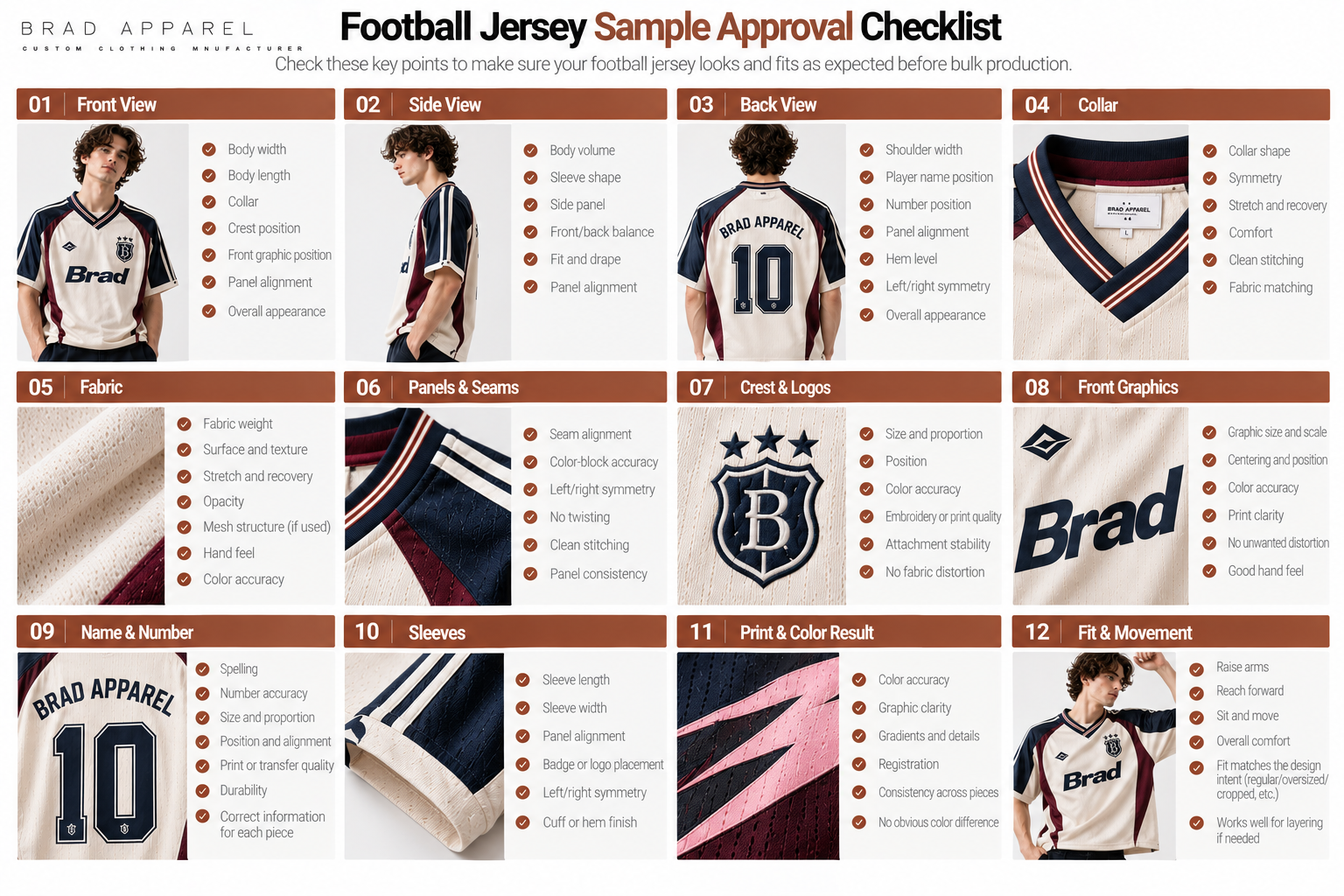
A football jersey sample should be checked for both:
garment construction
and
graphic accuracy.
1. Front View
Check:
- Body width
- Body length
- Collar
- Crest position
- Front graphic position
- Panel alignment
2. Side View
Check:
- Body volume
- Sleeve shape
- Side panel
- Front/back balance
3. Back View
Check:
- Shoulder width
- Player name position
- Number position
- Panel alignment
- Hem level
4. Collar
Check:
- Shape
- Symmetry
- Stretch
- Recovery
- Comfort
5. Fabric
Check:
- Weight
- Surface
- Stretch
- Opacity
- Mesh structure if used
- Hand feel
6. Panels & Seams
Check:
- Seam alignment
- Color-block accuracy
- Left/right symmetry
- No twisting
- Clean stitching
7. Crest & Logos
Check:
- Size
- Position
- Color
- Attachment
- Fabric distortion
8. Front Graphics
Check:
- Scale
- Centering
- Color
- Alignment
- No unwanted distortion
9. Name & Number
Check:
- Spelling
- Number
- Size
- Position
- Attachment
- Center alignment
This is especially important for personalized orders.
10. Sleeves
Check:
- Length
- Width
- Panel alignment
- Badge placement
- Left/right symmetry
11. Print & Color Result
Check:
- Color accuracy
- Graphic clarity
- Gradients
- Registration
- Overall consistency
12. Fit & Movement
Ask the wearer to:
- Raise arms
- Reach forward
- Sit
- Walk
- Layer the jersey if intended
The final fit should match the intended use.
Common Football Jersey Development Mistakes
Treating It Like a Basic T-Shirt
Multiple panels, graphics and decorations require more planning.
Choosing the Print Method After Fabric Approval
Fabric and decoration should be developed together.
Assuming All Polyester Is the Same
Different knitted structures can behave very differently.
Adding Mesh Without a Clear Purpose
More mesh does not automatically improve the garment.
Designing Artwork Without the Pattern
All-over graphics may need to follow individual pattern pieces.
Ignoring Seam Alignment
Graphics crossing panels should be reviewed before production.
Making an Oversized Jersey by Simply Sizing Up
Width, shoulder, sleeve and length should be rebalanced intentionally.
Using Dense Embroidery on Very Lightweight Fabric Without Testing
The decorated area may distort.
Approving Colors Only From a Screen
Physical fabric and print samples should be reviewed.
Forgetting Personalized Order Control
Incorrect:
- Names
- Numbers
- Sizes
can create production errors that are difficult to correct after printing.
What Should You Send a Football Jersey Manufacturer?
A useful development brief should define:
| Area | What to Specify |
|---|---|
| Product Type | Performance / fashion / retro / streetwear |
| Fit | Athletic / regular / relaxed / oversized / cropped |
| Fabric | Polyester jersey / interlock / mesh / custom knit |
| Fabric Feel | Lightweight / structured / soft / textured |
| Collar | Crew / V-neck / rib / polo-style / custom |
| Sleeve | Short / long / set-in / raglan / drop shoulder |
| Panels | Shoulder / side / sleeve / back inserts |
| Printing | Sublimation / transfer / screen print |
| Crest | Print / embroidery / patch / other |
| Front Artwork | Logo / sponsor-style graphic / pattern |
| Back | Name / number / graphic |
| Sleeve | Badge / logo / stripes |
| Color | Pantone or approved reference |
| Hem | Straight / shaped / side vent |
| Personalization | Names / numbers / individual variants |
| Quantity | Sample and bulk quantity |
A visual mockup is useful.
But the manufacturer still needs actual dimensions, artwork files, fabric specifications and construction instructions.
How Brad Apparel Can Develop a Custom Football Jersey
A football-jersey project can follow:
Design Reference
↓
Fit Direction
↓
Fabric Selection
↓
Panel & Pattern Development
↓
Collar Construction
↓
Print Method Selection
↓
Graphic Layout
↓
Crest / Badge Development
↓
First Sample
↓
Fit + Artwork Review
↓
Print / Color Approval
↓
Pre-Production Sample
↓
Bulk Production
Brad Apparel supports jersey development through Fabric Sourcing & Development, sportswear decoration through Printing Techniques, badges and logos through Embroidery Techniques, custom labels and components through Trims & Branding, and broader garment development through our Manufacturing Capabilities.
FAQ
What Is a Football Jersey?
A football jersey is a knitted sports top inspired by association football uniforms.
Modern versions can be developed for performance, fashion, streetwear or merchandise.
Is a Football Jersey the Same as a Soccer Jersey?
Yes, when referring to association football.
“Football jersey” is common internationally, while “soccer jersey” is widely used in markets such as the United States.
What Fabric Is Used for Football Jerseys?
Common directions include:
- Polyester jersey
- Polyester interlock
- Mesh
- Jacquard knit
- Other performance or fashion knits
There is no single mandatory construction.
Are Football Jerseys Always Polyester?
No.
Performance jerseys commonly use synthetic knitted fabrics, but fashion jerseys can use a wider range of textiles.
The fabric should match the intended product.
What Is Sublimation Printing on a Football Jersey?
Dye-sublimation is a printing process commonly used with suitable synthetic fabrics.
It is especially useful for complex, full-color and all-over football jersey artwork.
Can Football Jerseys Be Embroidered?
Yes.
Small crests and logos can use direct embroidery or embroidered patches.
Lightweight fabrics should be tested for puckering and distortion.
Can a Football Jersey Be Oversized?
Yes.
A fashion jersey can be developed with a wider body, extended shoulder and larger sleeves.
The pattern should be purpose-built rather than simply using a larger performance-jersey size.
Can a Football Jersey Be Cropped?
Yes.
Cropped football-inspired jerseys are a fashion interpretation.
The graphics and panel proportions should be adjusted for the shorter body.
Do Football Jersey Graphics Need to Match at the Seams?
Only where the design requires it.
Graphics that cross panels should be reviewed carefully, but not every seam needs perfect visual continuation.
Can Brands Add Custom Names and Numbers?
Yes.
Brands should provide a clear personalization list connecting each:
- Name
- Number
- Size
- Quantity
to avoid production errors.
Can You Make a Football Jersey Without a Real Team Logo?
Yes.
Fashion brands can create original:
- Crests
- Team names
- Sponsor-style graphics
- Numbers
- Color systems
to create a football-inspired product without representing an existing club.
What Should Brands Check Before Bulk Production?
Important points include:
- Fit
- Fabric
- Collar
- Panels
- Seam alignment
- Crest position
- Print quality
- Color
- Names
- Numbers
- Sleeve details
- Movement
The final approved sample should represent the intended bulk fabric, printing and trims.
Final Thoughts
Football jerseys have become much more than sports uniforms.
But the strongest fashion and lifestyle versions still borrow from the engineering logic of real sportswear.
A successful custom football jersey balances:
Fabric
+
Fit
+
Panels
+
Collar
+
Printing
+
Crest
+
Names & Numbers
+
Graphic Placement
as one complete product.
For clothing brands, that is what separates a generic polyester shirt with football graphics from a football-inspired garment that feels intentionally developed from sample through bulk production.
Keep Reading