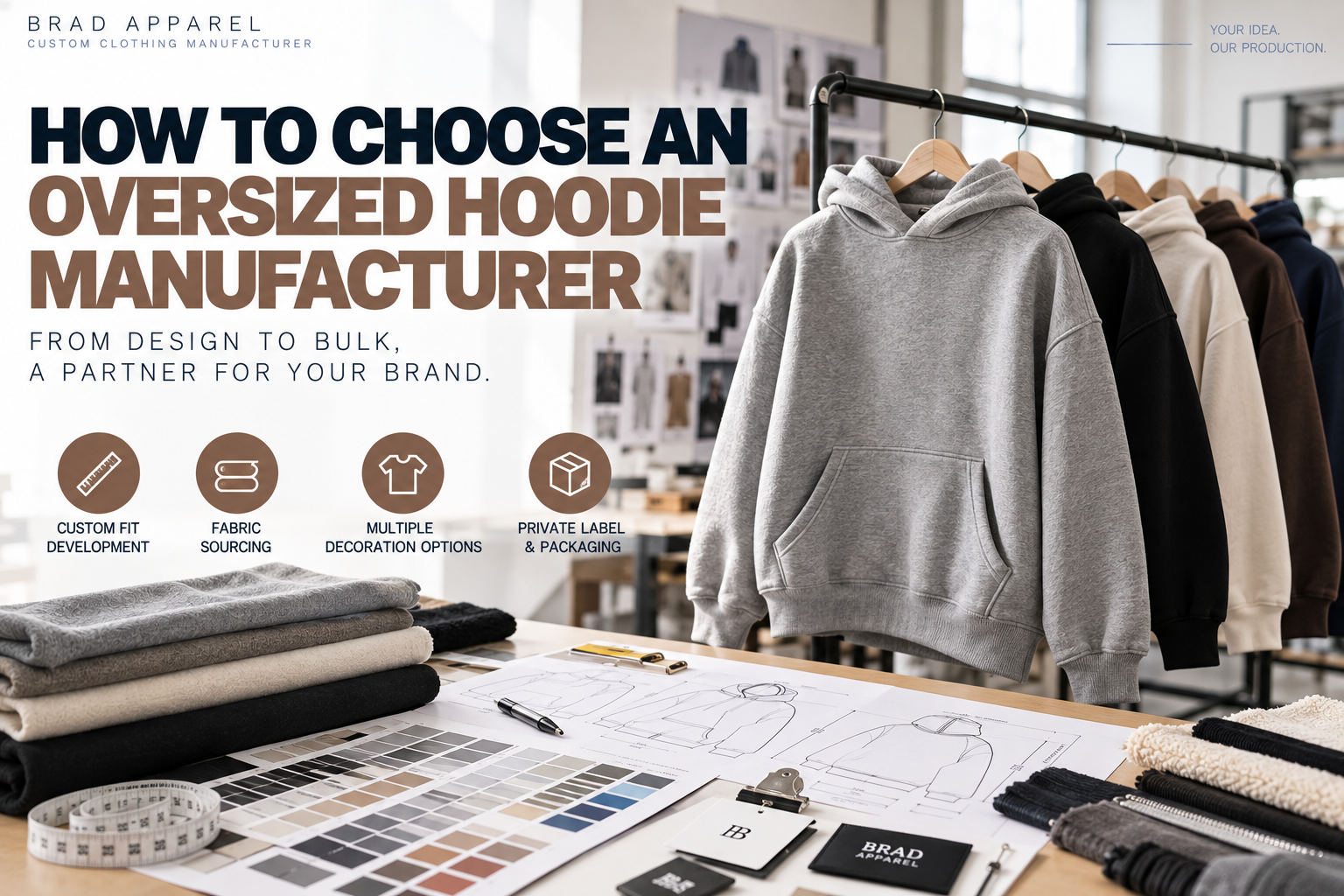
Searching for an oversized hoodie manufacturer can be confusing.
Dozens of suppliers may appear to offer the same product:
- Heavyweight hoodies
- Drop shoulders
- Custom labels
- Puff printing
- Low MOQ
- Private-label production
But two factories offering an "oversized hoodie" may be producing completely different garments.
One may simply increase a standard hoodie by one or two sizes.
Another may develop an entirely new pattern with:
- Wider chest proportions
- Controlled shoulder drop
- Larger sleeve volume
- Adjusted body length
- Rebalanced hood dimensions
- Repositioned kangaroo pocket
- Different rib proportions
For a clothing brand, the most important question is therefore not:
"Who sells oversized hoodies?"
It is:
"Which supplier can reproduce my oversized fit consistently from sample to bulk production?"
This guide explains how brands—especially those selling into the US market—can compare oversized hoodie manufacturers based on actual production capability rather than marketing claims.
First: Not Every "Hoodie Manufacturer" Is the Same
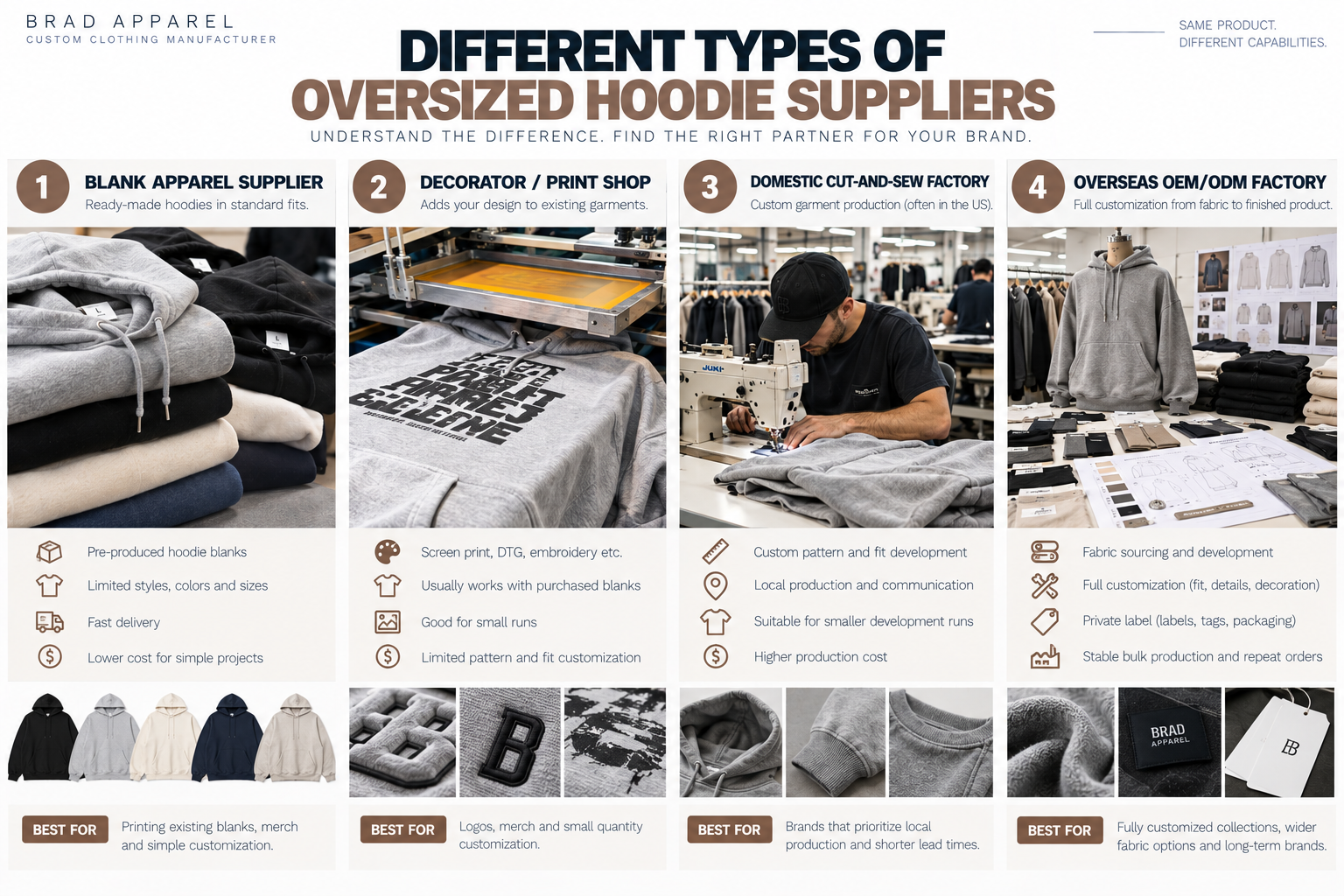
When searching online, you may encounter several different supplier models.
Understanding the difference can prevent a lot of confusion.
| Supplier Type | What They Usually Offer | Best For |
|---|---|---|
| Blank Apparel Supplier | Ready-made hoodie blanks in standard fits | Printing existing blanks quickly |
| Decorator / Print Shop | Printing or embroidery on purchased garments | Logos, merch and simple customization |
| Domestic Cut-and-Sew Factory | Custom pattern and garment production | Brands prioritizing local production |
| Overseas OEM/ODM Factory | Fabric sourcing, pattern development, decoration, labels and bulk production | Fully customized private-label collections |
These businesses may all appear when searching for:
oversized hoodie manufacturers
but they do not provide the same service.
Blank Hoodie Supplier vs Custom Manufacturer
A blank supplier normally offers a pre-developed garment.
You may be able to choose:
- Color
- Size
- Embroidery
but the fundamental hoodie pattern is already fixed.
That can be useful when speed and simplicity are the priority.
A custom cut-and-sew manufacturer works differently.
The garment can be developed around your own:
- Chest width
- Body length
- Shoulder position
- Sleeve width
- Hood size
- Pocket position
- Rib dimensions
For a brand trying to build a recognizable oversized silhouette, this distinction matters.
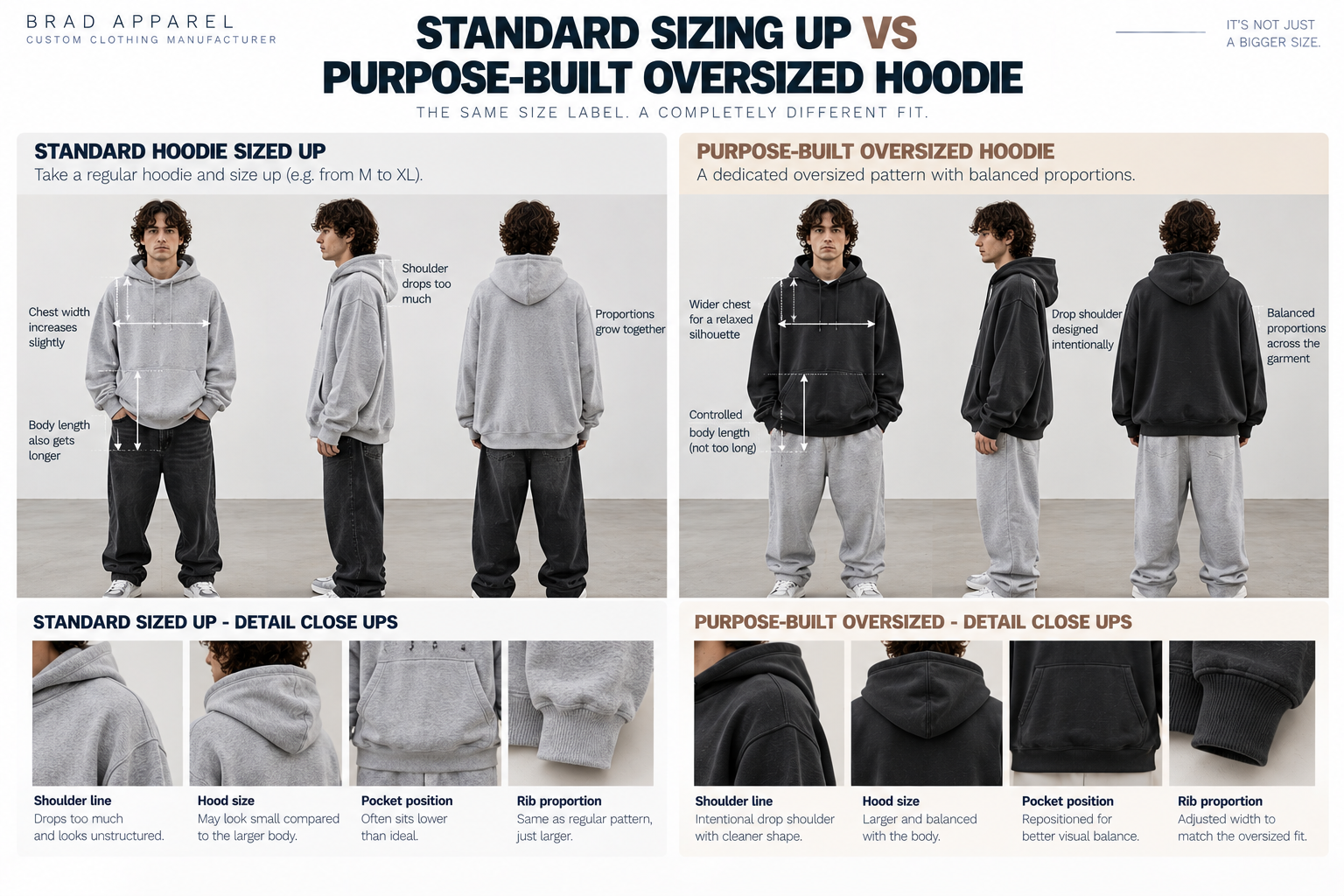
A True Oversized Hoodie Is Not Just a Bigger Hoodie
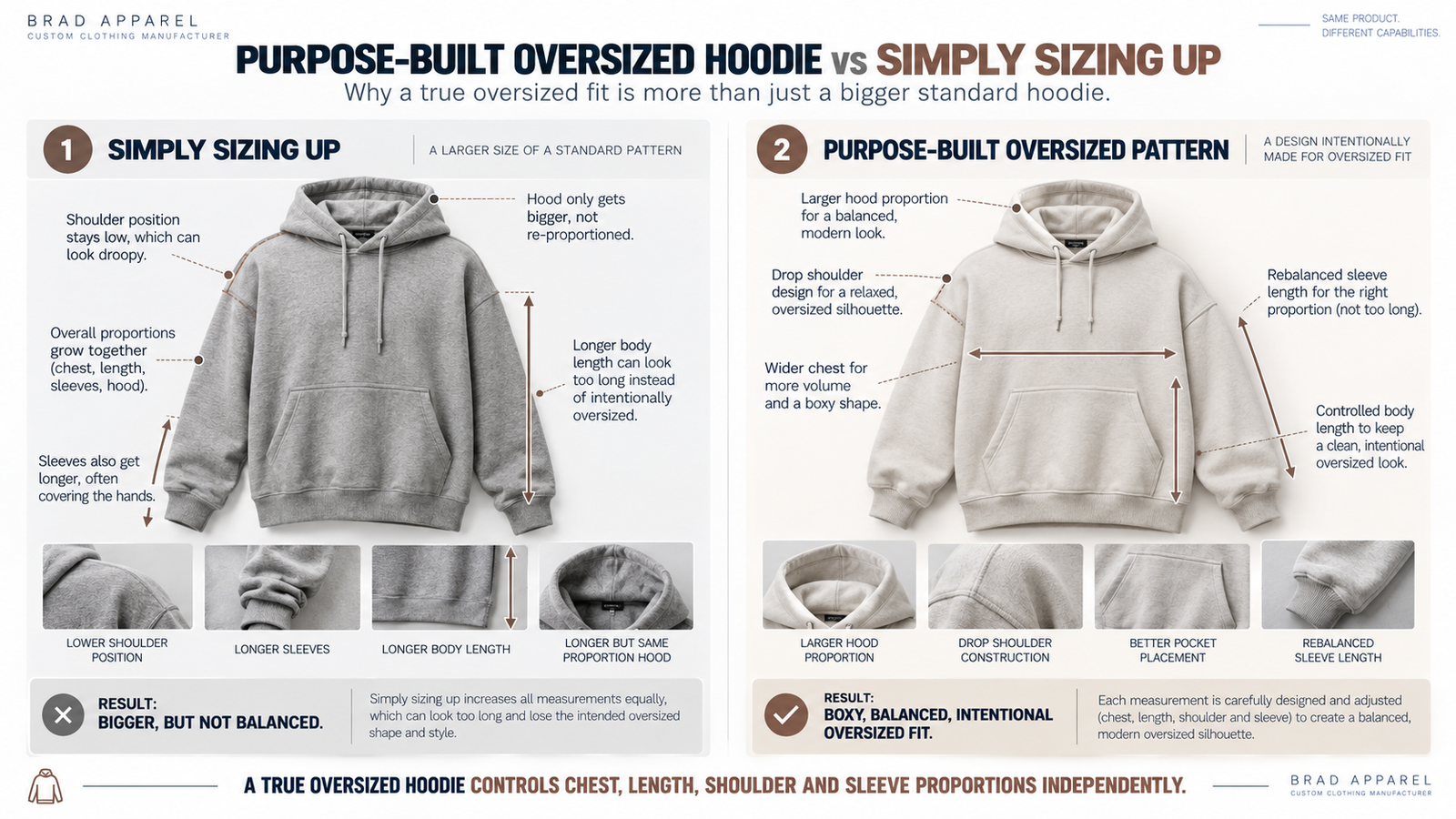
One of the first things to ask a manufacturer is:
"Do you develop a dedicated oversized pattern, or do you simply grade up a regular hoodie?"
These are not the same thing.
Simply Sizing Up
Imagine taking a standard Medium hoodie and wearing XL.
You may get:
- More chest width
- Longer sleeves
- Longer body
- Lower shoulder position
But everything grows together.
The result may look:
too long
rather than intentionally oversized.
Purpose-Built Oversized Pattern
A dedicated oversized block can control each dimension independently.
For example:
Chest width increases
while
Body length stays relatively controlled
and
Shoulder position moves outward
while
Sleeve length is rebalanced
This creates the boxy or drop-shoulder shape associated with modern streetwear.
A good manufacturer should understand this difference before cutting your sample.
10 Things to Check Before Choosing an Oversized Hoodie Manufacturer
Instead of ranking manufacturers by marketing claims, compare them using the same criteria.
1. Can They Develop the Fit You Actually Want?
Start with pattern capability.
Ask whether they can work from:
- Your tech pack
- Your size chart
- A physical reference garment
- A measurement sheet
- A design sketch
Then confirm which measurements can be adjusted.
For oversized hoodies, these commonly include:
- Chest width
- Shoulder width
- Body length
- Sleeve length
- Sleeve opening
- Armhole depth
- Hood dimensions
- Hem opening
The manufacturer should be able to explain how these measurements affect the silhouette.
2. Ask to See More Than Product Photos
A beautiful hoodie photo does not prove consistent manufacturing capability.
Ask for evidence from different stages.
Useful examples include:
- Fabric swatches
- Sample garments
- Pattern or measurement review
- Decoration strike-offs
- Sewing details
- Bulk production images
- Finished QC measurements
The objective is not to collect hundreds of factory photos.
It is to understand whether the supplier has a repeatable development process.
3. Check Fabric Sourcing Capability
An oversized hoodie uses more fabric than a regular fitted hoodie.
That makes fabric selection and availability especially important.
Before sampling, confirm:
- Composition
- Fabric structure
- GSM
- Color
- Surface finish
- Inside finish
- Shrinkage behavior
- Available quantity
You should also ask:
Can the same fabric be reordered later?
A great first drop becomes difficult to repeat if the exact fabric cannot be sourced again.
Brad Apparel's verified Fabric Sourcing & Development page explains how composition, structure, GSM, color and hand feel can be specified before sampling.
4. Look at Hood, Pocket and Rib Proportions
Oversized fit does not stop at the body pattern.
A wider body may require adjustments to:
Hood
A small hood can look visually weak on a very wide body.
Kangaroo Pocket
A standard pocket may appear too narrow or too high.
Rib Hem
The hem opening affects whether the hoodie:
- Falls straight
- Blouses inward
- Creates a cropped shape
Cuffs
Sleeve volume and cuff width should feel intentional together.
These details should be reviewed during sampling rather than copied automatically from a standard hoodie block.
5. Check Decoration Capability Before Approving the Garment
Large oversized hoodies often use larger artwork.
That may include:
- Screen printing
- Puff printing
- High-density printing
- Embroidery
- Appliqué
- Rhinestones
- Distressed graphics
But decoration should be evaluated together with the garment.
For example, large front artwork may interact with:
- Kangaroo pocket seams
- Side seams
- Zippers
- Hood placement
Ask the factory whether they can produce a strike-off or decoration sample before bulk production.
Brad Apparel's verified Printing Techniques page shows several available print directions for custom apparel projects.
6. Understand the MOQ Properly
MOQ is often advertised as one simple number.
In reality, several different minimums may exist.
Ask:
MOQ per style?
MOQ per color?
MOQ per fabric?
MOQ per decoration?
These distinctions matter.
For example:
A factory may accept:
100 pieces per style
but custom-dyed fabric may require a higher material minimum.
Or a custom metal zipper pull may require its own production quantity.
So do not evaluate manufacturers using one headline MOQ number alone.
7. Ask How Reorders Work
This is one of the most overlooked sourcing questions.
Your first order may be:
100 pieces
but if the product sells well, the next order may be:
500 or 1,000 pieces
Ask the manufacturer:
- Will the same pattern be saved?
- Will approved measurements be recorded?
- Will fabric details be documented?
- Can the same labels and trims be reordered?
- How are approved colors recorded?
The ability to repeat a successful product is often more important than making the first sample quickly.
8. Check Size Grading, Not Just the Medium Sample
An oversized Medium may look excellent.
That does not guarantee that:
XS
or
XXL
will maintain the same proportions.
Good grading should preserve the intended design language across the size range.
For example, the relationship between:
Chest width
and
Body length
should remain intentional.
The same applies to:
- Shoulder drop
- Hood scale
- Sleeve volume
- Pocket placement
Ask to review graded measurements before bulk cutting.
9. Understand the Sample Approval Process
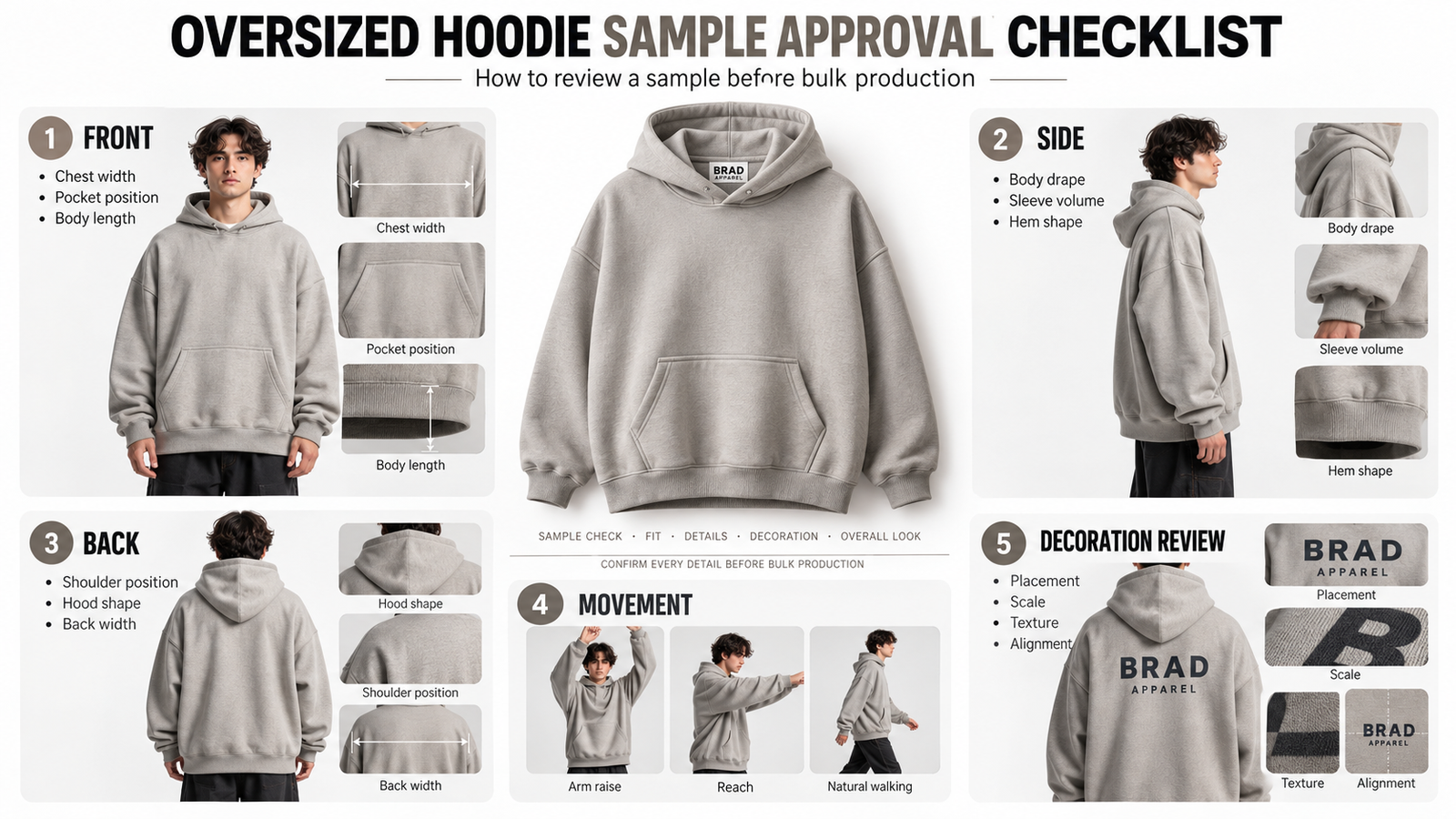
A useful sample process should allow you to evaluate more than color and fabric.
Review:
Front
- Chest width
- Pocket position
- Body length
Side
- Body drape
- Sleeve volume
- Hem shape
Back
- Shoulder position
- Hood shape
- Back width
Movement
- Arm raise
- Reach
- Natural walking
Decoration
- Placement
- Scale
- Texture
- Alignment
Write revisions down.
Do not approve production based only on messages such as:
"Make it slightly more oversized."
Turn feedback into measurements.
10. Compare the Full Production System
A factory should not only be able to make one good sample.
You are buying a repeatable production system.
That includes:
Fabric
↓
Pattern
↓
Sample
↓
Decoration
↓
Bulk Cutting
↓
Sewing
↓
Inspection
↓
Packing
The strongest supplier for your brand is usually the one that can control these stages consistently.
US-Based Manufacturer vs Overseas Manufacturer
A US brand does not automatically need a US factory.
Both sourcing routes can make sense.
The correct choice depends on your priorities.
| Priority | US-Based Production May Suit You | Overseas OEM/ODM May Suit You |
|---|---|---|
| Local communication | ✓ | |
| Short domestic transportation | ✓ | |
| Small local development runs | ✓ | Depends on factory |
| Wide fabric sourcing | ✓ | |
| Complex customization | Depends on factory | ✓ |
| Custom trims & packaging | Depends on factory | ✓ |
| Factory-direct production economics | Often | |
| Large-scale repeat orders | Depends on capacity | ✓ |
Neither model is automatically better.
A US brand should compare:
quality + capability + total cost + communication + lead time + repeatability
rather than choosing only according to factory location.
Manufacturer, Wholesaler or Brand?
This distinction is especially important when reading online "best manufacturer" lists.
A company selling oversized hoodies may be:
A Consumer Brand
It designs and sells clothing to end customers.
A Blank Apparel Supplier
It provides ready-made garments for printing and resale.
A Decorator
It applies logos to existing blanks.
A Custom Manufacturer
It develops and produces the garment itself.
These businesses solve different problems.
If you already have a fully developed oversized hoodie design, you usually need a manufacturer capable of:
pattern + sample + cut and sew + decoration + private label
rather than simply a company that sells oversized hoodies.
Send Every Manufacturer the Same RFQ
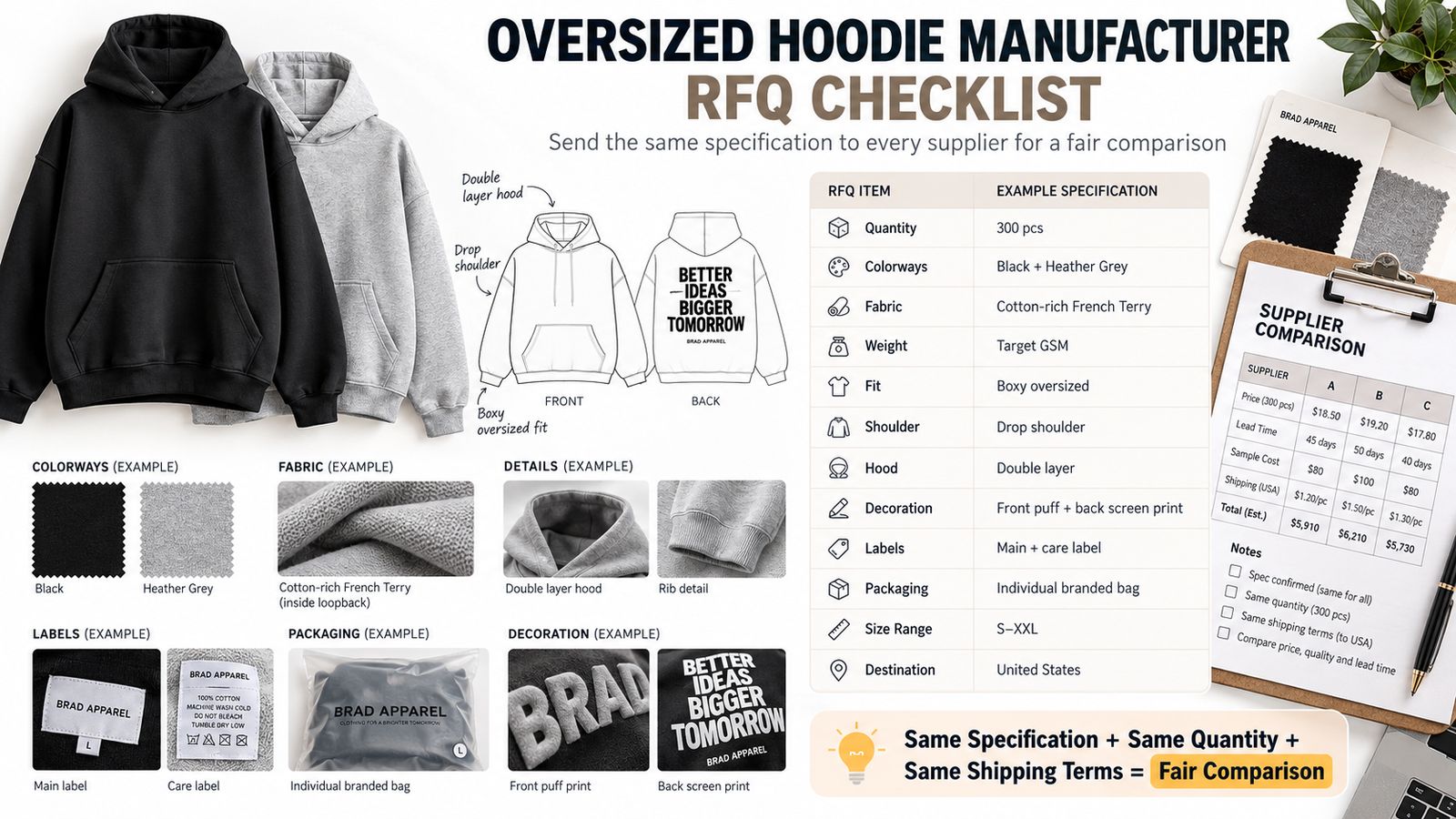
If you send different information to different suppliers, the quotations cannot be compared fairly.
Create one RFQ and send the same specifications to each manufacturer.
Include:
| Requirement | Example |
|---|---|
| Quantity | 300 pcs |
| Colorways | Black + Heather Grey |
| Fabric | Cotton-rich French terry |
| Weight | Target GSM |
| Fit | Boxy oversized |
| Shoulder | Drop shoulder |
| Hood | Double layer |
| Decoration | Front puff + back screen print |
| Labels | Main + care label |
| Packaging | Individual branded bag |
| Size Range | S–XXL |
| Destination | United States |
Then compare the responses.
Do Not Compare Unit Price Until the Specifications Match
Manufacturer A may quote:
$12
Manufacturer B:
$18
That does not tell you which supplier is expensive.
Maybe the first quote uses:
- Lighter fabric
- Standard pattern
- Single-layer hood
- Basic printing
- Stock trims
while the second includes:
- Custom oversized pattern
- Heavier fabric
- Double-layer hood
- Custom decoration
- Private labels
- Custom packaging
Compare:
same specification → same quantity → same shipping terms
before comparing price.
If your main question is specifically hoodie costing, Brad Apparel already has a separate guide explaining custom hoodie manufacturing cost.
Oversized Hoodie Manufacturer Red Flags
A lower quotation is not necessarily a red flag.
The real warning signs are process problems.
They Never Ask About Fit
If you say:
"I need an oversized hoodie"
and the factory immediately quotes without asking about measurements or silhouette, the quotation may be based on a generic block.
They Cannot Tell You the Fabric Specification
You should be able to confirm at least:
- Composition
- Fabric type
- Approximate GSM
- Finish
before bulk production.
They Refuse to Make a Sample
For a custom silhouette, sampling is important.
They Change Specifications Without Recording Them
If sample revisions happen only through scattered chat messages, bulk mistakes become more likely.
Use written measurements and approved specifications.
They Cannot Explain MOQ Structure
You should know whether minimums relate to:
- Style
- Color
- Fabric
- Trim
- Decoration
The Bulk Product Is Based on a Different Fabric
A sample approved in one material may fit differently when bulk fabric changes.
If fabric changes, the fit may need to be rechecked.
A Simple Manufacturer Comparison Scorecard
You do not need to assign a fake universal ranking.
Evaluate each supplier against your own project.
| Evaluation Area | What to Check |
|---|---|
| Pattern Capability | Can they create the intended oversized block? |
| Sample Accuracy | Does the sample match your measurements? |
| Fabric Sourcing | Can the approved fabric be reordered? |
| Decoration | Can they reproduce your artwork consistently? |
| Grading | Does the silhouette remain balanced across sizes? |
| MOQ | Does the minimum fit your launch plan? |
| Communication | Are technical questions answered clearly? |
| Bulk Control | How is the approved sample translated into production? |
| Reorder Ability | Are specifications documented for future runs? |
| Logistics | Are shipping terms and destination requirements clear? |
The supplier with the lowest price does not automatically score highest.
The supplier that best matches your business model may be different from the supplier that fits another brand.
Where Brad Apparel Fits
Brad Apparel is a custom apparel manufacturer based in Dongguan, China, serving overseas clothing brands.
For oversized hoodie development, projects can involve:
- Custom measurements
- Oversized and drop-shoulder silhouettes
- Fabric sourcing
- Sample development
- Printing and embroidery
- Private labels
- Packaging
- Bulk production
The important distinction is that the garment can be developed around the brand's specifications rather than requiring the brand to choose only from an existing blank.
Our verified Custom Hoodie Manufacturing page provides more detail on the available fit, fabric and customization routes.
Questions to Ask Before Choosing a Manufacturer
Before paying for a sample, ask:
- Can you develop a custom oversized pattern from my measurements?
- Can you work from a physical reference sample?
- What information do you need before quoting?
- Is the MOQ per style or per color?
- Can I approve fabric before the sample?
- Can you produce a decoration strike-off?
- How many sample revisions are possible?
- How do you grade the approved pattern?
- How do you record approved measurements?
- Can the same fabric and trims be reordered later?
- What changes after the sample is approved?
- What shipping terms are included in the quotation?
A manufacturer that answers these clearly gives you far more useful information than a generic list of "top suppliers."
FAQ
What Is an Oversized Hoodie Manufacturer?
An oversized hoodie manufacturer produces hoodies with deliberately relaxed or exaggerated silhouettes.
A custom manufacturer may also develop:
- Drop shoulders
- Boxy proportions
- Custom body length
- Wider sleeves
- Custom hood dimensions
rather than simply offering larger standard sizes.
Is an Oversized Hoodie Just One Size Bigger?
No.
Wearing a larger standard hoodie increases multiple measurements together.
A purpose-developed oversized hoodie controls chest, shoulder, length and sleeve proportions independently.
Should I Choose a US or Overseas Hoodie Manufacturer?
It depends on your priorities.
Consider:
- Customization
- MOQ
- Sampling
- Production scale
- Communication
- Total landed cost
- Lead time
rather than location alone.
What Should I Send an Oversized Hoodie Manufacturer?
Ideally provide:
- Tech pack or measurements
- Quantity
- Fabric direction
- Color
- Artwork
- Size range
- Labels
- Packaging
- Reference images
If you do not have a complete tech pack, a physical garment or detailed reference can also help communicate the intended fit.
What Is the Best GSM for an Oversized Hoodie?
There is no universal best GSM.
The correct fabric weight depends on:
- Desired structure
- Climate
- Fabric composition
- Interior finish
- Fit
- Target retail position
The silhouette should be developed together with the fabric.
What MOQ Should I Expect?
MOQ varies by:
- Manufacturer
- Fabric
- Color
- Decoration
- Custom trims
Always ask whether the stated minimum applies per style, per color or per material.
How Do I Know if a Manufacturer Can Make a Good Oversized Fit?
The best evidence is an approved sample.
Review:
- Chest width
- Shoulder position
- Body length
- Sleeve volume
- Hood scale
- Pocket position
- Overall drape
before approving bulk production.
Final Thoughts
Choosing an oversized hoodie manufacturer should not begin with:
"Who is number one?"
It should begin with:
"What does my product actually require?"
A brand developing a simple printed blank may need one type of supplier.
A streetwear label developing a signature heavyweight boxy hoodie may need another.
Define your:
Fit
Fabric
Decoration
Quantity
Branding
and
Reorder plan
first.
Then compare manufacturers using the same specification.
That makes supplier selection much more useful than choosing from a generic top-10 list.
Keep Reading