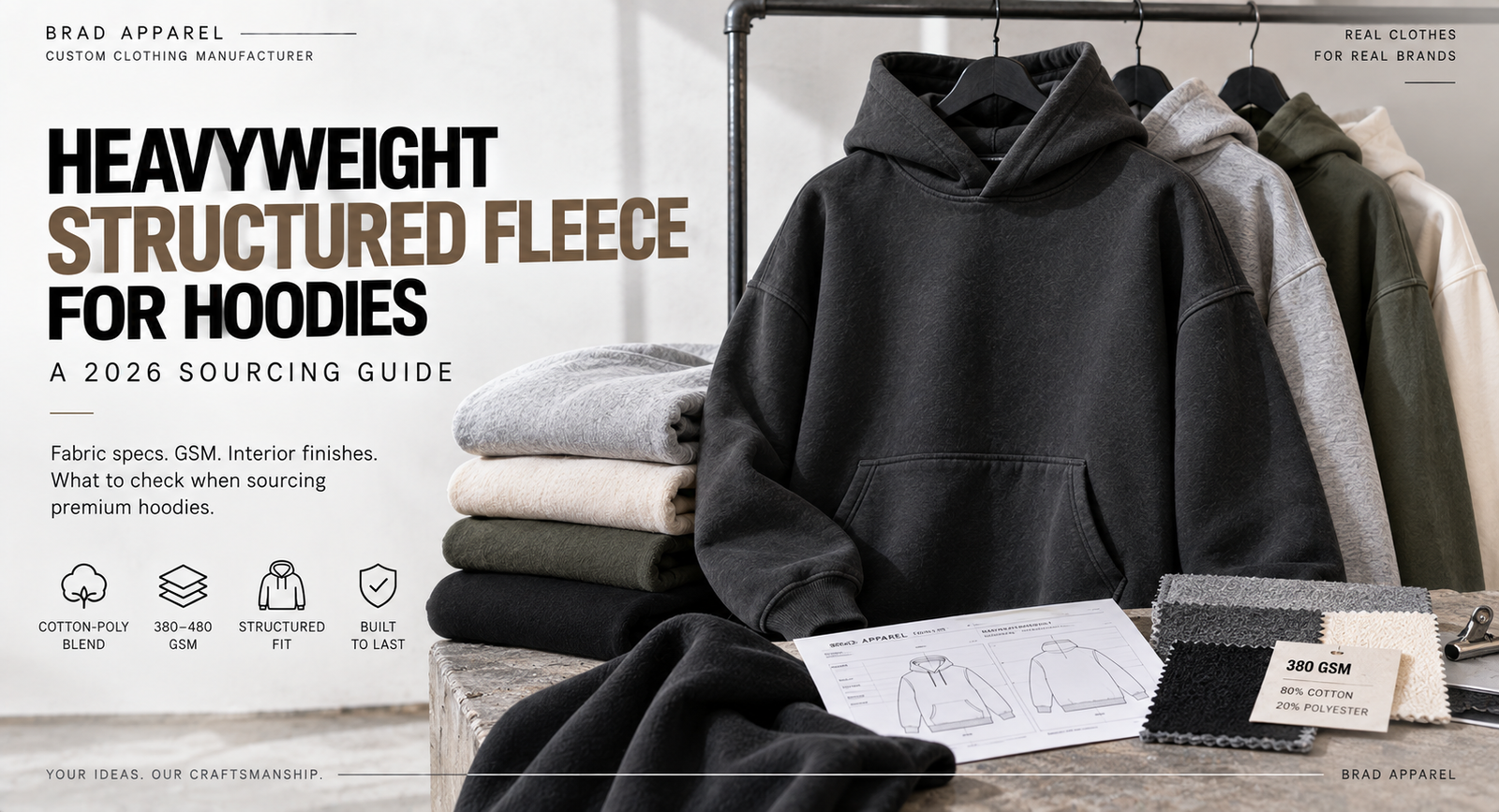
Some hoodies feel premium the moment you pick them up.
They feel dense, substantial and structured enough to hold their shape on a hanger.
Others collapse easily and feel thin even when the artwork looks good.
For brands developing premium streetwear hoodies, that difference often starts with the fabric specification.
The most important details are:
- GSM
- Cotton/polyester ratio
- Interior finish
- Shrinkage control
- Fabric stability
- Decoration compatibility
For a structured heavyweight hoodie, simply asking for "heavy fleece" is not enough.
You need a clear fabric specification.
The Core Specification: 380–480 GSM Cotton-Poly Fleece
A common starting point for premium structured hoodies is:
80% cotton / 20% polyester fleece
with a weight of approximately:
380–480 GSM
Each part of that specification affects the finished garment.
Cotton
Cotton contributes:
- Softness
- Breathability
- Natural hand feel
- Comfortable skin contact
Using cotton as the majority fiber helps the hoodie maintain the feel customers expect from premium casualwear.
Polyester
Polyester helps improve:
- Shape retention
- Durability
- Dimensional stability
- Resistance to stretching during repeated wear
For brands prioritizing structure, a cotton-polyester blend can provide more stability than pure cotton.
Why 380–480 GSM?
Fabric weight has a major effect on how a hoodie hangs and feels.
At approximately 380–480 GSM, fleece begins to feel noticeably more substantial.
The garment can:
- Hold its silhouette better
- Feel denser in the hand
- Support oversized fits
- Create a stronger premium impression
But heavier does not automatically mean better.
The goal is to find the right balance between structure and wearability.
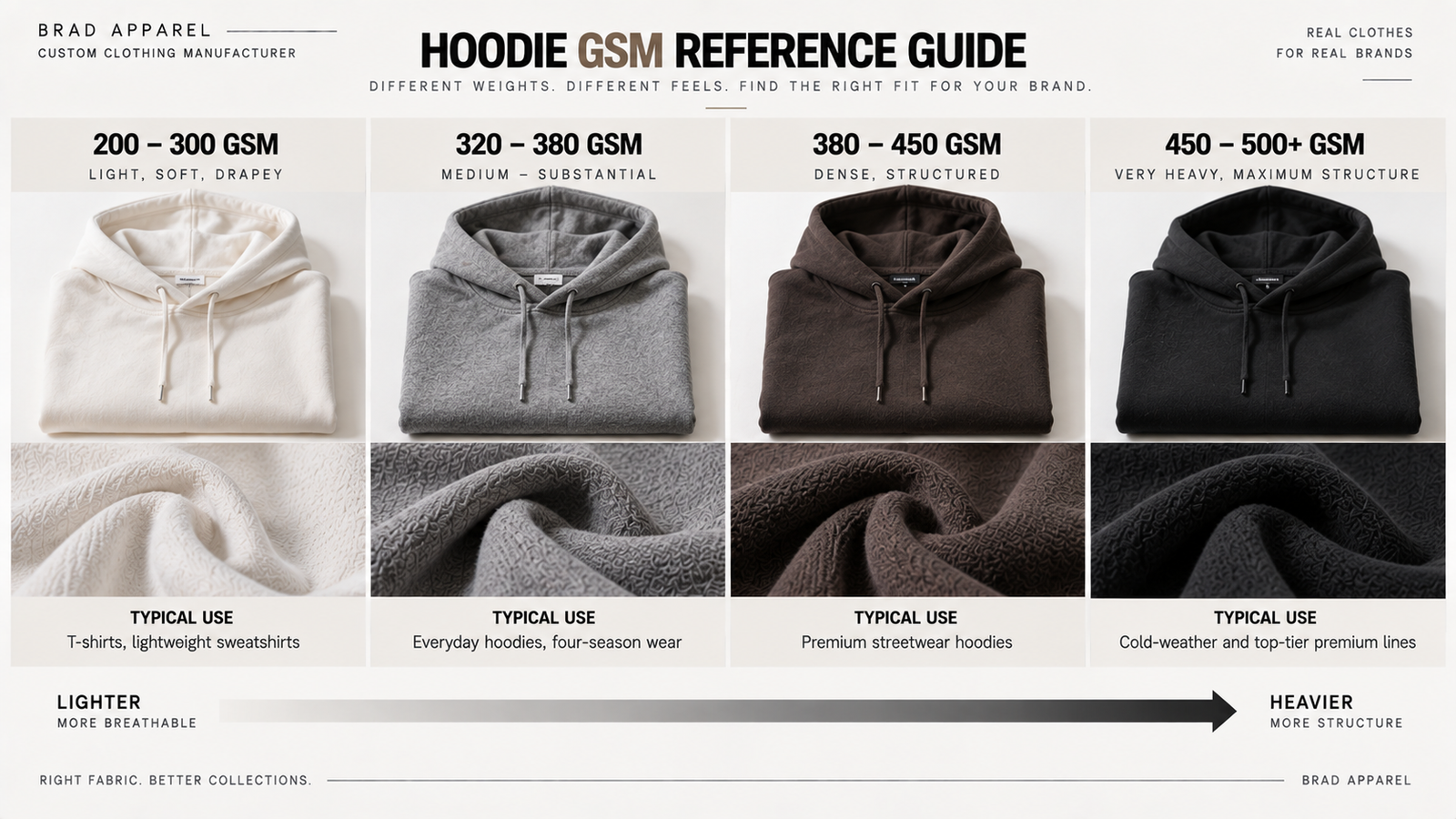
Hoodie GSM Reference Guide
| GSM Range | General Feel | Typical Use |
|---|---|---|
| 200–300 GSM | Light, soft and drapey | Lightweight sweatshirts and lighter garments |
| 320–380 GSM | Medium to substantial | Everyday hoodies and four-season wear |
| 380–450 GSM | Dense and structured | Premium streetwear hoodies |
| 450–500+ GSM | Very heavy and highly structured | Cold-weather and premium heavyweight lines |
For many premium streetwear projects, 380–480 GSM provides a useful balance between structure and comfort.
Is Heavier Always Better?
No.
Once fleece becomes extremely heavy, the garment can start to feel:
- Stiffer
- Warmer
- Bulkier
- Less breathable
A 500+ GSM hoodie can make sense for a specific cold-weather or ultra-heavyweight product.
But it is not automatically more premium than a well-developed 400 GSM hoodie.
The correct GSM should match:
- Climate
- Fit
- Target customer
- Retail positioning
- Intended season
Loopback vs Brushed Fleece
GSM tells you how heavy the fabric is.
But it does not tell you how the inside feels.
The interior finish makes a major difference.
Brushed Fleece
Brushed fleece has a soft, fuzzy interior.
The inner surface is mechanically brushed to create a raised nap.
Typical characteristics include:
- Softer interior
- Warmer hand feel
- More insulation
- Cozy winter positioning
Brushed fleece is commonly used for cold-weather hoodies.
Loopback Fleece
Loopback fleece keeps the knitted loops visible on the inside.
It is not brushed into a fluffy surface.
Typical characteristics include:
- Cleaner interior appearance
- Slightly more breathable feel
- Less fluffy hand feel
- More refined construction
Loopback can work particularly well for structured, premium streetwear hoodies intended for broader seasonal use.
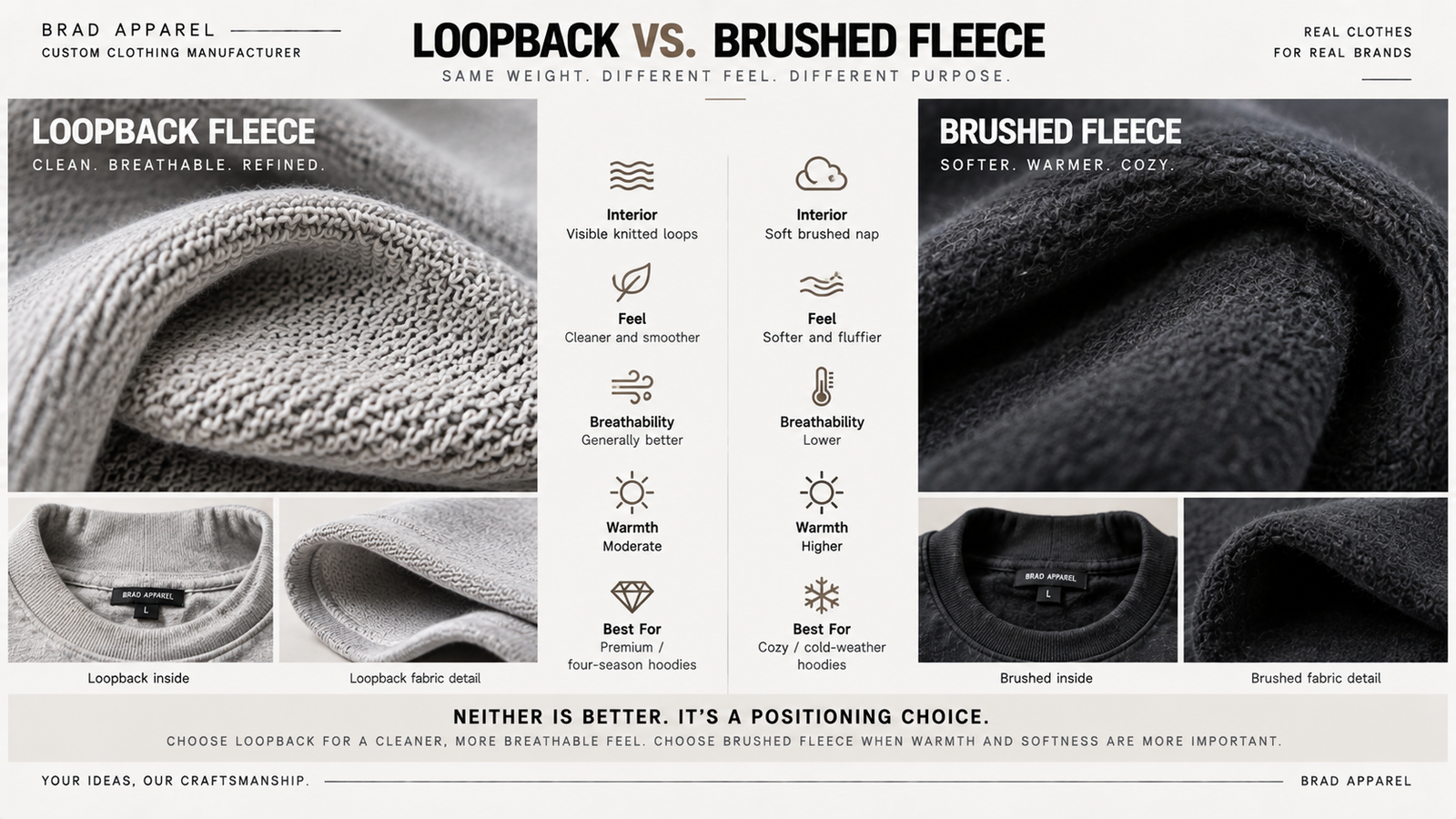
Loopback vs Brushed Fleece Comparison
| Feature | Loopback Fleece | Brushed Fleece |
|---|---|---|
| Interior | Visible knitted loops | Soft brushed nap |
| Feel | Cleaner and smoother | Softer and fluffier |
| Warmth | Moderate | Higher |
| Breathability | Generally better | Lower |
| Positioning | Premium / four-season | Cozy / cold-weather |
Neither option is automatically better.
The correct choice depends on the product you are trying to build.
What to Check When Sourcing Heavyweight Fleece
A supplier saying "heavyweight cotton fleece" does not provide enough information.
Before committing to bulk production, confirm the actual specification.
1. Confirm the Exact Fiber Ratio
Ask for the composition in writing.
For example:
80% cotton / 20% polyester
is much more useful than:
cotton-poly blend
Different ratios can behave differently in:
- Stretch
- Shape retention
- Hand feel
- Washing
- Durability
The exact composition should be included in your fabric specification or tech pack.
2. Request a Physical Fabric Swatch
Two fabrics can have the same:
- GSM
- Composition
- Colour
and still feel very different.
This can happen because of differences in:
- Yarn
- Knitting
- Finishing
- Brushing
- Density
Always evaluate the physical fabric before approving bulk production.
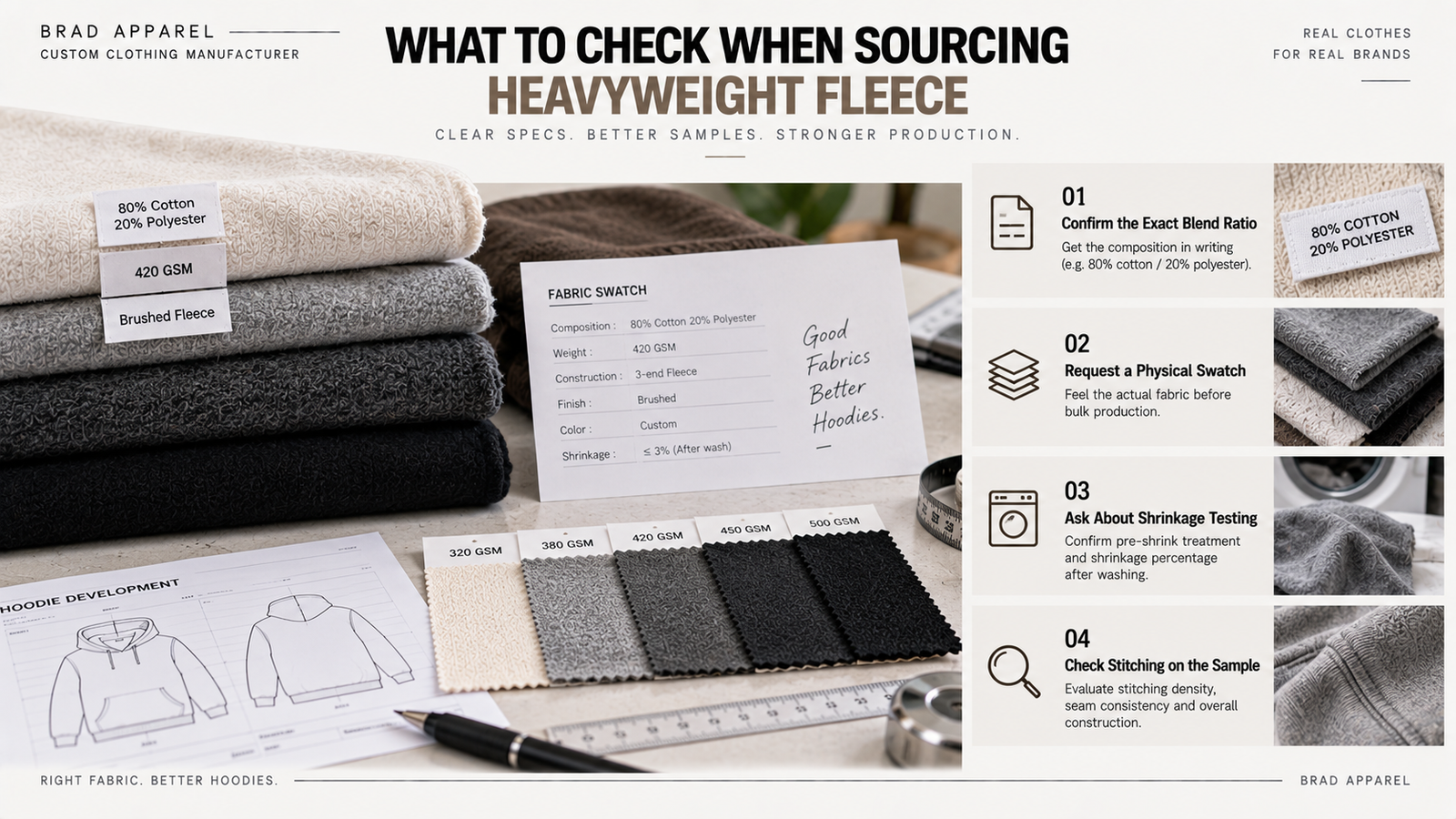
3. Ask About Shrinkage Testing
Heavyweight fleece should be evaluated after washing.
Ask your manufacturer about:
- Pre-shrink treatment
- Wash testing
- Shrinkage percentage
- Measurement tolerance
Do not assume that a heavy fabric will automatically remain dimensionally stable.
4. Check Stitching on the Sample
Premium fabric cannot compensate for poor garment construction.
Check:
- Stitch density
- Seam consistency
- Neckline construction
- Cuffs
- Waist rib
- Hood seams
- Pocket construction
Loose or inconsistent stitching can make even an expensive heavyweight fabric feel lower quality.
Why Heavyweight Fleece Works Well for Decoration
Structured fleece provides a relatively stable base for several decoration techniques.
Embroidery
Heavyweight fleece works particularly well with embroidery.
The dense fabric gives the stitches a stable foundation.
This makes it suitable for:
- Small chest logos
- Sleeve embroidery
- Back embroidery
- Flat embroidery
- 3D embroidery
The exact embroidery specification should still be tested on the actual fabric before bulk production.
Puff Print
Puff printing creates a raised dimensional effect.
Heavy fleece provides enough substance to support the raised print and helps reduce unwanted distortion around the graphic.
It works especially well for:
- Typography
- Logos
- Streetwear graphics
Screen Printing
Screen printing remains a reliable option for heavyweight hoodies.
It works well for:
- Large graphics
- Logos
- Bold typography
- Simple colour designs
The artwork, ink system and curing process should be matched to the actual fabric.
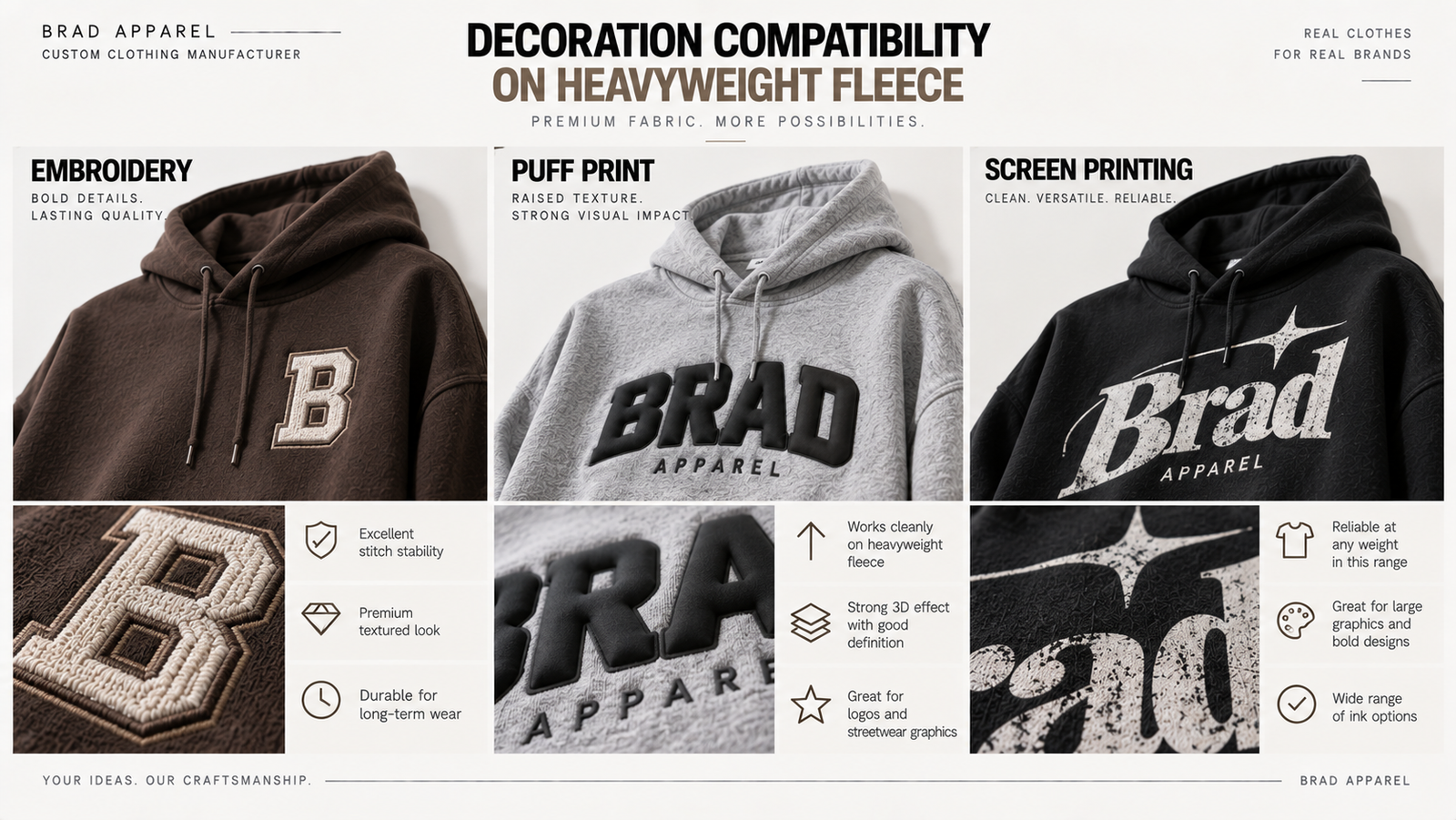
Decoration Compatibility Guide
| Decoration Method | Heavyweight Fleece Compatibility | Best For |
|---|---|---|
| Embroidery | Excellent | Premium logos and detailed branding |
| Puff Print | Excellent | Raised streetwear graphics |
| Screen Printing | Excellent | Bold graphics and larger designs |
Heavyweight structured fleece is therefore a flexible base for many premium streetwear designs.
Choosing the Right Heavyweight Fleece
Before approving your hoodie fabric, confirm these five points:
- Fiber composition
- GSM
- Interior finish
- Shrinkage performance
- Physical hand feel
For example, a specification could read:
80% cotton / 20% polyester
420 GSM
Brushed fleece interior
Pre-shrunk
That gives your manufacturer a much clearer target than simply requesting "premium heavyweight fleece."
How Brad Apparel Supports Heavyweight Hoodie Development
At Brad Apparel, we help brands develop custom heavyweight hoodies from fabric sourcing through sampling and bulk production.
Through our Fabric & Accessory Sourcing service, brands can compare:
- Different GSM options
- Cotton/polyester ratios
- Loopback fleece
- Brushed fleece
- Colours
- Ribbing
- Fabric finishes
Physical fabric swatches can be evaluated before committing to production.
Custom Hoodie Development
Our Custom Hoodie service supports development of:
- Heavyweight hoodies
- Oversized hoodies
- Streetwear hoodies
- Custom colours
- Custom GSM
- Custom ribbing
- Labels
- Packaging
- Printing
- Embroidery
The goal is to develop the fabric, fit and decoration as one complete product rather than treating them as separate decisions.
FAQ
What GSM Is Best for a Premium Heavyweight Hoodie?
Approximately 380–480 GSM is a useful range for structured premium hoodies.
It provides more weight and shape than lightweight fleece while remaining wearable.
Is 500 GSM Better Than 400 GSM?
Not automatically.
A 500+ GSM hoodie will usually feel heavier and warmer.
For many products, approximately 380–480 GSM provides a better balance between structure and comfort.
Why Do Some Hoodies Feel Floppy?
Fabric weight and composition both affect structure.
Lighter fleece generally drapes more, while polyester content can help improve shape retention.
A structured hoodie therefore depends on more than just appearance.
Is 100% Cotton Fleece Good for Premium Hoodies?
It can work well for a softer, more casual product.
However, cotton-poly blends generally provide better shape retention when structure is the priority.
What Is the Difference Between Loopback and Brushed Fleece?
Loopback fleece keeps the knitted loops visible on the inside.
Brushed fleece has those inner fibers brushed into a soft, fuzzy surface.
Choose loopback for a cleaner and more breathable feel.
Choose brushed fleece when warmth and softness are more important.
Which Decoration Works Best on Heavyweight Fleece?
Heavyweight fleece works particularly well with:
- Embroidery
- Puff print
- Screen printing
The final method should still be tested on the actual fabric during sampling.
What GSM Works for a Four-Season Hoodie?
Approximately 320–380 GSM can work well across more of the year.
For a heavier premium or winter-focused hoodie, 450 GSM and above provides noticeably more weight and warmth.
What MOQ Should I Expect for a Custom Heavyweight Hoodie?
MOQ depends on:
- Fabric composition
- GSM
- Colour
- Decoration
- Labels
- Packaging
- Quantity per colour
For an accurate MOQ and sample plan, send us your target specification.
Final Thoughts
A premium heavyweight hoodie starts with the fabric specification.
The most important decisions are:
- Cotton/polyester ratio
- GSM
- Loopback or brushed interior
- Shrinkage performance
- Fabric hand feel
For structured streetwear hoodies, approximately 380–480 GSM cotton-poly fleece is a strong starting point.
But heavier does not always mean better.
The best fabric is the one that gives your hoodie the right balance of:
- Structure
- Comfort
- Durability
- Warmth
- Decoration performance
Get the fabric right first, and the rest of the hoodie becomes much easier to develop.
Keep Reading