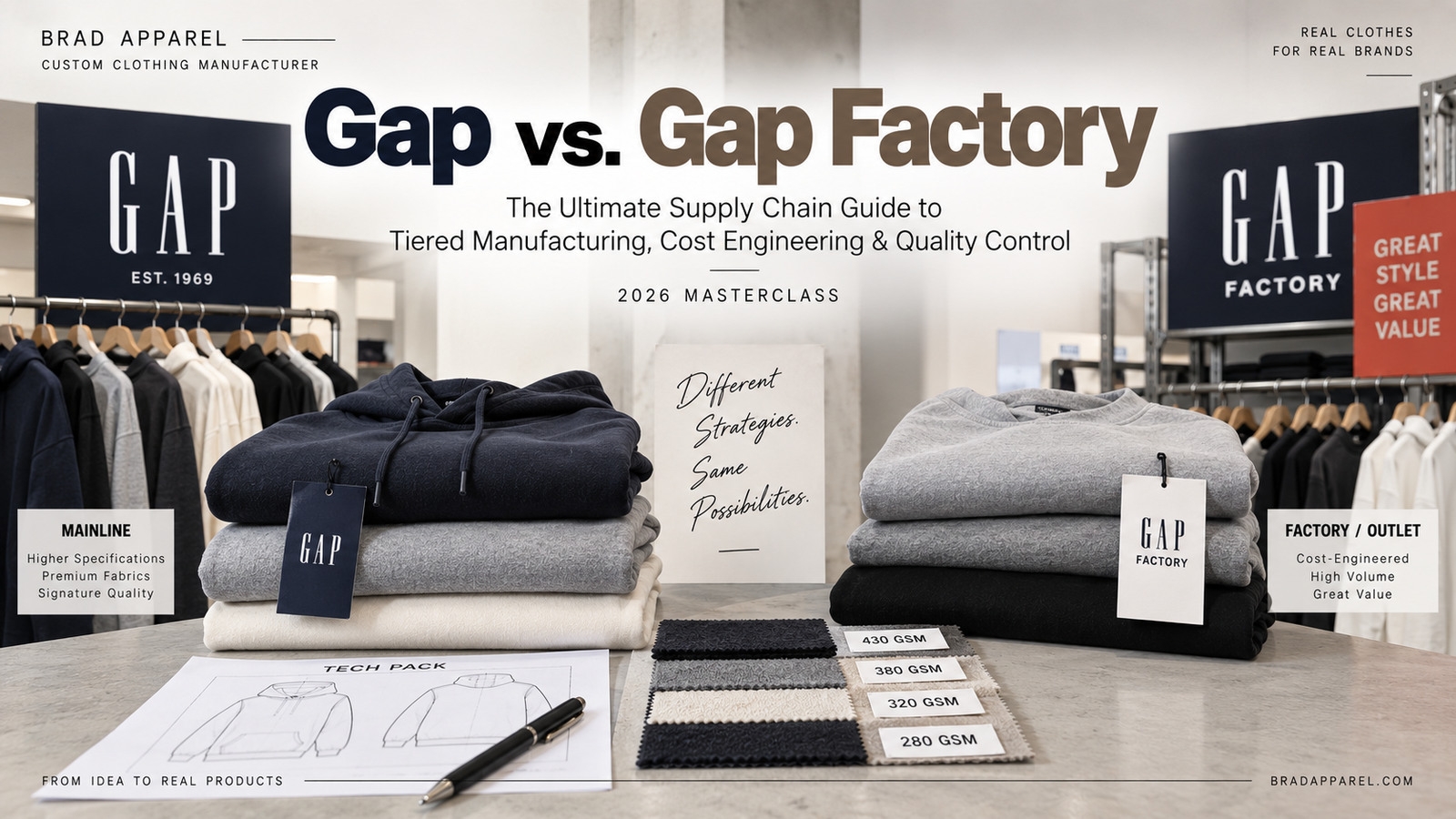
Why can two garments from the same retail group look similar but feel noticeably different in weight, construction and finish?
For clothing brands, the useful lesson is not simply whether one product came from a mainline store and another from an outlet.
The real lesson is tiered product engineering.
Large apparel businesses often build different product tiers around different targets:
- Retail price
- Fabric weight
- Construction complexity
- Trim quality
- Production efficiency
- Target customer
- Margin
For independent brands, the same strategy can be useful.
Instead of forcing every product into one quality and price level, you can build:
Tier 1 — Signature / Premium Line
Designed to establish the strongest version of your brand through:
- Premium fabric
- Heavier GSM
- Custom patterns
- More complex construction
- Higher-grade trims
- Specialized decoration
Tier 2 — Core / Promotional Line
Designed around:
- More accessible pricing
- Simpler construction
- Efficient fabric usage
- Scalable production
- Entry-level products
- Promotional drops
This guide explains how clothing brands can apply tiered manufacturing, cost engineering and quality control when developing their own collections.
The "Outlet Leftover" Assumption
A common assumption is that outlet products are simply unsold mainline products moved into a lower-priced store.
In reality, major retailers may also develop products specifically for different channels and price tiers.
For a clothing manufacturer, that distinction matters because different product tiers can begin with different:
- Tech packs
- Fabrics
- Patterns
- Trims
- Construction methods
- Target costs
The garment may look similar from a distance while being engineered differently from the beginning.
How Tiered Apparel Manufacturing Works
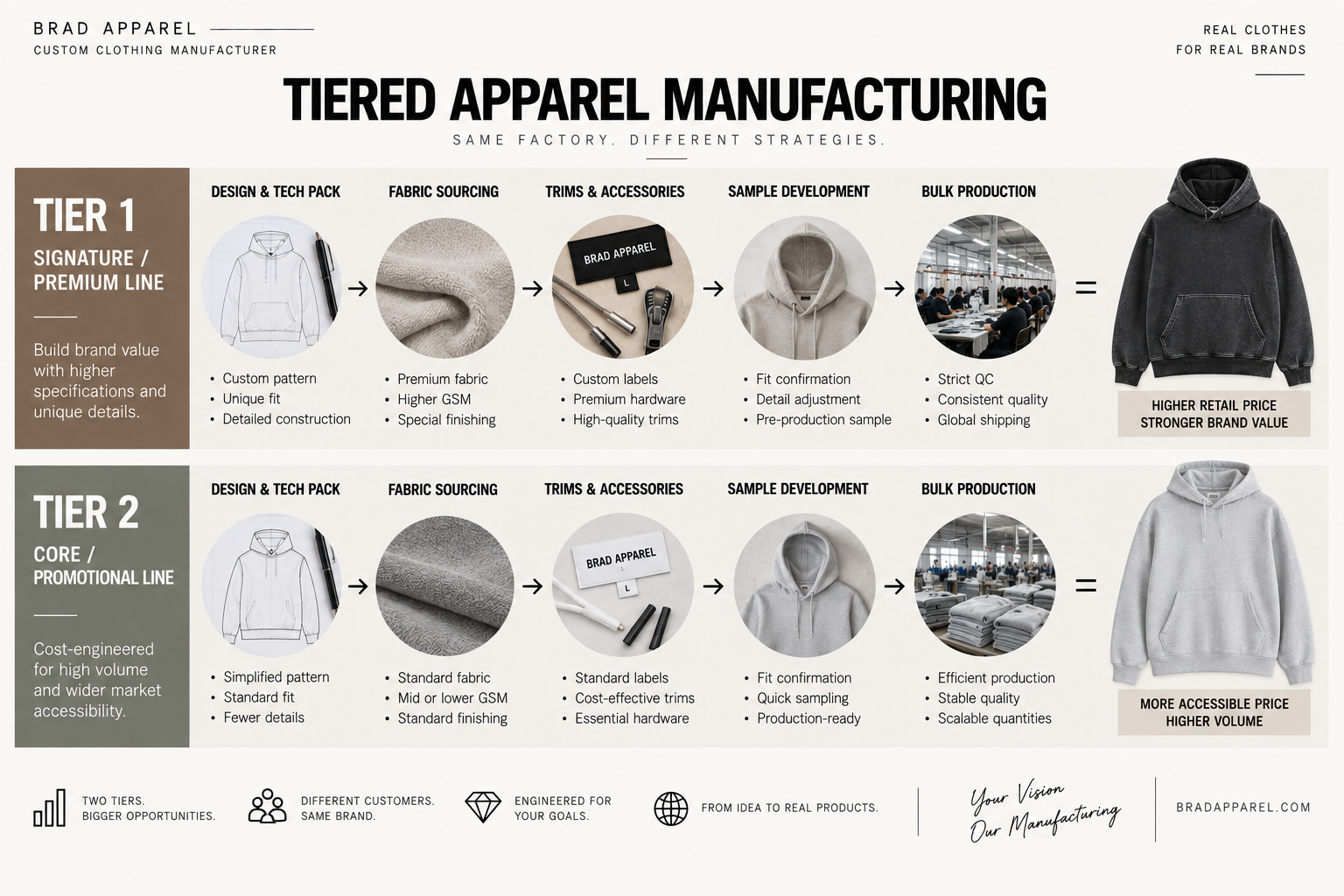
A simple tiered strategy might look like this:
Tier 1: Signature Product
Brand Strategy
↓
Custom Tech Pack
↓
Premium Fabric
↓
Complex Construction
↓
Premium Trims
↓
Specialized Printing / Embroidery
↓
Higher Retail Positioning
Tier 2: Core Product
Brand Strategy
↓
Simplified Tech Pack
↓
Mid-Weight Fabric
↓
Efficient Construction
↓
Standardized Trims
↓
Simpler Decoration
↓
More Accessible Retail Price
The goal is not necessarily to make the second product "bad."
The goal is to engineer each garment for a different commercial purpose.
Where the Cost Difference Actually Comes From
There are four major areas where garment specifications can change significantly between product tiers:
- Fabric
- Finishing
- Construction
- Trims and hardware
1. Fabric Architecture
Fabric is normally one of the biggest cost drivers in apparel production.
A premium streetwear garment may use:
- Combed cotton
- Long-staple cotton
- Higher-density yarn
- Heavier GSM
- Custom knitting
- Premium finishing
A cost-engineered product may instead use:
- Standard cotton
- Carded yarn
- Cotton/polyester blends
- Lower GSM
- Standard finishing
Example: Hoodie Fabric Tiers
A premium hoodie could be developed around:
360–420 GSM heavyweight fleece or French terry
while a more accessible core hoodie may use:
260–320 GSM fleece
Neither specification is automatically right or wrong.
They simply create different products.
2. Finishing and Washing
Two fabrics with similar composition and GSM can still feel very different after finishing.
Premium programs may include:
- Pre-shrinking
- Compacting
- Enzyme washing
- Silicone softening
- Anti-pilling finishing
- Pigment washing
Simpler programs may use:
- Standard dyeing
- Standard drying
- Basic softening
Every extra finishing step adds:
- Processing time
- Dye-house cost
- Testing
- Production risk
3. Seam and Garment Construction
Construction is another major difference between product tiers.
Premium garments may use:
- Higher stitch density
- Reinforced seams
- Shoulder taping
- Coverstitching
- Multi-panel hoods
- Heavy ribbing
- Custom pattern geometry
Simpler products may use:
- Standard stitching
- Fewer construction operations
- Standard commercial patterns
- Lighter ribbing
- Simplified hood construction
More sewing operations mean more machine time and more labor.
4. Trims and Hardware
Small components can have a surprisingly large impact on the final garment.
Examples include:
- Zippers
- Buttons
- Drawcords
- Metal aglets
- Woven labels
- Heat-transfer labels
- Eyelets
- Custom packaging
A premium hoodie might use:
- Custom metal zipper
- Engraved hardware
- Thick woven label
- Custom drawcord
- Metal aglets
A core version might use:
- Standard zipper
- Standard cord
- Printed neck label
- Simpler packaging
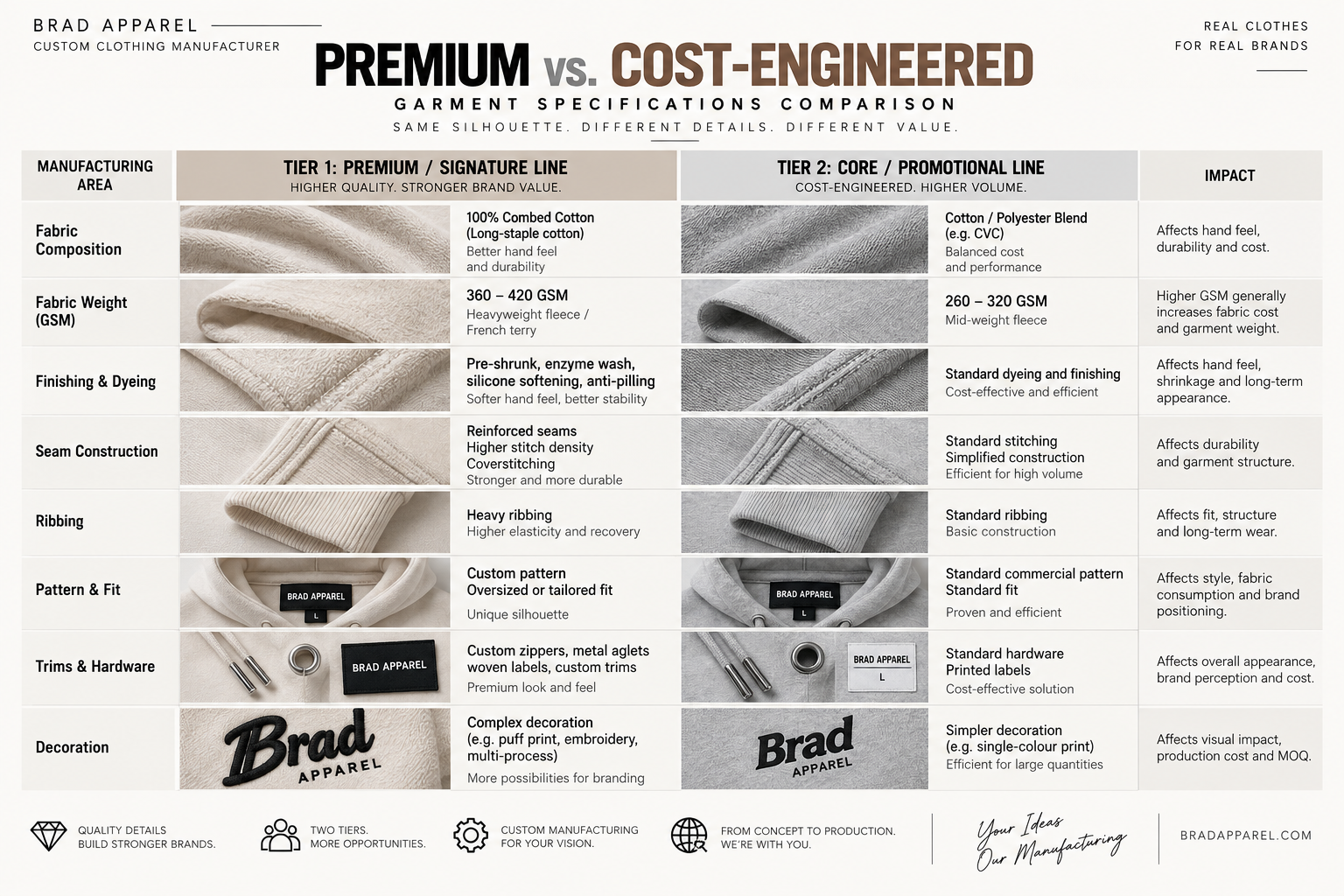
Premium vs Cost-Engineered Garment Specification
Here is an illustrative manufacturing comparison rather than a claim about any specific retailer's internal specifications:
| Manufacturing Area | Tier 1: Premium | Tier 2: Core |
|---|---|---|
| Fabric | Combed cotton / premium blend | Standard cotton / CVC blend |
| Hoodie GSM | 360–420 GSM | 260–320 GSM |
| T-Shirt GSM | 240–300 GSM | 160–200 GSM |
| Shrinkage Control | Pre-shrunk / compacted | Standard finishing |
| Construction | Reinforced / more operations | Simplified |
| Ribbing | Heavy rib | Standard rib |
| Pattern | Custom silhouette | Standard commercial fit |
| Trims | Customized hardware | Standard hardware |
| Decoration | Complex / multi-process | Simpler artwork |
The important point is that cost is engineered through dozens of small specification decisions.
Garment Cost Engineering
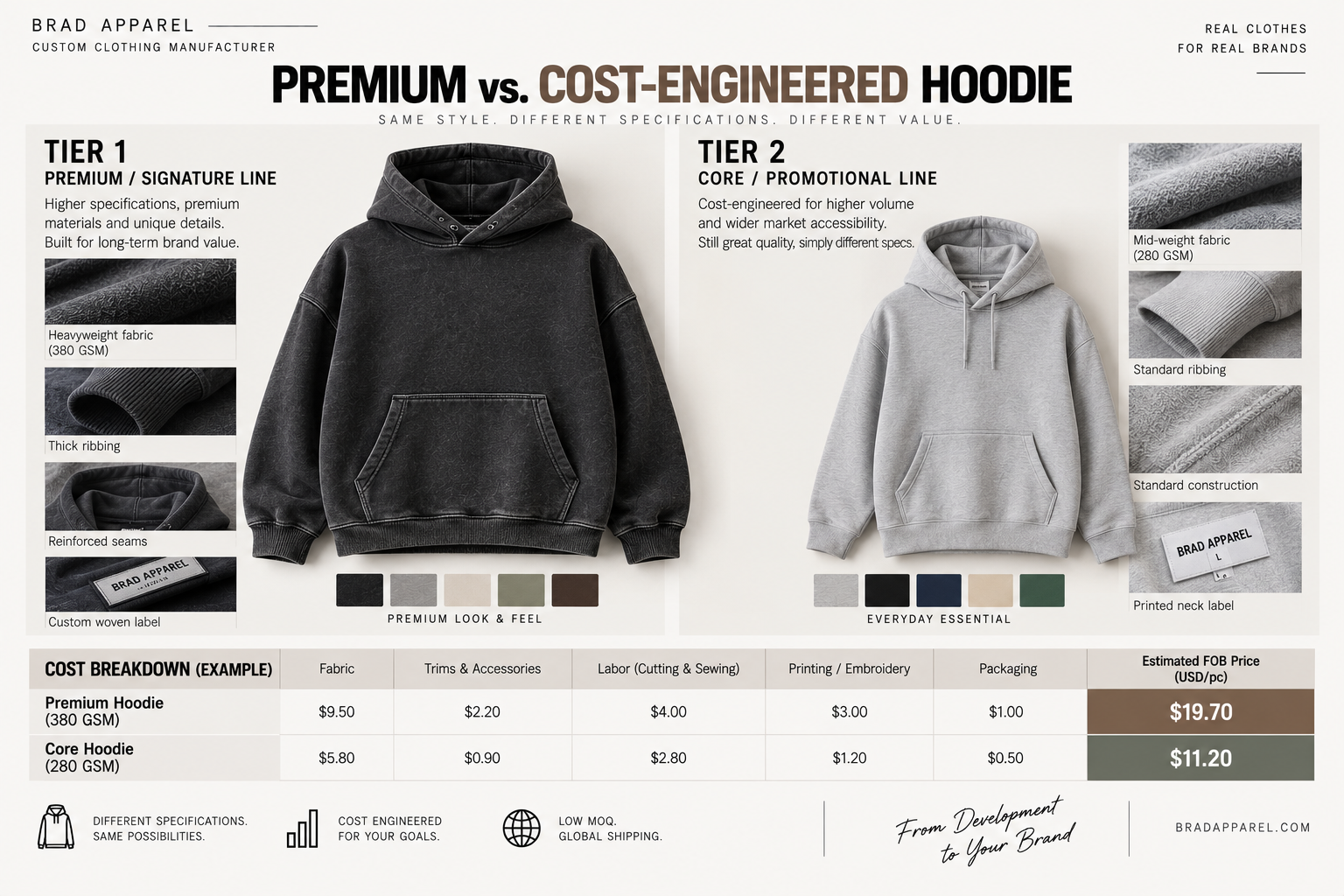
One of the most useful exercises for a brand is developing two versions of the same garment.
For example:
Product A
Premium heavyweight streetwear hoodie.
Product B
Accessible promotional hoodie.
The silhouette and branding language can remain related while the technical specifications change.
Example BOM: Premium vs Promotional Hoodie
The following is an illustrative sourcing model showing where costs may diverge.
Tier 1 — Premium Heavyweight Hoodie
Fabric
380 GSM heavyweight French terry
Higher fabric consumption and more expensive yarn.
Finishing
- Pre-shrink treatment
- Enzyme wash
- Softener
- Anti-pilling finishing
Construction
- Heavy rib
- Reinforced seams
- Multi-panel hood
- Additional stitching operations
Decoration
- Puff print
- Embroidery
- Multi-colour screen printing
Trims
- Custom neck label
- Metal aglets
- Custom packaging
Tier 2 — Promotional Hoodie
Fabric
280 GSM cotton/poly fleece
Lower fabric weight and more efficient material usage.
Finishing
Standard dyeing and finishing.
Construction
- Standard hood
- Standard rib
- Simplified seams
Decoration
Single-colour print.
Trims
- Heat-transfer label
- Standard packaging
Why Fabric Weight Changes Cost So Quickly
One of the easiest ways to understand apparel costing is through fabric consumption.
Imagine two hoodies using approximately the same pattern.
One uses:
280 GSM fleece
The other uses:
420 GSM fleece
The heavier version requires significantly more fiber by weight.
That affects:
- Fabric price
- Shipping weight
- Cutting
- Handling
- Finishing
- Final garment weight
This is why asking only:
"How much is a hoodie?"
is not enough.
The manufacturer needs the technical specification.
Pattern Efficiency Also Matters
Fabric cost is not determined only by GSM.
Marker efficiency matters too.
A simple pattern may fit efficiently across the fabric width.
A more complex pattern with:
- Oversized body
- Extra-wide sleeves
- Multi-panel hood
- Unusual panels
- Large pockets
can increase fabric waste.
This means two garments using the exact same fabric can still have different fabric consumption per piece.
Advanced Streetwear Finishing
Premium product tiers can also create differentiation through finishing and decoration.
Vintage and Pigment Washing
Popular options include:
Acid / Snow Wash
Creates high-contrast vintage variation.
Pigment Wash
Creates a worn-in surface colour.
Enzyme Wash
Can soften the cotton surface and reduce loose fibers.
These techniques should always be tested on the actual fabric because wash results depend heavily on:
- Fiber content
- Dye
- GSM
- Garment construction
Decoration Options for Premium Streetwear
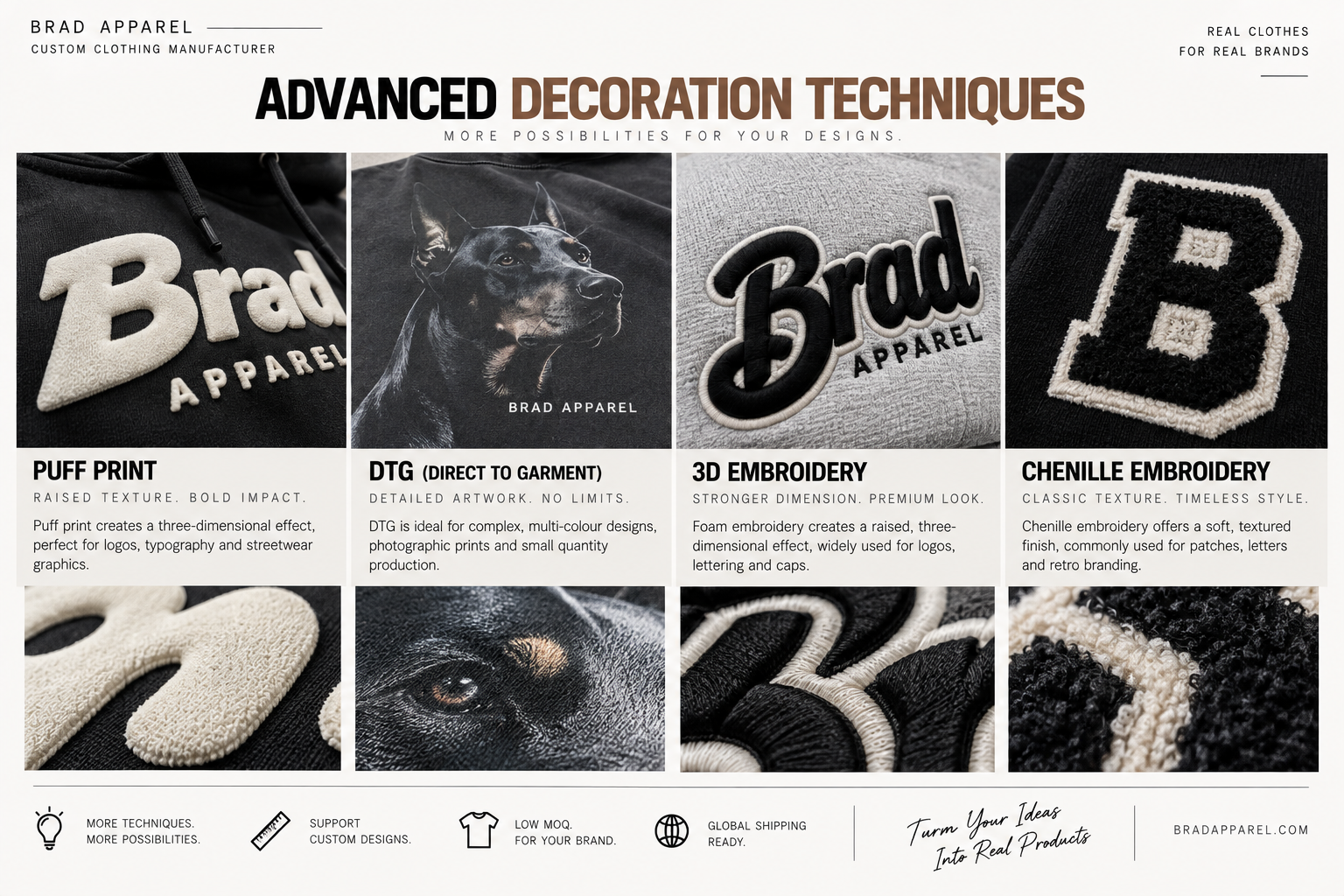
Puff Print
Creates a raised dimensional surface.
Suitable for:
- Typography
- Logos
- Streetwear graphics
DTG
Useful for:
- Detailed artwork
- Photographic designs
- Gradient artwork
- Smaller runs
Fabric composition and pretreatment need to be tested before production.
3D Embroidery
Foam can be placed beneath embroidery stitches to create raised lettering.
Works particularly well for:
- Logos
- Lettering
- Caps
- Heavyweight hoodies
Chenille Embroidery
Creates a soft, textured varsity-style surface.
Often used for:
- Patches
- Letters
- Center-chest graphics
- Retro branding
Quality Control Is Part of Product Engineering
A premium product is not premium simply because the fabric is expensive.
Quality must remain consistent across the production run.
Important checks include:
- Fabric inspection
- GSM
- Colour
- Measurements
- Stitching
- Print placement
- Embroidery
- Shrinkage
- Packing
A Four-Stage Garment QC Process
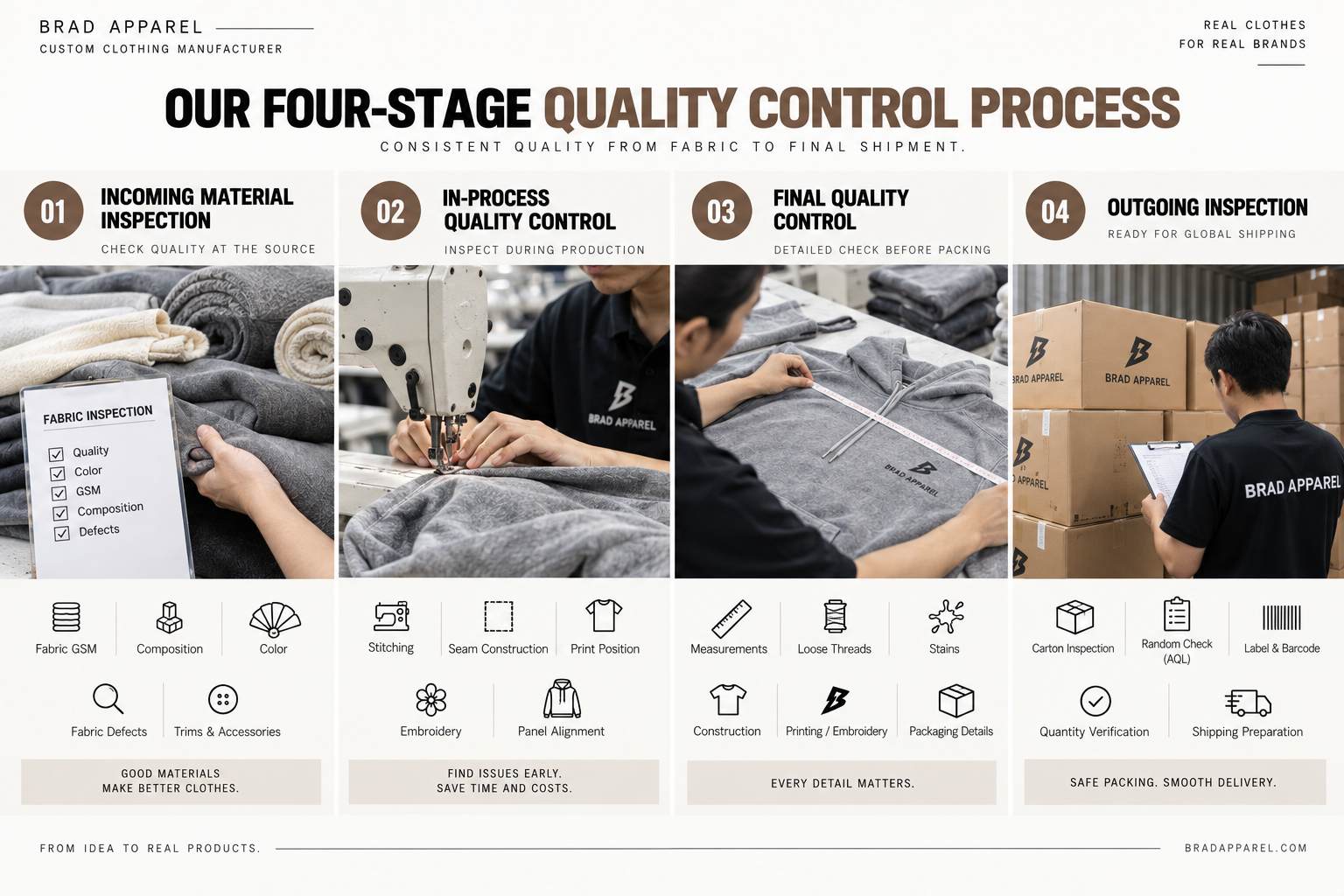
A structured QC workflow can include four stages.
Stage 1 — Incoming Material Inspection
Check:
- Fabric GSM
- Composition
- Colour
- Fabric defects
- Trims
- Accessories
Stage 2 — In-Process Quality Control
During sewing and decoration, inspect:
- Stitch alignment
- Seam construction
- Print position
- Embroidery position
- Panel alignment
Finding problems during production is much easier than discovering them after the entire order is finished.
Stage 3 — Final Quality Control
After sewing, garments can be checked for:
- Measurements
- Loose threads
- Stains
- Construction defects
- Printing defects
- Packaging details
Stage 4 — Outgoing Inspection
Before shipping, perform final random checks on finished cartons and garments.
Depending on the buyer, formal AQL inspection may also be requested.
Important Apparel Quality Tests
Shrinkage Test
Wash-testing helps verify how much the garment changes after laundering.
Check:
- Body length
- Chest width
- Sleeve
- Waist
- Inseam
before and after washing.
Colour Fastness
Colour testing helps identify potential:
- Bleeding
- Crocking
- Transfer
This is especially important for:
- Dark colours
- Pigment-dyed fabrics
- Washed garments
Seam Strength
Stress points should be checked carefully.
Examples include:
- Pocket corners
- Hood seams
- Drawcord eyelets
- Crotch seams
- Side seams
Certifications and Compliance
Certification requirements depend on:
- Buyer
- Product
- Destination market
- Retail channel
- Material claims
Common standards that apparel brands may encounter include:
- OEKO-TEX Standard 100
- Global Recycled Standard (GRS)
- ISO 9001
- WRAP
Not every order requires every certification.
Brands should confirm the exact documentation required by their customer or destination market before production.
How Independent Brands Can Build Tiered Collections
You do not need to be a global retailer to use this strategy.
A small streetwear brand could create:
Tier 1 — Signature Hoodie
420 GSM fleece
- Oversized custom pattern
- Heavy rib
- Puff printing
- Embroidery
- Custom metal trims
- Premium packaging
Retail positioning:
Hero product
Tier 2 — Core Hoodie
300 GSM fleece
- Standard relaxed fit
- Standard rib
- Screen printing
- Simpler trims
- Standard packaging
Retail positioning:
Accessible everyday product
Why This Strategy Works
The two products serve different purposes.
The premium garment can:
- Build brand identity
- Increase perceived value
- Create content
- Attract enthusiasts
The core garment can:
- Reach more customers
- Support higher volume
- Create entry-level purchases
- Improve product accessibility
The mistake is not having two tiers.
The mistake is pretending the two tiers are technically identical when they are not.
How Brad Apparel Supports Tiered Product Development
At Brad Apparel, brands can develop both premium and cost-engineered garments within one manufacturing workflow.
Our development process can include:
1. Product Review
Send:
- Design
- Reference
- Tech pack
- Target price
- Target quantity
2. Fabric Sourcing
Compare:
- Composition
- GSM
- Hand feel
- Colour
- Finish
Through our Fabric & Accessory Sourcing service.
3. Pattern Development
For custom silhouettes, our Pattern Development process can develop:
- Oversized fits
- Dropped shoulders
- Cropped fits
- Custom pants
- Specialty garment construction
4. Sampling
Develop the garment before bulk production.
5. Bulk Production
After sample approval, move into:
- Cutting
- Printing / embroidery
- Sewing
- QC
- Packing
6. Shipping
Arrange shipment according to:
- Quantity
- Destination
- Timeline
- Budget
Low-MOQ Tier Testing
One advantage of working with smaller production runs is the ability to test a product tier before scaling it.
For example:
First Drop
50–100 pieces of a premium heavyweight hoodie.
Measure:
- Sell-through
- Customer feedback
- Fit response
- Return rate
Then decide whether to scale.
This can reduce inventory risk compared with immediately placing a large production order.
FAQ
Are Factory Outlet Products Always Unsold Mainline Inventory?
No.
Some outlet products may come from clearance channels, but outlet divisions can also carry products developed specifically for that channel.
The important sourcing lesson is that products sold under related branding do not necessarily share identical specifications.
Does Higher GSM Always Mean Better Quality?
No.
Higher GSM creates more weight and usually more structure.
But quality also depends on:
- Fiber
- Yarn
- Finishing
- Construction
- Shrinkage
- Sewing
A well-developed 320 GSM garment can outperform a poorly constructed 450 GSM garment.
How Can I Lower Clothing Production Cost Without Making the Product Feel Cheap?
Consider adjusting:
- GSM
- Fiber blend
- Pattern complexity
- Construction operations
- Trims
- Decoration
- Packaging
The goal should be cost engineering, not simply removing quality.
Should My Brand Have Both Premium and Core Products?
It depends on your positioning.
A tiered structure can be useful when you want to serve different customers or price points while maintaining a consistent brand identity.
Can the Same Factory Produce Both Tiers?
Yes.
If the manufacturer can source the required fabrics and control the different technical specifications, both tiers can be produced within the same supply chain.
What MOQ Does Brad Apparel Support?
Brad Apparel supports low-MOQ custom development starting from approximately 50 pieces per design for many projects.
Exact MOQ depends on:
- Fabric
- Colour
- Pattern
- Decoration
- Trims
Final Thoughts
The most useful lesson from comparing mainline and value-oriented apparel is not that one garment is simply "better" than another.
It is that garments can be engineered for different purposes.
A premium product may prioritize:
- Heavy fabric
- Complex pattern
- Premium trims
- Advanced decoration
A core product may prioritize:
- Production efficiency
- Accessible pricing
- Simpler construction
- Scalable quantities
Both can belong in the same brand.
The key is to define the purpose of each product before you begin sourcing.
When the target customer, retail price and product specification are aligned from the beginning, apparel cost engineering becomes much more strategic.
Keep Reading