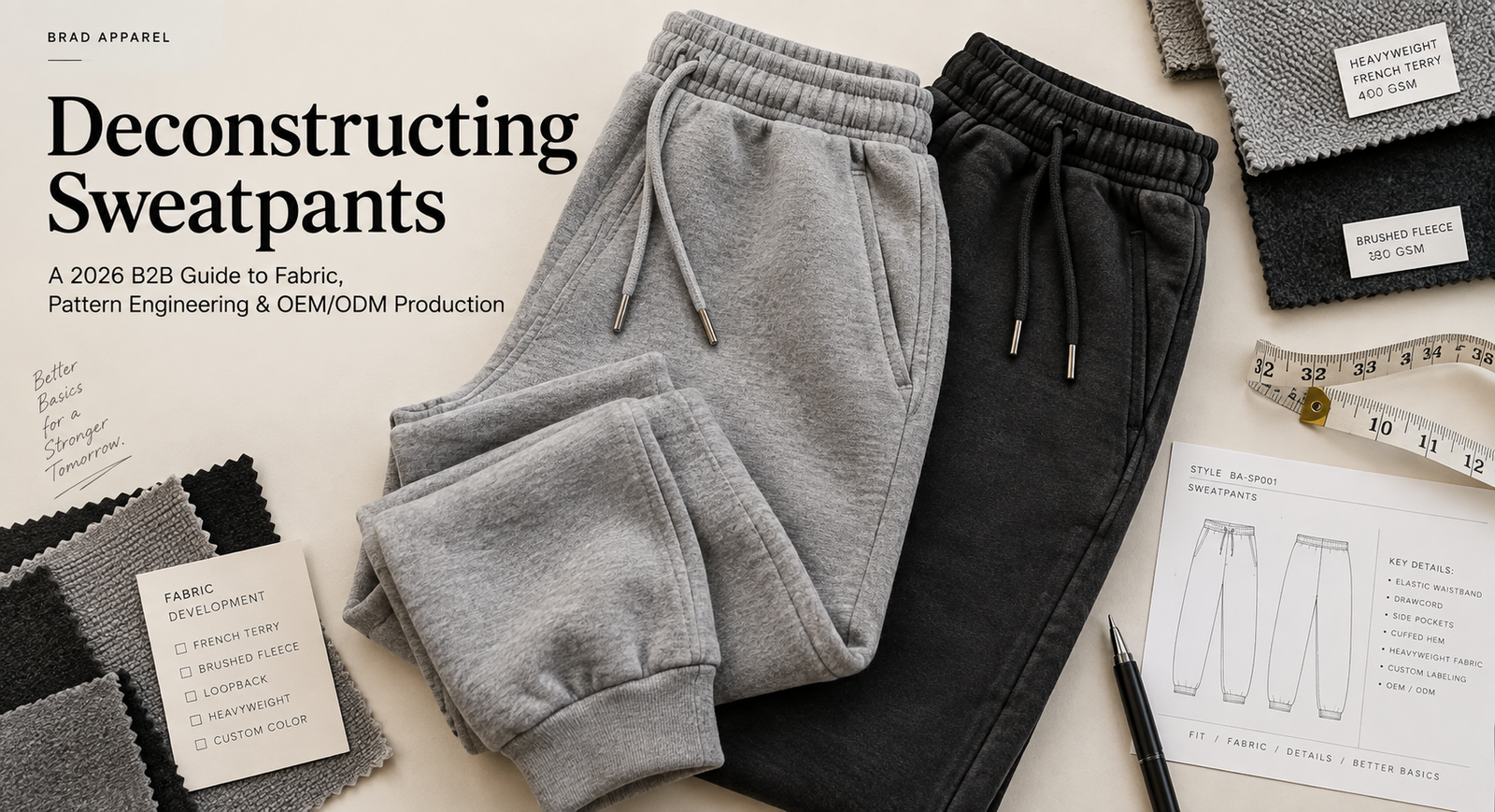
Premium sweatpants may look simple from the outside.
But from a manufacturing perspective, the final fit and feel depend on much more than fleece fabric, elastic and a drawstring.
Important development decisions include:
- Fabric composition
- GSM
- Interior finish
- Shrinkage control
- Waistband construction
- Pocket engineering
- Crotch mobility
- Knee shape retention
- Decoration
- Quality control
Well-known sportswear products such as Nike Tech Fleece and Club Fleece can be useful retail reference points when developing a custom product.
The goal is not to copy an existing garment.
The goal is to understand why certain fabrics, patterns and construction methods perform the way they do — and then build a product around your own brand requirements.
Sweatpants Fabric: What Actually Matters?
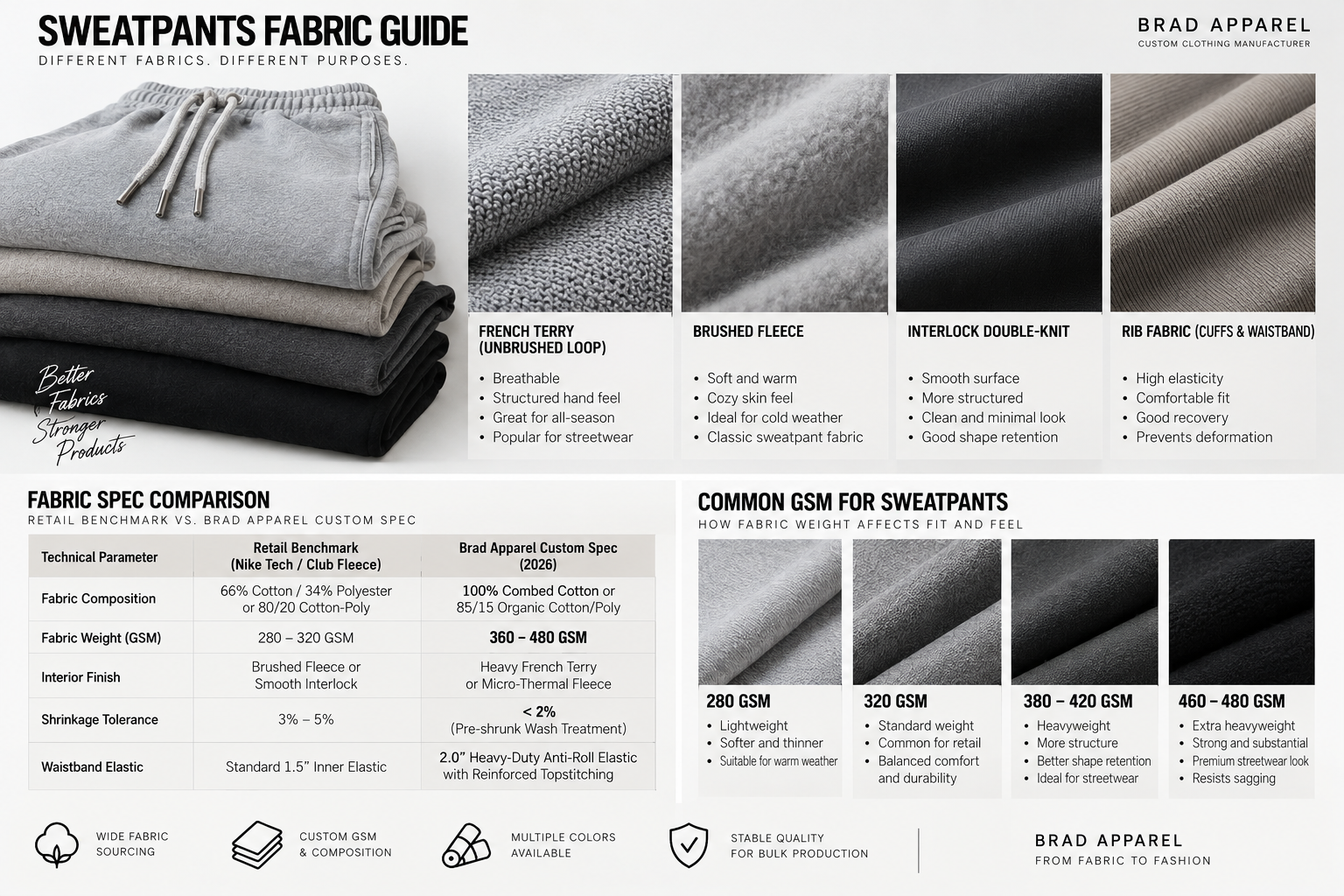
Factories typically evaluate sweatpant fabric using several key specifications:
Composition
GSM
Interior structure
Shrinkage
Surface finishing
These specifications influence:
- Hand feel
- Structure
- Warmth
- Breathability
- Durability
- Decoration performance
Retail Benchmark vs Custom Heavyweight Streetwear
The original sourcing brief uses mainstream fleece sweatpants as a retail benchmark and compares them with heavier custom B2B specifications.
| Technical Area | Retail Reference | Custom Heavyweight Option | Main Effect |
|---|---|---|---|
| Composition | Cotton/poly blends | 100% cotton or cotton-rich blends | Hand feel and stability |
| GSM | Approx. 280–320 GSM reference | 360–480 GSM | Structure and garment weight |
| Interior | Brushed fleece / smooth knit | French terry / heavyweight fleece | Warmth and breathability |
| Shrinkage Control | Commercial tolerance | Pre-shrunk development | Fit consistency |
| Waistband | Standard elastic | Heavy anti-roll elastic | Waist retention |
These ranges should be treated as product-development references rather than universal specifications for every retail garment.
Why Heavyweight Sweatpants Feel Different
For streetwear brands, moving from approximately 300 GSM into the 360–480 GSM range can dramatically change the garment.
Heavyweight fabrics can provide:
- More structure
- Stronger drape
- Fuller leg shape
- More substantial hand feel
- Better support for embroidery
- Better compatibility with oversized silhouettes
However, GSM alone does not determine quality.
A heavy fabric with poor recovery or weak construction can still develop:
- Knee bagging
- Waist distortion
- Pocket sagging
- Shrinkage problems
Fabric and pattern need to work together.
French Terry vs Brushed Fleece
Heavy French Terry
French terry keeps visible loops on the inside.
It can provide:
- Cleaner interior appearance
- Better breathability
- Structured hand feel
- Multi-season wear
This makes heavyweight French terry particularly useful for premium streetwear sweatpants.
Brushed Fleece
Brushed fleece has a softer raised interior.
It offers:
- More warmth
- Softer skin feel
- Cozy positioning
- Cold-weather performance
The choice depends on the target product rather than one fabric being universally better.
Pattern Engineering: Why Premium Sweatpants Need More Than a Basic Block
Fabric is only half of the product.
A premium sweatpant pattern must also control how the garment behaves during movement and repeated wear.
Three areas deserve particular attention:
- Knee shape
- Pocket structure
- Crotch mobility
1. Preventing Knee Sagging
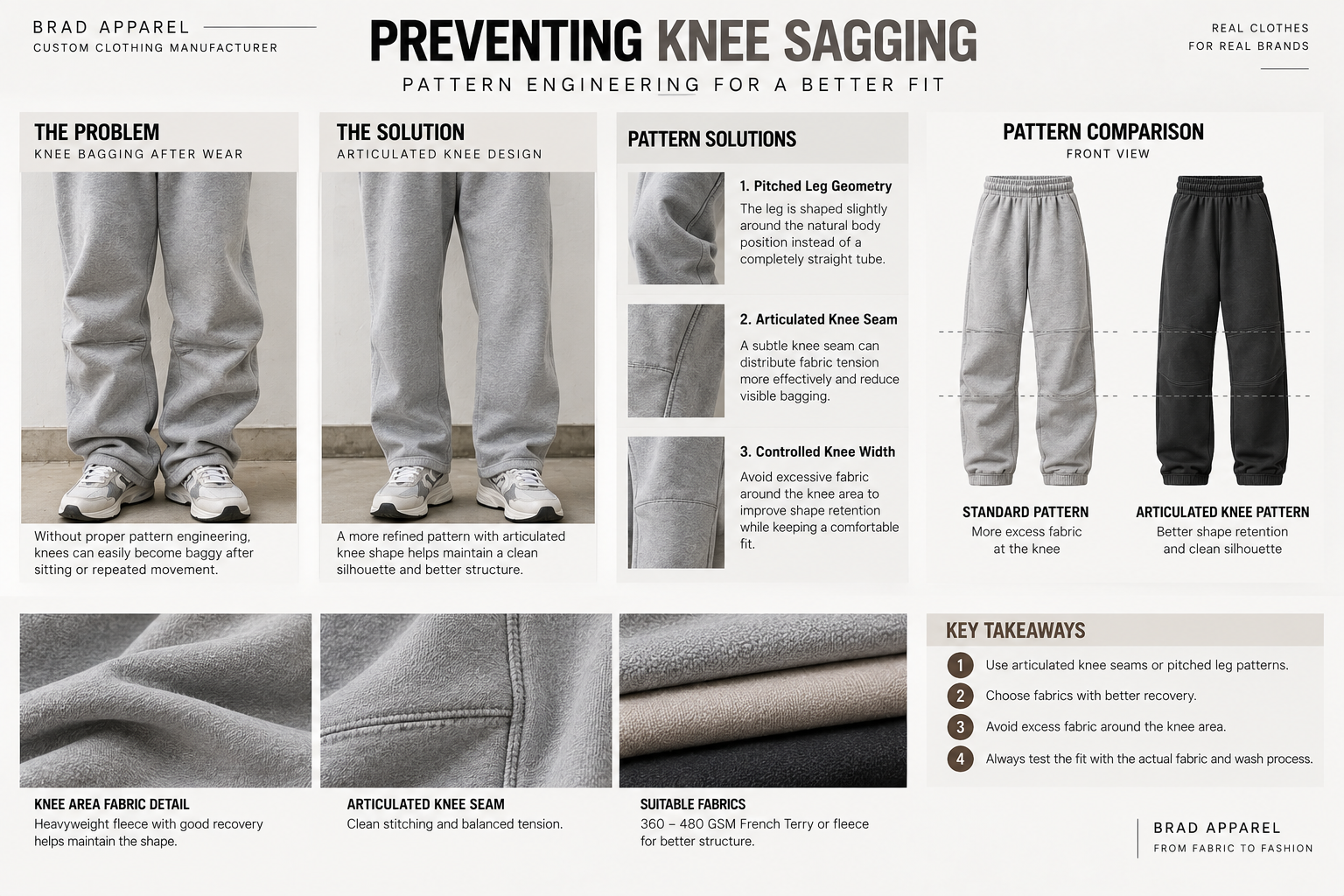
One common problem with sweatpants is knee bagging.
After sitting, walking or bending repeatedly, the knee area can stretch forward and fail to recover.
The result is a permanent bulge even when the wearer is standing.
Several factors affect this:
- Fabric recovery
- Polyester content
- Knitting density
- GSM
- Leg pattern
- Knee shaping
Pattern Solutions
A pattern maker may use:
Pitched Leg Geometry
The leg is shaped slightly around the natural body position rather than being completely straight.
Articulated Knee
A subtle knee seam or shaping panel can distribute fabric tension more effectively.
Controlled Knee Width
Too much excess fabric around the knee increases the chance of visible bagging.
The goal is not to make the sweatpant tight.
It is to control where the fabric volume sits.
2. Pocket Bag Anchoring
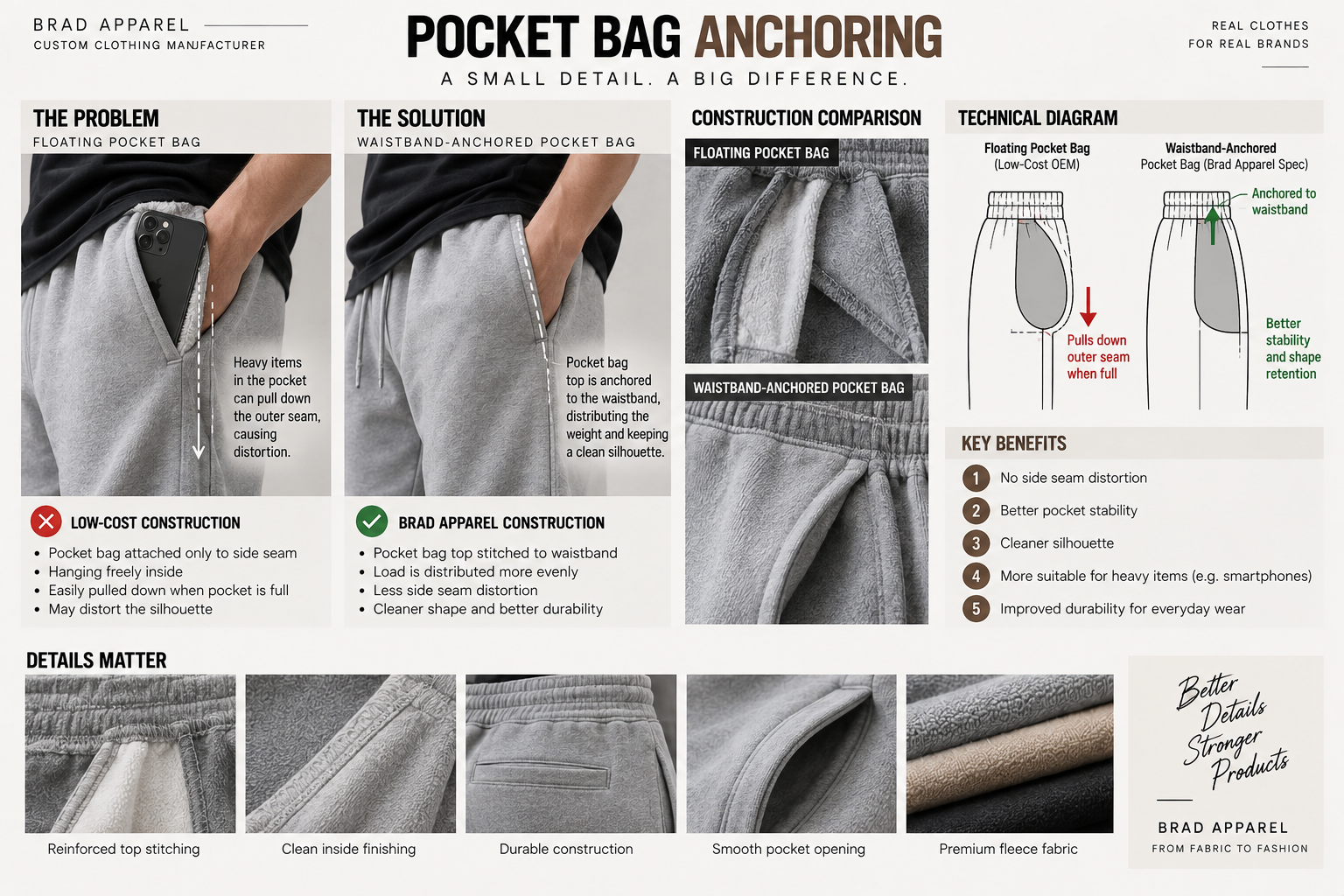
Large smartphones create a surprising amount of stress on sweatpant pockets.
A poorly constructed pocket may pull directly on the outer side seam.
This can distort the entire leg.
Floating Pocket Bag
In a simple construction, the pocket bag hangs freely from the side seam.
When the pocket becomes heavy:
Pocket weight → Side seam tension → Visible garment distortion
This is especially noticeable on soft fleece.
Waistband-Anchored Pocket Bag
A stronger solution is attaching part of the pocket bag directly into the waistband seam.
This distributes the load across a more stable area of the garment.
Benefits can include:
- Less side-seam distortion
- Better pocket stability
- Improved shape retention
- Cleaner silhouette when carrying a phone
Pocket architecture should therefore be part of the pattern-development process.
3. Crotch Gusset & Seam Reinforcement
Sweatpants used for:
- Training
- Gym wear
- Oversized streetwear
- Travel
- High-mobility casualwear
experience significant stress through the crotch and inner thigh.
A simple cross seam concentrates stress in one area.
Gusset Construction
A diamond or oval gusset panel can help distribute tension.
Possible benefits include:
- Greater mobility
- Less seam stress
- Reduced risk of thread popping
- Better comfort
Flatlock or reinforced multi-thread stitching can also improve durability.
Waistband Engineering
The waistband affects the sweatpant every time it is worn.
A premium waistband should provide:
- Stable tension
- Good recovery
- Comfortable stretch
- Resistance to twisting
Anti-Roll Elastic
Wider, heavier elastic can help prevent the internal waistband from:
- Folding
- Twisting
- Rolling
- Losing shape
Reinforced topstitching can further stabilize the elastic inside the waistband.
Example BOM: 420 GSM Heavyweight Sweatpants
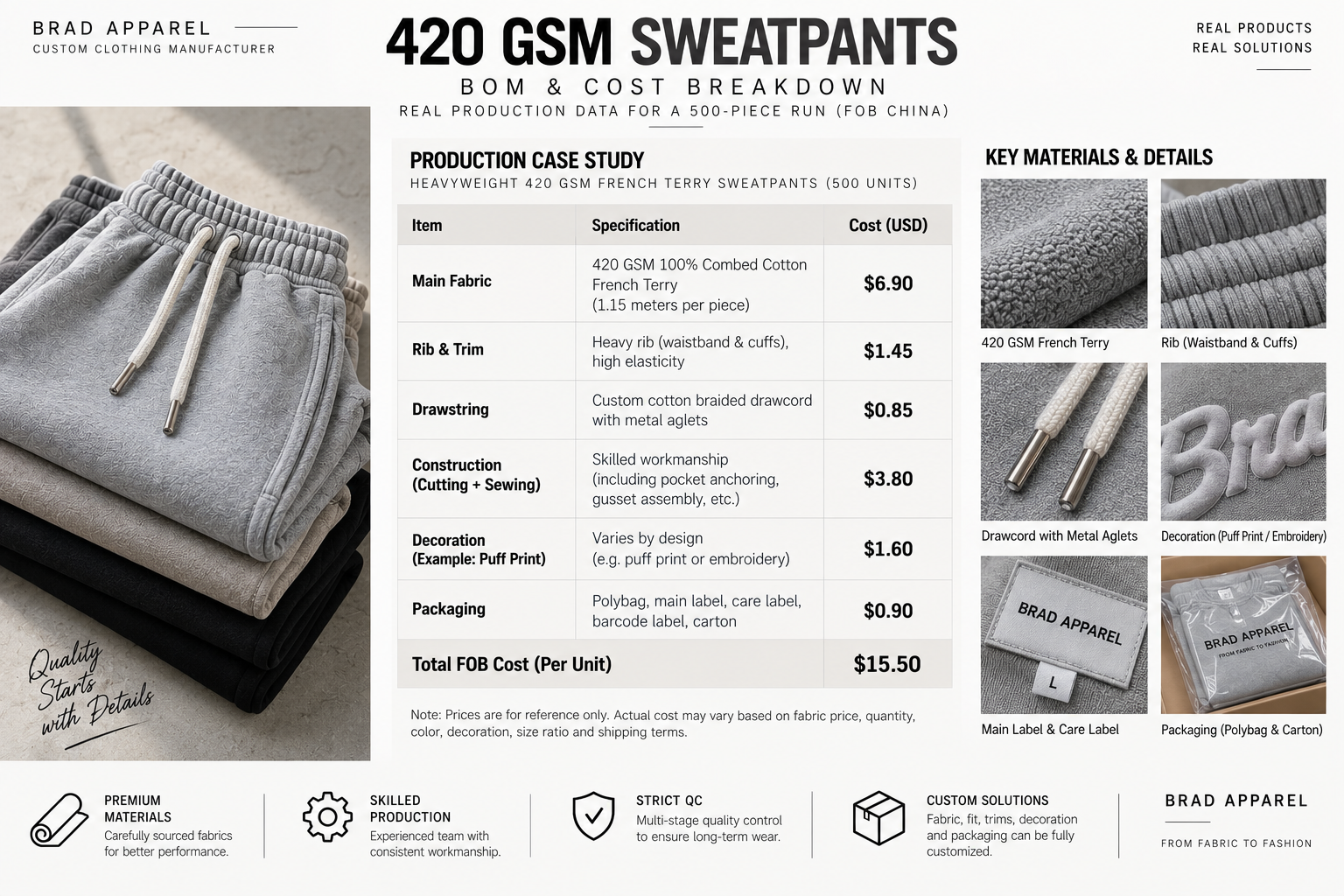
The following is the production scenario from the source brief for a 500-piece run of heavyweight sweatpants.
Main Fabric
420 GSM 100% combed cotton French terry
Approximate usage:
1.15 meters per piece
Waistband & Rib
Heavy rib cuffs and reinforced waistband construction.
Drawcord
Custom cotton braided drawcord with metal aglets.
Construction
Includes:
- Reinforced seams
- Anchored pockets
- Gusset assembly
Decoration
Puff print or custom embroidery.
Packaging
Includes:
- Main label
- Care label
- Polybag
- Barcode label
The example FOB calculation in the source brief totals approximately:
$15.50 per piece
Actual pricing will vary by fabric price, quantity, colour, decoration, size ratio and shipping terms.
Where Sweatpants Cost Actually Comes From
The fabric is usually one of the largest cost components.
But several smaller items can significantly change the final FOB price:
- Heavy elastic
- Metal aglets
- Custom drawcord
- Pocket reinforcement
- Gusset panels
- Extra seams
- Embroidery
- Puff printing
- Washing
- Labels
- Packaging
This is why two visually similar sweatpants can have very different production costs.
Fabric Options for Custom Sweatpants
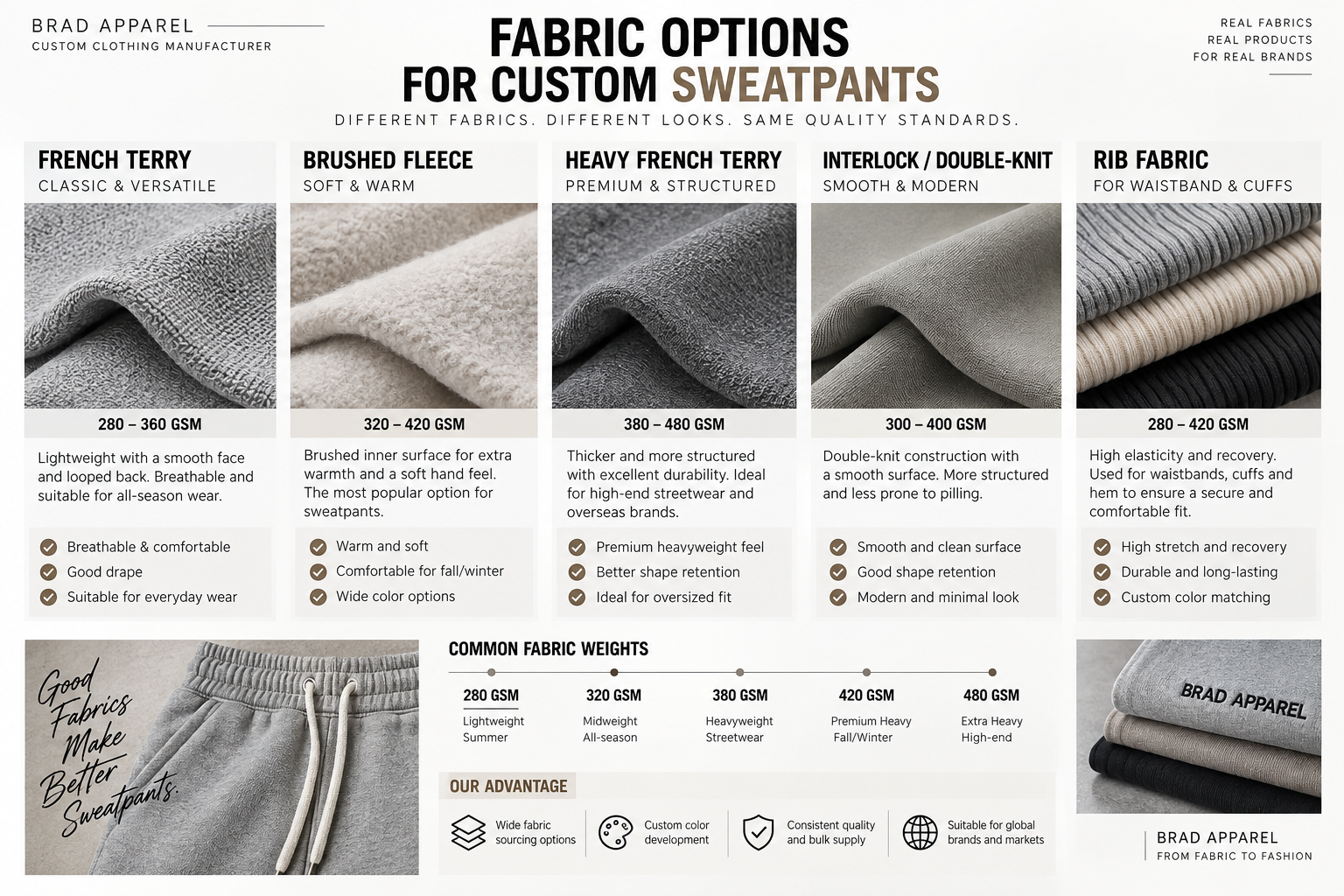
380–480 GSM Heavy French Terry
Best for:
- Premium streetwear
- Oversized sweatpants
- Vintage collections
- Structured silhouettes
Key characteristics:
- Loopback interior
- Strong structure
- Breathable construction
- Good wash compatibility
Cotton / Polyester Fleece
Common blends include:
80/20
or:
85/15
Polyester can improve:
- Shape retention
- Durability
- Shrinkage control
- Recovery
The brushed interior provides more warmth.
Wash & Finishing Options
Sweatpants can change dramatically after finishing.
Pigment Wash
Creates a surface-dyed vintage effect.
Acid Wash
Produces higher contrast and more irregular fading.
Enzyme Wash
Can soften the cotton surface and reduce loose fibers.
Pre-Shrink Treatment
Helps improve dimensional stability before cutting and bulk production.
Wash treatments should always be tested on the actual fabric and garment sample.
Decoration Options
Heavyweight sweatpants provide a stable base for several decoration methods.
Embroidery
Works well for:
- Small thigh logos
- Back pocket branding
- Side-leg graphics
Puff Print
Works well for:
- Raised typography
- Streetwear logos
- Bold graphics
Screen Printing
Suitable for:
- Large leg prints
- Logos
- Higher-volume production
Silicone Printing
Useful when a cleaner technical finish is needed.
The placement should be confirmed carefully around:
- Pockets
- Seams
- Knee shaping
- Crotch panels
Four-Stage Sweatpants Quality Control
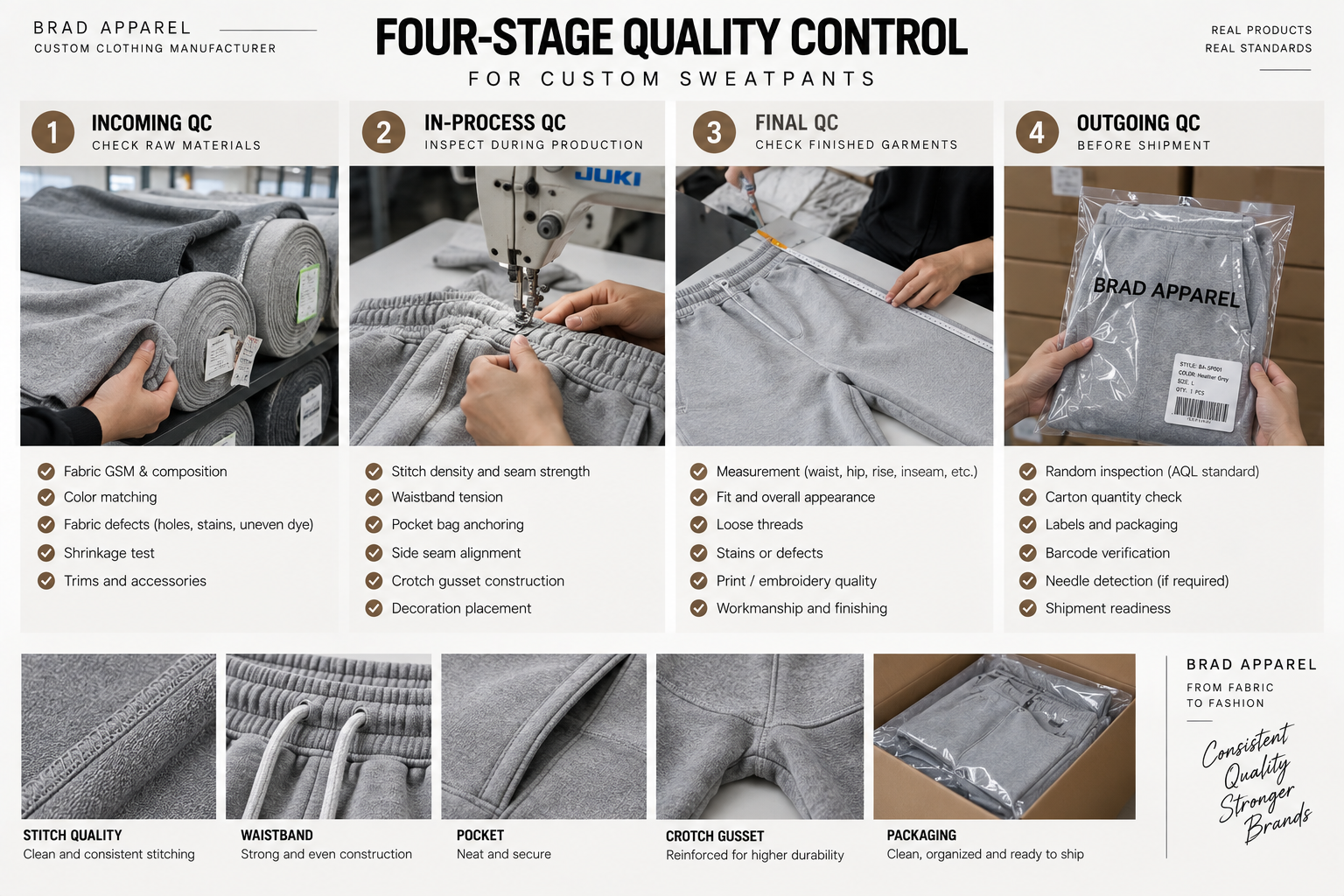
Quality control should begin before sewing starts.
Stage 1 — Incoming Quality Control
Check:
- Fabric GSM
- Colour
- Fabric defects
- Composition
- Shrinkage
- Trims
Stage 2 — In-Process Quality Control
During sewing, inspect:
- Waistband tension
- Stitch density
- Pocket anchoring
- Side seam alignment
- Gusset construction
- Decoration placement
Finding defects early prevents entire production batches from being affected.
Stage 3 — Final Quality Control
Finished sweatpants should be measured against the approved specification.
Key measurements include:
- Waist
- Hip
- Front rise
- Back rise
- Inseam
- Outseam
- Thigh
- Knee
- Leg opening
Also inspect:
- Loose threads
- Stains
- Print defects
- Embroidery defects
Stage 4 — Outgoing Quality Control
Before shipment, check:
- Random finished garments
- Carton quantity
- Labels
- Packaging
- Barcode
- Needle detection where required
Formal AQL inspection can also be arranged according to buyer requirements.
Shrinkage Control for Heavyweight Sweatpants
Heavy cotton fabric can shrink noticeably if not properly developed.
A practical process should include:
- Fabric shrinkage testing
- Sample washing
- Measurement comparison
- Pattern allowance adjustment
- Bulk wash verification
The source brief targets very tight shrinkage control for its custom specification.
In real production, the acceptable tolerance should be confirmed for the exact fabric, wash process and buyer requirement.
How Brad Apparel Develops Custom Sweatpants
At Brad Apparel, our Custom Bottom Production service supports sweatpant development from fabric sourcing to bulk manufacturing.
Brands can customize:
- GSM
- Composition
- Fit
- Rise
- Leg shape
- Cuffs
- Open hem
- Waistband
- Drawcord
- Pocket construction
- Gusset
- Printing
- Embroidery
- Labels
- Packaging
Fabric Sourcing
Through our Fabric & Accessory Sourcing, brands can compare:
- French terry
- Brushed fleece
- Cotton/poly blends
- Heavyweight cotton
- Custom rib
- Elastic
- Drawcord
- Hardware
Physical swatches should be evaluated before bulk production.
Pattern Development
Through Pattern Development, sweatpants can be developed around:
- Straight leg
- Relaxed leg
- Wide leg
- Tapered leg
- Open hem
- Cuffed hem
- High rise
- Standard rise
- Oversized streetwear fit
The pattern should be tested with the actual fabric because fabric weight and recovery can significantly change the final silhouette.
FAQ
What GSM Is Best for Heavyweight Streetwear Sweatpants?
Approximately 360–480 GSM can work well for heavyweight streetwear.
The best weight depends on:
- Climate
- Fit
- Fabric composition
- Desired structure
Is French Terry or Fleece Better for Sweatpants?
Choose French terry when you want:
- Cleaner loopback interior
- Better breathability
- Structured hand feel
Choose brushed fleece when you want:
- More warmth
- Softer interior
- Cold-weather comfort
Why Do Sweatpants Sag at the Knees?
Possible causes include:
- Low fabric recovery
- Excess knee volume
- Poor pattern balance
- Repeated tension
- Weak knit structure
Pattern shaping and fabric selection should be evaluated together.
Why Should the Pocket Bag Be Anchored?
Anchoring the pocket bag toward the waistband helps distribute the weight of items such as smartphones.
This can reduce visible pulling on the side seam.
Does a Sweatpant Need a Crotch Gusset?
Not every design requires one.
A gusset is most useful when:
- Mobility is important
- The garment is used for training
- The fit is oversized
- Additional seam reinforcement is needed
What MOQ Does Brad Apparel Support?
Brad Apparel supports low-MOQ custom production starting at approximately 50 pieces per design/colorway for many projects.
The exact MOQ depends on:
- Fabric
- Colour
- Decoration
- Wash
- Trims
Final Thoughts
Premium sweatpants are not simply fleece pants with an elastic waistband.
The final product depends on how several systems work together:
Fabric
Pattern
Pocket architecture
Waistband
Crotch construction
Shrinkage control
Decoration
Quality control
Retail products can provide useful references, but your own product should be developed around your brand's target customer, price point and intended use.
The best sweatpant is not the one that copies another brand most closely.
It is the one where fabric, fit and construction have been engineered to work together.
Keep Reading