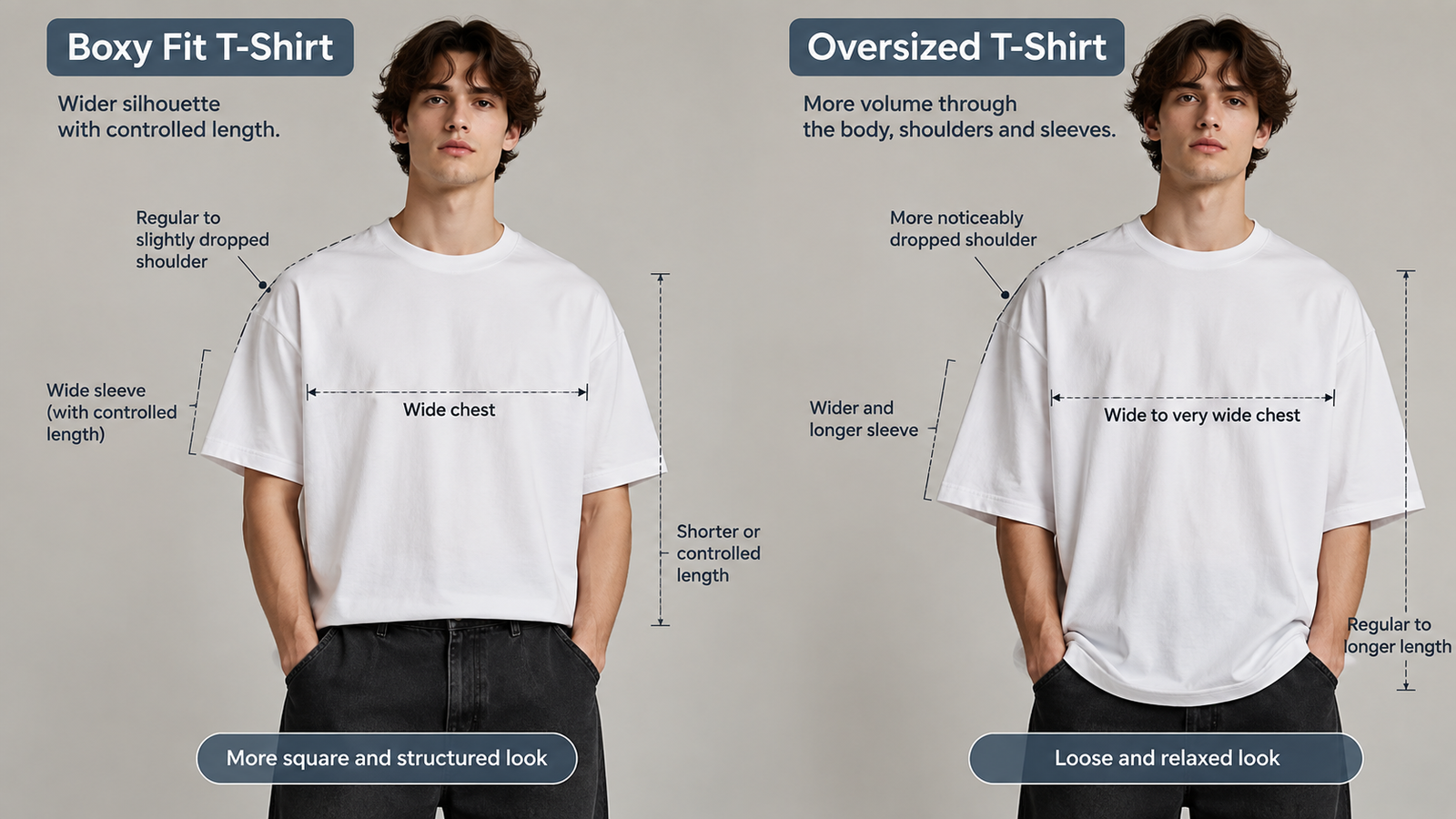
A boxy T-shirt usually looks wider and more square.
An oversized T-shirt usually looks larger overall.
This difference may sound small, but for clothing brands it affects the entire pattern—including chest width, body length, shoulder position, sleeve shape and size grading.
In this guide, we explain boxy fit vs oversized T-shirts from a garment-development perspective and show how boxy, oversized, relaxed and drop-shoulder fits differ.

Boxy Fit vs Oversized T-Shirt: Quick Comparison
| Feature | Boxy Fit | Oversized Fit |
|---|---|---|
| Body Width | Wide | Wide to very wide |
| Body Length | Shorter or controlled | Usually regular to longer |
| Shoulder | Regular to moderately dropped | Usually more noticeably dropped |
| Sleeve Width | Wide | Wide to very wide |
| Sleeve Length | Controlled | Often longer |
| Overall Shape | Square and structured | Loose and relaxed |
| Main Visual Effect | Width | Overall volume |
| Common Style | Premium basics, streetwear | Streetwear, casualwear |
The main difference is not simply garment size.
It is proportion.
What Is a Boxy Fit T-Shirt?
A boxy T-shirt has a relatively wide body compared with its length.
Instead of following the body closely or tapering toward the waist, the side seams normally fall more vertically.
Typical characteristics include:
- Wider chest
- Straighter body
- Controlled garment length
- Wider sleeves
- Minimal waist taper
- Regular or dropped shoulders
The result is a more square silhouette.
A boxy fit does not necessarily mean cropped.
The body can still have a normal wearable length, but the width-to-length ratio makes the T-shirt appear broader.
What Is an Oversized T-Shirt?
An oversized T-shirt adds volume across more areas of the garment.
That may include:
- Wider chest
- Wider shoulders
- Lower armholes
- Wider sleeves
- Longer sleeves
- More body length
- Greater overall ease
The goal is normally a loose, relaxed silhouette.
However, a properly developed oversized T-shirt is not simply a regular T-shirt produced two or three sizes larger.
A true oversized pattern controls each measurement individually.
That is what allows the garment to look intentionally oversized rather than simply too big.
Boxy vs Oversized: The Most Important Difference Is Proportion
Consider two T-shirts with the same chest width.
| Measurement | T-Shirt A | T-Shirt B |
|---|---|---|
| Chest Width | 64 cm | 64 cm |
| Body Length | 68 cm | 75 cm |
Both garments have exactly the same chest measurement.
But they will not look the same.
T-Shirt A will usually appear more boxy because the width is stronger in relation to the length.
T-Shirt B will look longer and more traditionally oversized.
This is why chest width alone cannot define a fit.
For boxy T-shirts, one of the most important relationships is:
Body Width ÷ Body Length
The actual measurements vary by size, customer and brand aesthetic, but the principle remains the same.
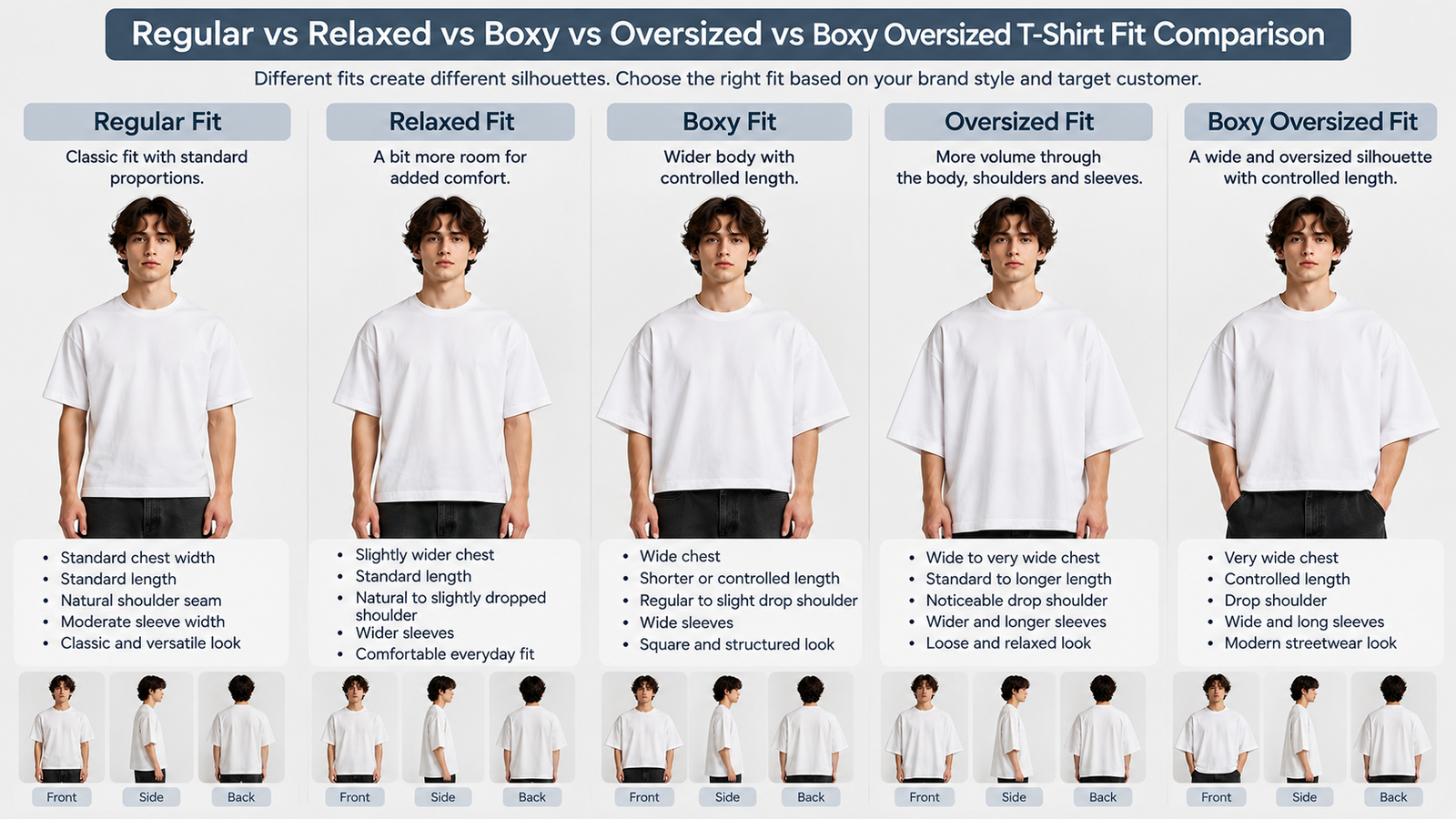
Boxy Fit vs Relaxed Fit vs Oversized Fit
These terms are often mixed together.
But they normally represent different levels of volume.
Regular Fit
A regular T-shirt generally follows standard body proportions.
Typical characteristics:
- Standard chest width
- Shoulder seam near the natural shoulder
- Moderate sleeve width
- Standard body length
It provides comfortable room without intentionally creating an oversized silhouette.
Relaxed Fit
A relaxed fit adds some extra ease.
Typical characteristics:
- Slightly wider chest
- Slightly wider sleeves
- More room through the body
- Usually close to a normal garment length
It feels looser than a regular fit but is usually not dramatically oversized.
Oversized Fit
Oversized garments intentionally increase visual volume.
Typical characteristics:
- Wide chest
- Extended shoulders
- Larger armholes
- Wider sleeves
- More wearing ease
Boxy Fit
Boxy fit focuses primarily on proportion.
Typical characteristics:
- Wide chest
- Straight body
- Controlled length
- Wide sleeve shape
A boxy T-shirt can therefore be moderately loose or extremely oversized.
Can a T-Shirt Be Both Boxy and Oversized?
Yes.
This is why the term boxy oversized T-shirt is commonly used.
A boxy oversized pattern may combine:
- Very wide chest
- Drop shoulders
- Wide sleeves
- Increased overall volume
- Controlled body length
This creates the volume associated with oversized streetwear without making the garment excessively long.
For example:
Wide chest + strong drop shoulder + wide sleeve + controlled length
creates a completely different silhouette from:
Wide chest + long body + long sleeve
even though both garments could technically be described as oversized.
Drop Shoulder Is Not the Same as Oversized
This is another common misunderstanding.
Drop shoulder describes shoulder construction.
Oversized describes overall garment volume.
Boxy describes garment proportion.
They are three different concepts.
A drop-shoulder T-shirt moves the shoulder seam beyond the natural shoulder point and onto the upper arm.
That can make the garment appear wider, but it does not automatically make the entire T-shirt oversized.
You can have:
- Regular body + slight drop shoulder
- Boxy body + regular shoulder
- Boxy body + drop shoulder
- Oversized body + strong drop shoulder
The exact combination depends on the desired silhouette.

Why Shoulder Width Changes the Entire T-Shirt
Shoulder width has a major visual effect on streetwear T-shirts.
Imagine increasing the shoulder measurement while keeping the chest almost unchanged.
The upper body immediately appears wider.
But this change also affects the sleeve.
When the shoulder seam moves outward:
- Sleeve starting position changes
- Sleeve length may need adjustment
- Armhole shape changes
- Sleeve angle can change
- Overall upper-body volume increases
This is why pattern development should not treat shoulder, sleeve and body measurements separately.
They need to work together.
Slight Drop Shoulder vs Strong Drop Shoulder
There is no single standard drop-shoulder measurement.
Different brands use very different proportions.
Slight Drop Shoulder
Creates a cleaner, more subtle silhouette.
Often suitable for:
- Premium basics
- Minimal streetwear
- Relaxed fits
- Moderate boxy fits
Strong Drop Shoulder
Creates more visual width.
Often suitable for:
- Oversized streetwear
- Graphic T-shirts
- Heavy boxy silhouettes
- Statement fits
The stronger the shoulder drop becomes, the more important sleeve proportion becomes.
Why Sleeve Shape Matters So Much
The sleeve is one of the most overlooked parts of an oversized T-shirt.
A wide body paired with a narrow sleeve can look unbalanced.
Likewise, a very wide and long sleeve can overwhelm a shorter boxy body.
Important sleeve measurements include:
- Sleeve length
- Sleeve width
- Sleeve opening
- Armhole depth
For a cleaner boxy fit, you might use:
Wide body + moderate drop shoulder + wide sleeve + controlled sleeve length
For a more exaggerated oversized fit:
Very wide body + strong drop shoulder + deeper armhole + wider and longer sleeve
Small changes can produce noticeably different silhouettes.
Why You Should Not Create an Oversized T-Shirt by Simply Sizing Up
Imagine taking a regular Medium T-shirt and using the measurements of an XL or XXL.
The garment becomes larger.
But every dimension increases according to standard grading.
That can result in:
- Excessive body length
- Excessive sleeve length
- Oversized neckline
- Incorrect shoulder position
- Unbalanced proportions
A dedicated oversized pattern works differently.
Instead of increasing everything equally, the pattern maker can selectively increase:
- Chest width
- Shoulder width
- Sleeve width
while controlling:
- Body length
- Neck opening
- Sleeve length
- Hem position
This creates an intentional silhouette.
What Measurements Define a Boxy T-Shirt?
For custom production, the word "boxy" should never replace an actual size chart.
Important measurements include:
| Measurement | Why It Matters |
|---|---|
| Chest Width | Controls body volume |
| Body Length | Strongly affects boxy proportion |
| Shoulder Width | Controls shoulder position |
| Sleeve Length | Balances shoulder width |
| Sleeve Width | Controls upper-arm volume |
| Sleeve Opening | Changes sleeve appearance |
| Armhole | Influences mobility and drape |
| Hem Width | Defines lower-body shape |
| Neck Width | Controls neckline proportion |
| Front Neck Drop | Changes neckline depth |
The measurement method should also be clearly defined.
For example, different suppliers may measure sleeve length differently depending on whether it is taken:
- From the shoulder seam
- From center back neck
- Along the upper sleeve
A clear measurement diagram helps avoid confusion.
Example: How Small Measurement Changes Affect Fit
Suppose the original sample has:
- Chest: 62 cm
- Length: 72 cm
- Shoulder: 56 cm
- Sleeve: 23 cm
The brand wants a stronger boxy fit.
Instead of simply sizing up, the next sample could move toward:
- Chest: 65 cm
- Length: 69 cm
- Shoulder: 59 cm
- Sleeve: 22 cm
The garment becomes:
wider
but also:
slightly shorter
The shoulder becomes broader, while sleeve length remains controlled.
This creates a stronger boxy proportion without increasing the entire garment.
These numbers are only an example—the correct measurements depend on the intended size and customer.
Boxy Fit Does Not Mean Cropped
A boxy T-shirt can be short relative to its width without exposing the waist.
This distinction is important.
Boxy
Means the garment has a broad, square proportion.
Cropped
Means the garment has intentionally reduced body length.
A T-shirt can therefore be:
- Boxy but not cropped
- Boxy and cropped
- Oversized and long
- Oversized and cropped
These descriptions should be treated separately during product development.
Reference Photo vs Reference Garment
Brands frequently send factories reference images.
They are useful for showing:
- Overall silhouette
- Styling
- Shoulder position
- Sleeve appearance
- Intended aesthetic
But photos have limitations.
A manufacturer cannot accurately determine from a photo whether the garment is:
- 68 cm or 72 cm long
- 60 cm or 65 cm wide
- 2 cm or 5 cm wider at the shoulder
Perspective, model size and camera angle can also affect the appearance.
A physical reference garment provides much more reliable information.
It allows the pattern team to measure:
- Chest
- Length
- Shoulder
- Sleeve
- Armhole
- Neck opening
- Hem
Then the brand can request specific changes.
For example:
Keep the chest width, shorten the body by 2 cm, increase shoulder width by 3 cm and widen the sleeve opening by 1 cm.
This is much more precise than:
Make it more oversized.
How to Describe a Boxy T-Shirt to a Manufacturer
Instead of saying:
I want an oversized T-shirt.
try describing the silhouette more clearly.
For example:
We want a boxy oversized T-shirt with a wide chest, controlled body length, moderate drop shoulder and wide sleeves. The fit should look structured and wide rather than long.
Then provide:
- Reference images
- Target size
- Chest width
- Body length
- Shoulder width
- Sleeve length
- Sleeve opening
If you already have a physical reference garment, sending it to the factory can make the first pattern much more accurate.
For a broader overview of choosing a production partner, see our T-Shirt Manufacturer Guide.
How to Evaluate a Boxy or Oversized Sample
A sample should not be evaluated only as a flat garment.
It should be checked on a model or mannequin.
Front View
Look at:
- Overall body width
- Body length
- Shoulder position
- Sleeve width
- Sleeve opening
Ask:
Does the T-shirt look intentionally wide?
Or does it simply look too large?
Side View
Check:
- Body volume
- Armhole
- Sleeve shape
- Front and back balance
The side view often reveals excess volume that is difficult to see from the front.
Back View
Check:
- Shoulder width
- Shoulder drop
- Back width
- Sleeve balance
A strong drop shoulder may look good from the front but excessively wide from the back.
Movement
The wearer should also:
- Raise their arms
- Sit down
- Walk
- Turn sideways
A T-shirt should maintain the intended silhouette while still remaining wearable.
The Same Fit Should Work Across Multiple Sizes
Once the base size is approved, the pattern needs to be graded.
This is where many oversized garments lose their original character.
If every measurement is increased using conventional grading rules, larger sizes may become excessively long.
For a boxy silhouette, grading needs to preserve the intended relationship between:
- Width
- Length
- Shoulder
- Sleeve
The goal is not to make every size identical.
It is to maintain the same visual direction.
For example, an XL should still look intentionally boxy—not simply longer than the Medium.
Common Boxy and Oversized T-Shirt Development Mistakes
1. Using Only the Word "Oversized"
Oversized is a design direction, not a technical specification.
Measurements are still required.
2. Sizing Up a Regular Pattern
This often creates too much length and poor proportions.
3. Focusing Only on Chest Width
Body length, shoulder and sleeve measurements are equally important.
4. Ignoring Sleeve Proportion
Wide bodies need sleeves that visually support the silhouette.
5. Making the Shoulder Too Wide
More shoulder drop is not always better.
Excessive shoulder width can make the garment look sloppy.
6. Confusing Boxy With Cropped
A garment can be boxy without being extremely short.
7. Copying Measurements Without Considering the Target Customer
A fit developed for one body type or market may need adjustment for another.
8. Approving Only From Flat-Lay Photos
The garment should be checked when worn.
Boxy Fit vs Oversized Fit: Which Should Your Brand Choose?
The answer depends on the product you want to create.
Choose a Boxy Fit If You Want:
- Strong horizontal proportion
- Controlled body length
- A structured silhouette
- Modern streetwear appearance
- Wide but intentional shape
Choose an Oversized Fit If You Want:
- More overall volume
- Relaxed silhouette
- Longer body options
- Larger sleeves
- Stronger casual appearance
Choose a Relaxed Fit If You Want:
- More comfort than regular fit
- Moderate volume
- Less dramatic proportions
- Easy everyday wear
Choose a Boxy Oversized Fit If You Want:
- Significant width
- Drop shoulders
- Wide sleeves
- High visual volume
- Controlled body length
There is no universally better fit.
The correct choice depends on your collection, customer and brand identity.
Boxy vs Oversized vs Relaxed: Final Comparison
| Fit | Width | Length | Shoulder | Overall Look |
|---|---|---|---|---|
| Regular | Standard | Standard | Natural | Classic |
| Relaxed | Moderately wide | Standard | Natural / slight drop | Comfortable |
| Oversized | Wide / very wide | Standard / long | Drop shoulder | Loose |
| Boxy | Wide | Controlled | Regular / drop | Square |
| Boxy Oversized | Very wide | Controlled | Drop shoulder | Wide + dramatic |
This table is a useful starting point.
But actual fit should always be confirmed through measurements and sampling.
FAQ
What Is the Difference Between Boxy Fit and Oversized Fit?
A boxy fit emphasizes width while keeping body length relatively controlled. An oversized fit generally adds more volume throughout the chest, shoulders, sleeves and sometimes body length.
Is Boxy Fit the Same as Oversized?
No.
Boxy describes the relationship between garment width and length.
Oversized describes the overall amount of volume.
A T-shirt can be both boxy and oversized.
What Does Boxy Fit Mean in T-Shirts?
A boxy T-shirt usually has a wide, straighter body with relatively controlled length, creating a square-looking silhouette.
What Is a Boxy Oversized T-Shirt?
A boxy oversized T-shirt combines substantial body width and oversized volume with controlled body length.
It often includes dropped shoulders and wider sleeves.
What Is the Difference Between Relaxed Fit and Oversized Fit?
Relaxed fit adds moderate ease while keeping relatively conventional proportions.
Oversized fit intentionally creates significantly more volume through the body, shoulders and sleeves.
Is Drop Shoulder the Same as Oversized?
No.
Drop shoulder refers specifically to the position of the shoulder seam.
An oversized T-shirt often uses drop shoulders, but the two terms do not mean the same thing.
Are Boxy T-Shirts Short?
Boxy T-shirts are often shorter relative to their width, but they do not need to be cropped.
The key is the width-to-length proportion.
How Do You Make a T-Shirt More Boxy?
From a pattern-development perspective, a stronger boxy fit may involve increasing chest width, controlling body length, adjusting the shoulder and balancing the sleeve shape.
The exact changes should be based on the starting pattern.
Should I Size Up to Get an Oversized Fit?
For everyday styling, sizing up can make a garment looser.
For clothing production, however, a dedicated oversized pattern generally gives much better control over chest width, shoulders, sleeves and body length.
What Measurements Matter Most for a Boxy T-Shirt?
Important measurements include:
- Chest width
- Body length
- Shoulder width
- Sleeve length
- Sleeve width
- Sleeve opening
- Armhole
- Hem width
The relationship between these measurements determines the final silhouette.
Final Thoughts
The difference between a boxy fit and an oversized T-shirt comes down to proportion.
A boxy T-shirt emphasizes:
width + controlled length
An oversized T-shirt emphasizes:
overall volume
A relaxed T-shirt sits between a regular and oversized fit, while drop shoulder describes the shoulder construction rather than the complete silhouette.
For clothing brands, the most reliable way to develop these fits is not to rely on terms such as "boxy" or "oversized" alone.
Define the actual:
chest width + body length + shoulder width + sleeve shape
Then evaluate those proportions on a sample.
That is what turns a general reference image into a repeatable garment pattern.
Keep Reading